
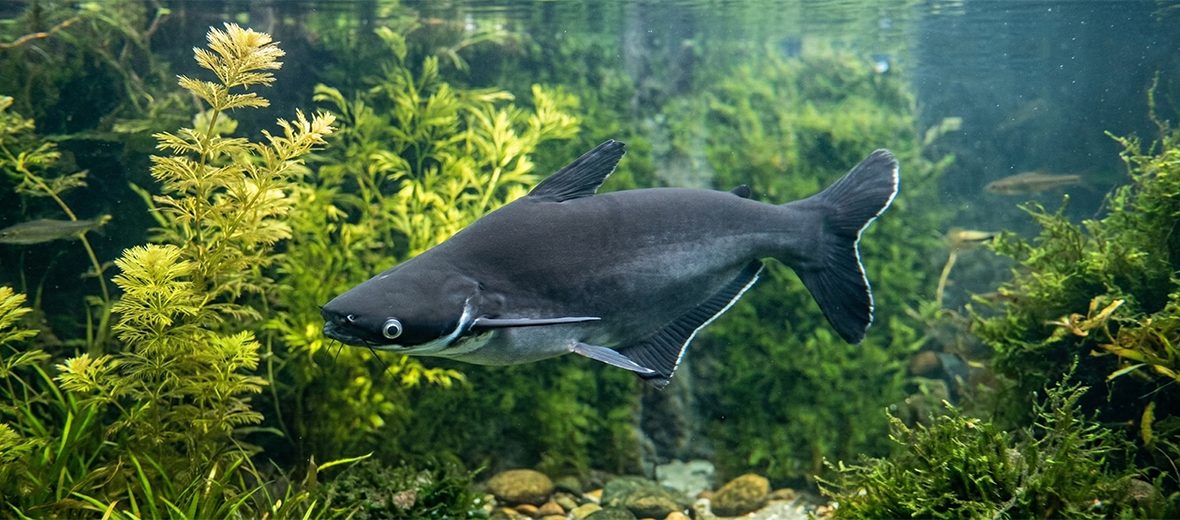
The iridescent shark, aka iridescent shark catfish, despite its primary common name, is not an actual shark, but a species of catfish. They dwell in the Mekong basin as well as the Chao Phraya River in southeastern Asia, and are heavily cultivated for food in that region. These fish face the threats of overfishing and over harvesting; habitat loss and destruction, as well as division by dams, and they also face the effects of water pollution. The IUCN lists these fish as Endangered. Their population trend is listed as decreasing.
First the Stats…
Scientific name: Pangasianodon hypophthalmus
Weight: Up to 97 lbs.
Length: Up to 4.3 feet
Lifespan: Up to 20+ years
Now on to the Facts!
1.) Their meat is typically marketed under the common name swai (Thai สวาย).
2.) The odd appearance and iridescence have made them popular with fishkeeping hobbyists, among whom they are also known as the sutchi catfish or Siamese shark catfish.
3.) They hail from the large rivers Chao Phraya and Mekong, although they have also been introduced into other rivers for aquaculture.
4.) They’re able to tolerate hypoxic (lacking oxygen) conditions thanks to their swim bladder which can also be utilized as an air-breathing organ.
5.) In August 2015, an environmental group in Santander, Colombia, confirmed that these fish had been found in 1 of the tributaries that feed into the Magdalena River, having been accidentally introduced from illegal farm fisheries in the area.
But wait, there’s more on the iridescent shark!
6.) This find has raised an alarm amongst the scientific community and government officials, seeing as the Magdalena river is home to over 200 native fish species, 35 of which are classified as endangered.
7.) Despite their lowly reputation as a cheap fish, the total export of pangasius from Vietnam reached $1.8 billion USD in 2014.
Did you know…?
Females can lay upwards of 1,000,000 eggs each breeding season.
8.) Other fish, crustaceans, algae, and other plant matter are all on the menu.
9.) These catfish are sold as pets for home aquariums, however, they are not easy fish to keep. They are schooling fish that prefer to dwell in groups, are used to living in rivers, and are active fish that require a lot of space.
10.) They require a minimum tank size of 39 feet to develop naturally. Schools of these fish require even larger tanks. Providing smaller housing results in stunted growth and premature death.
Now a Short Iridescent Shark Video!
Be sure to share & comment below! Also, check out the Critter Science YouTube channel. Videos added regularly. Be sure to like and subscribe!

Want to suggest a critter for me to write about? Let me know here.
Some source material acquired from: Wikipedia & IUCN

Leave a Reply