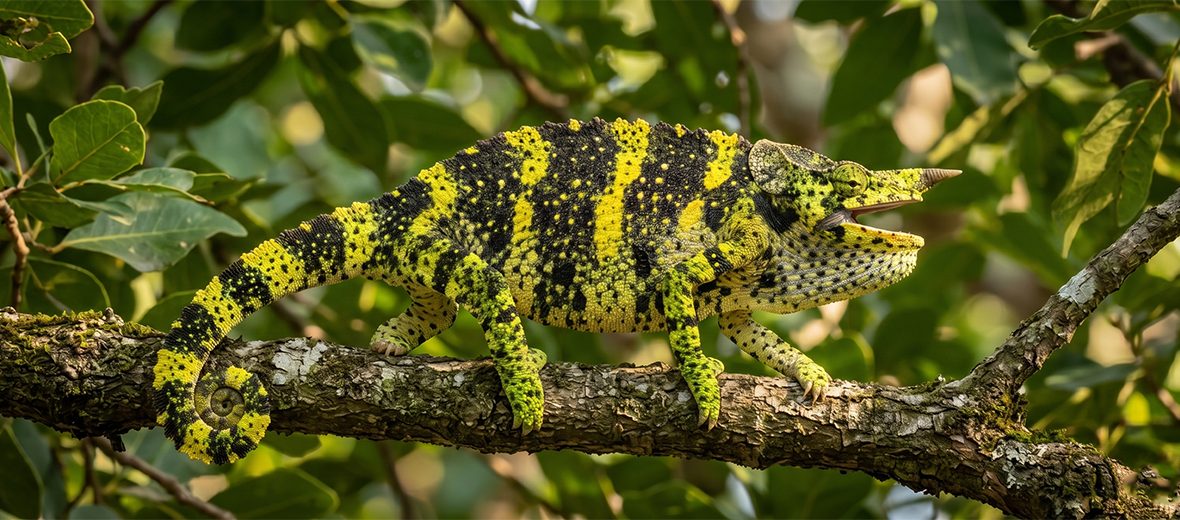
The Meller’s chameleon, aka Meller’s giant one-horned chameleon or giant one-horned chameleon, hails from east Africa in Malawi, Mozambique, and Tanzania. They face the threat of capture for the international pet trade. Between 1977 – 2011 approximately 50,363 live individuals were exported from across the native range of this species for the pet trade. This activity can have a huge impact on their numbers over time. Otherwise, they are abundant enough to be listed as Least Concern by the IUCN. Their population trend is listed as Unknown at this time.
First the Stats…
Scientific name: Trioceros melleri
Weight: Up to 21 ounces
Length: Up to 30 inches
Lifespan: Up to 14 years
Now on to the Facts!
1.) These chameleons are the largest species of chameleon from the African mainland
2.) They get their common name and specific name from a “Dr. Meller” who biologist and zoologist John Gray mentions within the section about the habitat of this species in his 1865 description.
3.) Dr. Meller was a botanist who’s formal name was Charles James Meller (1836 – 1869).
4.) Their preferred habitats are dry forests, miombo woodlands (vast tropical and subtropical savanna biome stretching across central and southern Africa), and bushy savannas.
5.) This species is sexually dimorphic in that females are not only smaller than males, but have a less developed dorsal and medial crest.
But wait, there’s more on the Meller’s chameleon!
6.) Their tails are relatively short in chameleon standards. They only measure up to 1/3rd the length of their body.
7.) When basking in the sun, the side of their body that faces the sunlight can turn dark green or black, while the rest of their body remains much lighter.
Did you know…?
The tongue of these chameleons can reach upwards of 20 inches in length.
8.) Like other chameleons, they change their color patterns due to stress. Mild excitement or stress is viewed as dark spotting overlaying their normal color. These dark green spots turn to black mottling as they become more upset.
9.) Females can lay a clutch up to 90 eggs, but usually only up to 40 per season are produced. The eggs hatch in up to 180 days.
10.) Smaller lizards, spiders, crickets, worms, and caterpillars are all on the menu, with small birds being taken by larger adults.
11.) Like other chameleons, they are arboreal (spend their life in trees and shrubs).
Now a Short Meller’s Chameleon Video!
Be sure to share & comment below! Also, check out the Critter Science YouTube channel. Videos added regularly. Be sure to like and subscribe!

Want to suggest a critter for me to write about? Let me know here.
Some source material acquired from: Wikipedia & IUCN