
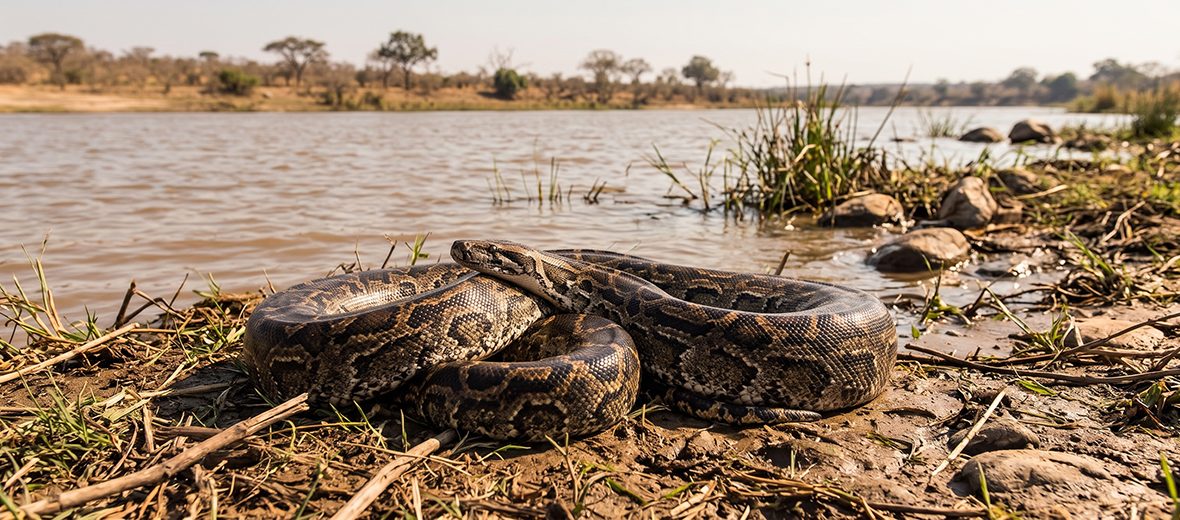
The Central African rock python hails from sub-Saharan Africa and is not only Africa’s largest snake they are also among the largest snakes in the world, along with the green anaconda, reticulated python, Burmese python, Southern African rock python, Indian python, yellow anaconda, and Australian scrub python. Exports of these snakes from Togo have risen fast in recent years, but it’s not known whether harvesting for the pet trade has yet reached or is likely to reach a level that is not sustainable in this country, or whether this reflects the trends throughout the snake’s very large range. They are also very popular as bushmeat and used as leather. Seeing as individuals are collected at around 10 – 13 years of age, this can have negative effects on the viability of subpopulations of this snake. The species is also heavily used in traditional medicine in Cameroon and the majority of West Africa. Another major threat exists in the form of deforestation, as this species is often found in primary, secondary, and gallery forest habitats. These pythons are also subject to a degree of persecution, as they are perceived as a threat to livestock and potentially humans, however, in some areas traditional beliefs object to killing these snakes. Due to all these threats, they are listed as Near Threatened by the IUCN. Their population trend is listed as decreasing as well.
First the Stats…
Scientific name: Python sebae
Weight: Up to 200 lbs.
Length: Up to 24+ feet
Lifespan: Up to 30+ years
Now on to the Facts!
1.) Their preferred habitats are evergreen forests, moist, open savannas, and areas closely associated with permanent water sources like riverbanks, lake shores, and the edges of swamps.
2.) They brumate (hibernation for reptiles) during the dry season.
3.) This python is widely feared, although they are nonvenomous and seldomly kill humans.
4.) These pythons were first described by German naturalist Johann Friedrich Gmelin in 1789.
5.) They also carry the common names of African rock python or simply rock python.
But wait, there’s more on the Central African rock python!
6.) Pythons also have 2 functioning lungs, unlike more advanced snakes, which have only 1.
7.) After gripping their prey, they coil around it, tightening their coils every time their victim breathes out. Death is believed to be due to cardiac arrest rather than by asphyxiation or crushing.
Did you know…?
Their constriction force can be up to 15 psi. The constriction rapidly occludes major blood vessels, halts blood flow to vital organs, and induces cardiac arrest and circulatory collapse within seconds!
8.) Unlike many other snakes, the female will violently protect her nest and sometimes even her hatchlings, for a time.
9.) Small antelopes, hyraxes, monkeys, waterbirds, monitor lizards, crocodiles, dogs, cats, chickens, goats, young sheep, impalas, and more are all on the menu.
10.) Females produce up to 100 hard-shelled eggs that hatch in up to 90 days.
But wait, there’s still more on the Central African rock python!
11.) Mom shows a surprising level of maternal care, coiling around her eggs, sheltering them from predators, and possibly assisting them to incubate, until they hatch.
12.) She will guard the hatchlings for up to 2 weeks after hatching from their eggs to continue protecting them from various predators in a manner that is unusual for snakes in general and pythons in particular.
Did you know…?
The Luo people of Kenya dwelling primarily in the area region of Lake Victoria typically consider snakes to be evil and believe that sorcerers make them harm people. However, they display a different attitude towards pythons – in that they have them appear in play songs and even worshiping them.
13.) As the mammalian and avian game populations are slowly reduced in the Congo Basin, the amount of large-bodied snakes provided at rural bushmeat markets increases.
14.) Subsequently, a sizable proportion of the human population faces the threat of Armillifer armillatus infections, which is a python-borne zoonotic disease.
15.) In some regions of eastern Nigeria, primarily in the towns of Idemili in Anambra, the python is revered as a sacred symbol of the deity Eke Idemili.
Now a Short Central African Rock Python Video!
Be sure to share & comment below! Also, check out the Critter Science YouTube channel. Videos added regularly. Be sure to like and subscribe!

Want to suggest a critter for me to write about? Let me know here.
Some source material acquired from: Wikipedia & IUCN

Leave a Reply