
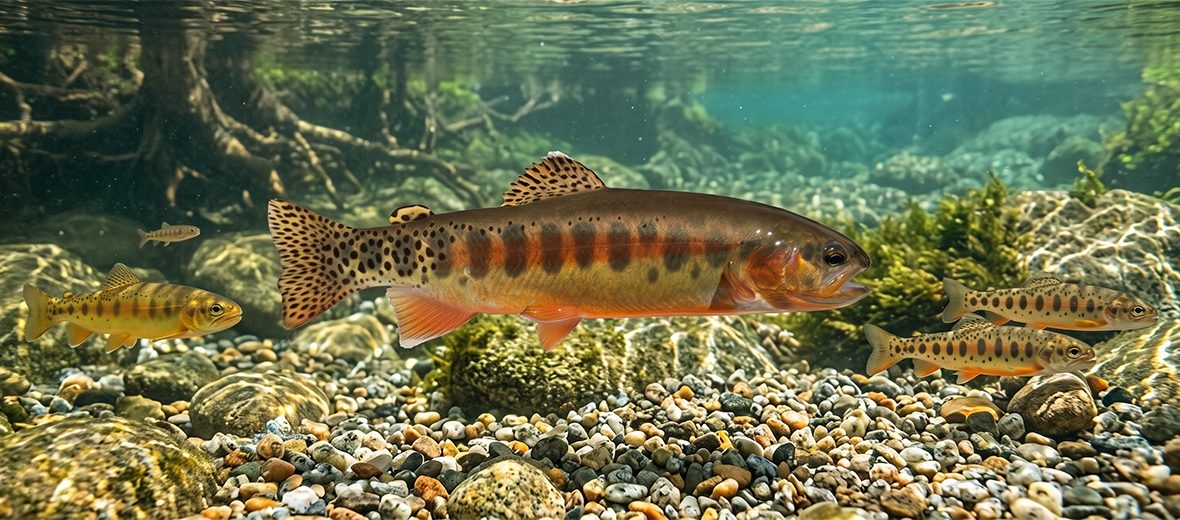
The California golden trout has been the official freshwater state fish of California since 1947. They are closely related to 2 rainbow trout subspecies. These fish face the threats of hybridization and introgression which can cause genetic pollution due to interbreeding with other trout species. This has caused such a decline in their original species numbers that a mere 1% of their pure bloodline exists, to date. Habitat loss and degradation is another threat faced, due to livestock grazing in the Sierra Nevada meadows which destroys streamside vegetation. This also widens stream channels, reduces water depth, and eliminates available shade. Finally, climate change causing warming atmospheric temperatures in high-elevation ecosystems and raises water temperatures to potentially lethal levels. These trout are not currently evaluated by the IUCN. Their population trend is listed as declining overall though, and highly fragmented.
First the Stats…
Scientific name: Oncorhynchus aguabonita
Weight: Up to 11.25 lbs.
Length: Up to 28 inches
Lifespan: Up to 20 years
Now on to the Facts!
1.) As mentioned, these trout are closely related to 2 rainbow trout subspecies. The Little Kern golden trout, in the Little Kern River basin, and the Kern River rainbow trout, in the Kern River system. Together, these 3 form what is sometimes referred to as the “golden trout complex”; a species complex.
2.) They were first scientifically described by the prominent ichthyologist David Starr Jordan in 1892.
3.) This species of trout can be found at elevations of up to 12,000 feet.
4.) Through years of overexploitation, mismanagement and competition with exotic species these fish have been brought to the brink of being designated as “threatened”.
5.) Introduced brook trout outcompete them for food, introduced brown trout prey on them, and introduced rainbow trout hybridize with them, damaging the native gene pool through introgression (the transfer of genetic material from 1 species into the gene pool of another).
But wait, there’s more on the California golden trout!
6.) The Golden Trout Wilderness was established within Inyo National Forest and Sequoia National Forest in 1978, which protects the upper watersheds of the Kern River and South Fork Kern River. This also resulted in the closure of the Tunnel Air Camp airstrip and air charters operations for sport fishermen in the region.
7.) In September 2004, the California Department of Fish and Game signed an agreement with federal agencies to work on rebuilding back-country habitats that were heavily damaged by overgrazing from both cattle and sheep, as part of a detailed conservation strategy.
Did you know…?
In 1965 there were an estimated 40,000 golden trout. In recent years there are only approximately 400 – 2,600 recorded to be within a distance of the Volcano Creek. That is a 93.5% decrease!
8.) Based on the size, age, and weight of the individual fish, females can lay upwards of 2,300 eggs per spawning season.
9.) Eggs hatch in up to 50 days.
10.) These fish are diurnal (active during the day).
Now a Short California Golden Trout Video!
Be sure to share & comment below! Also, check out the Critter Science YouTube channel. Videos added regularly. Be sure to like and subscribe!

Want to suggest a critter for me to write about? Let me know here.
Some source material acquired from: Wikipedia & IUCN

Leave a Reply