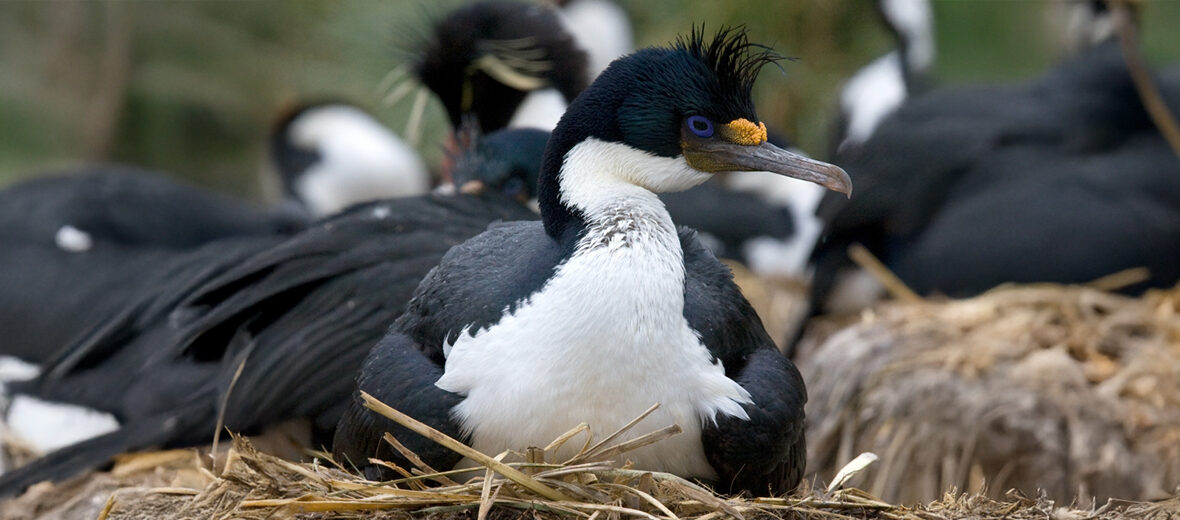
The imperial shag, aka imperial cormorant, is native to southern South America, islands of the Subantarctic, and the Antarctic Peninsula, mostly among rocky coastal regions, but also locally around large inland lakes. These cormorants face the threats of hunting; trapping; overfishing; tourism, that affects their breeding; and invasive species, that result in predation of eggs and chicks. However, these birds are still abundant enough to be listed as Least Concern by the IUCN. Their population trend is listed as unknown at this time.
First the Stats…
Scientific name: Leucocarbo atriceps
Weight: Up to 7.7 lbs.
Length: Up to 31 inches
Wingspan: Up to 4 feet
Lifespan: Up to 20 years
Now on to the Facts!
1.) They are also known as blue-eyed shags or blue-eyed cormorants.
2.) These birds were first described by Phillip Parker King (P. P. King) in 1828.
3.) While there is still much debate about species and subspecies, the following birds will be treated as subspecies in this article: Macquarie shag, Crozet shag, Heard Island shag, South Georgia shag, Antarctic shag, and the imperial shag.
4.) These birds are monogamous (mate for life).
5.) With most colonies being small, some colonies have up to several hundred pairs, and the breeding grounds are shared with other seabirds, such as rock-hopper penguins, and others.
But wait, there’s more on the imperial shag!
6.) The nest is made of seaweed and grass, and is then cemented together with mud and feces (poop).
7.) Females lay up to 5 eggs that hatch in up to 5 weeks.
Did you know…?
These critters can perform dives of up to 200 feet under the water!
8.) Besides black vultures and gulls, skuas also raid nests and eat the eggs and chicks.
9.) Crustaceans, fish, polychaetes, gastropods, squids, and octopuses are all feasted upon.
10.) It is estimated that there are over 10,000 pairs existing, to date.
Now a Short Imperial Shag Video!
Be sure to share & comment below! Also, check out the Critter Science YouTube channel. Videos added regularly!

Want to suggest a critter for me to write about? Let me know here.
Some source material acquired from: Wikipedia & IUCN
Photo credit: Samuel Blanc