
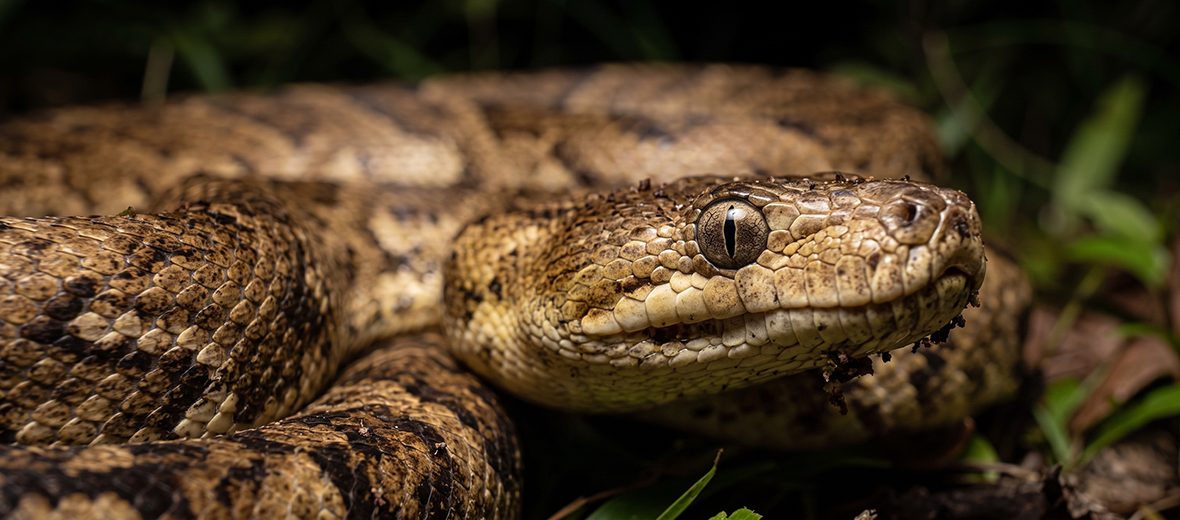
The Cuban boa, aka Cuban tree boa or Majá de Santa María, is 1 of the largest snakes in North America. They are a member of the family Boidae. These snakes face the threats of habitat loss and destruction at the hands of residential and commercial developments, farming, ranching, mining and quarrying. Roads and railroads divide their territory and can result in vehicle strike (being hit by vehicles). Humans hunt and trap them for food and out of fear. Invasive species also prey on these snakes. However, these boas are abundant and widely distributed throughout Cuba, and thus listed as Least Concern by the IUCN. Their population trend is listed as stable.
First the Stats…
Scientific name: Chilabothrus angulifer
Weight: Up to 66 lbs.
Length: Up to 16 feet
Lifespan: Up to 30+ years
Now on to the Facts!
1.) The genus name Chilabothrus hails from the Greek cheilos, meaning “lip”, á “without” and bothros “pits”. The specific name hails from the Latin word angirlus, meaning “angle”, likely in reference to the angular shapes of the main design of the dorsal pattern.
2.) Their preferred habitats are rainforests, cloud forests, evergreen forests, semi-deciduous forests, thorn forests, and coastal scrub forests.
3.) They can be found at elevations of up to 3,983 feet.
4.) Contrary to their massive size, these boas are semi-arboreal (spend part of their lives in trees) and climb rather skillfully.
5.) These boas prey on various anurans, lizards, aquatic birds, red-tailed hawks, turkey vultures, forest birds, caged birds, crested caracaras, Muscovy ducks, bats, goats, sheep, pigs, dogs, cats, European rabbits, hutias, mice, and rats.
But wait, there’s more on the Cuban boa!
6.) Black hawks, barn owls, and humans all prey on juveniles. Adults have no natural predators.
7.) Females undergo up to a 180 day gestation (pregnancy) that yields up to 22 young. The eggs are developed in the female, then the juveniles hatch inside of mom and are born alive. Then the female reabsorbs the shells to regain calcium.
Did you know…?
Boas are viviparous (produce live young from developing eggs inside the female’s body.
8.) Males reach reproductive age at 3 years of age, while females are reproductively mature at 5 years old.
9.) These boas have over 100 curved and razor sharp teeth.
10.) They can exert approximately 60+/- PSI of pressure when squeezing their prey.
Now a Short Cuban Boa Video!
Be sure to share & comment below! Also, check out the Critter Science YouTube channel. Videos added regularly. Be sure to like and subscribe!

Want to suggest a critter for me to write about? Let me know here.
Some source material acquired from: Wikipedia & IUCN

Leave a Reply