
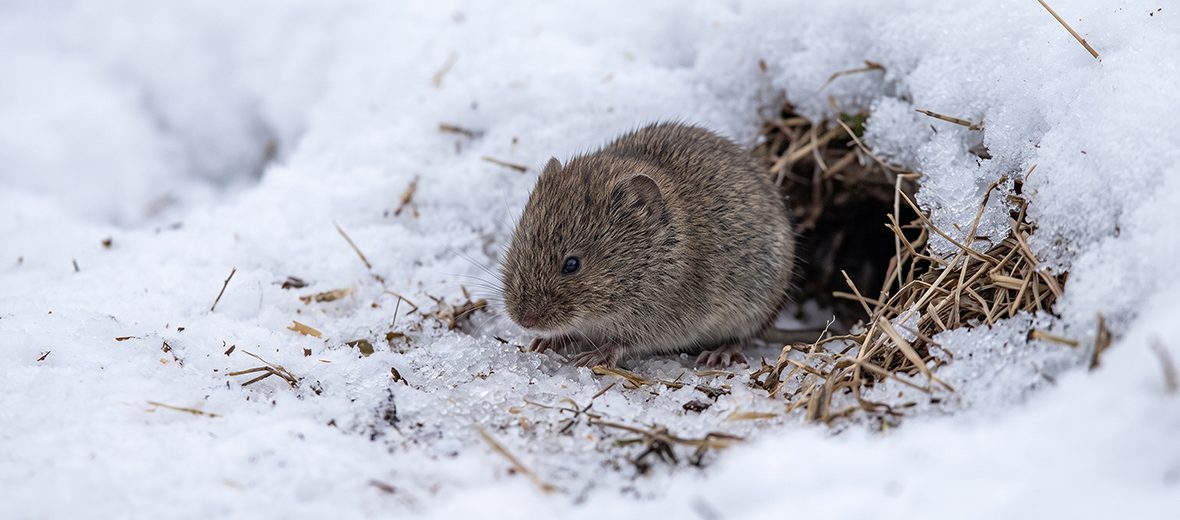
The eastern meadow vole, aka fields mouse or meadow mouse, is a very wide spread rodent that can be found from throughout Canada to the U.S. Because these voles reproduce rapidly and cause millions of dollars in damage to agricultural crops, lawns, and orchards (by “girdling” or chewing the bark off the base of trees), they are heavily targeted by humans. Threats from human management include: lethal trapping, poison baits, and habitat modification, including farmers and homeowners intentionally destroying their protective ground cover through close mowing, tilling, burning, or herbicide usage, which exposes these voles to lethal predation or forces them to abandon their burrows. Meadow vole populations are notorious for being highly cyclic, experiencing massive population booms every 2 – 5 years followed by abrupt population crashes. During these crashes, localized populations can deplete their high-protein food sources, succumb to extreme weather conditions, or suffer from intense physiological stress and disease outbreaks (such as tularemia), causing numbers to plummet drastically within a single year. However, despite these threats, these critters are highly abundant and widespread. Thus they are listed as Least Concern by the IUCN. Their population trend is listed as stable.
First the Stats…
Scientific name: Microtus pennsylvanicus
Weight: Up to 2.6 ounces
Length: Up to 7.7 inches, plus up to a 2.5 inch tail
Lifespan: Up to 18 months
Now on to the Facts!
1.) These voles are preyed on by many, including red-tailed hawks, owls, gulls, foxes, coyotes, weasels, martens, raccoons, opossums, cats, bobcats, lynx, snakes, and even northern pikes.
2.) Grasses, sedges, green shoots, various herbaceous plants, and tree bark are all on the menu.
3.) These voles, while being aggressive towards one another, do also tend to live in close proximity of each other.
4.) American zoologist George Ord first described these voles in 1815.
5.) Their preferred habitats are moist, dense grasslands, wet meadows, and damp agricultural fields with a heavy layer of ground cover and plant litter.
But wait, there’s more on the eastern meadow vole!
6.) These voles are cathemeral (active both day and night).
7.) Females undergo up to a 23 day gestation (pregnancy) that yields up to 11 pups.
Did you know…?
A female can reach reproductive maturity in as little as 3 weeks!
8.) Nests are utilized as nurseries, resting areas, and for protection against the weather. They are built out of woven grass; plus, they are typically subterranean or are constructed under boards, rocks, logs, brush piles, hay bales, fence posts, or in grassy tussocks.
9.) These voles are an important food source for many predators, and are also disperses of mycorrhizal fungi.
10.) They can run at speeds of up to 6 mph.
Now a Short Eastern Meadow Vole Video!
Be sure to share & comment below! Also, check out the Critter Science YouTube channel. Videos added regularly. Be sure to like and subscribe!

Want to suggest a critter for me to write about? Let me know here.
Some source material acquired from: Wikipedia & IUCN


Leave a Reply