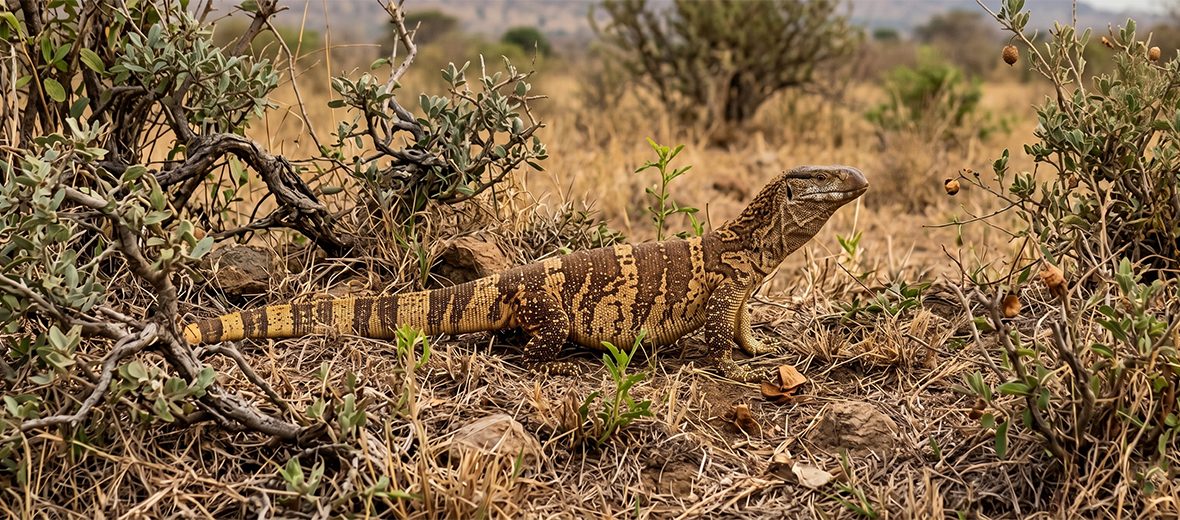
The rock monitor, aka white-throated monitor, is 1 of the largest species of lizard in Africa. They hail from the eastern and southern parts of Africa. These lizards face the threats of habitat loss and destruction at the hands of farming, ranching, residential, and commercial developments. Their microhabitats are also encroached upon as humans continue to develop the land and destroy termite mounds that these monitors utilize for shelter and laying their eggs. Retaliatory killing also takes place as these lizards are forboding and sometimes kill poultry and other small domesticated animals. However, these critters are abundant enough to be listed as Least Concern by the IUCN. Their population trend is listed as stable.
First the Stats…
Scientific name: Varanus albigularis
Weight: Up to 60 lbs.
Length: Up to 6.6 feet, including the tail
Lifespan: Up to 25 years
Now on to the Facts!
1.) These lizards are also called leguaan or likkewaan in some locales.
2.) They were first described by French zoologist François Marie Daudin in 1802.
3.) There are 4 recognized subspecies: white-throated monitor, Angolan white-throated monitor, eastern white-throated monitor, and the black-throated monitor.
4.) These monitors dwell in a range of habitats like steppes, grasslands, and savannas.
5.) Amphibians, birds, lizards, snakes, tortoises, eggs, rats, and mice are all on the menu.
But wait, there’s more on the rock monitor!
6.) Beetles, millipedes, molluscs, orthopterans, and scorpions are also readily consumed.
7.) They are preyed on by rock pythons, martial eagles, and leopards.
Did you know…?
These very intelligent lizards have shown the ability to count as high as 6 in an experiment conducted by Dr. John Philips at the San Diego Zoo, California, in 1999.
8.) Some people living with the HIV/AIDS virus in the Yumbe District of Uganda have reportedly injected themselves with the blood of rock monitors, because they believe it to be a cure for the virus. It’s not.
9.) As a direct result of this practice, these monitors have become an expensive item in the Ugandan black market, selling for more than the equivalent of $175 USD each.
10.) Females lay up to 51 eggs per clutch, each year. The eggs hatch in around 200+ days.
Now a Short Rock Monitor Video!
Be sure to share & comment below! Also, check out the Critter Science YouTube channel. Videos added regularly. Be sure to like and subscribe!

Want to suggest a critter for me to write about? Let me know here.
Some source material acquired from: Wikipedia & IUCN