
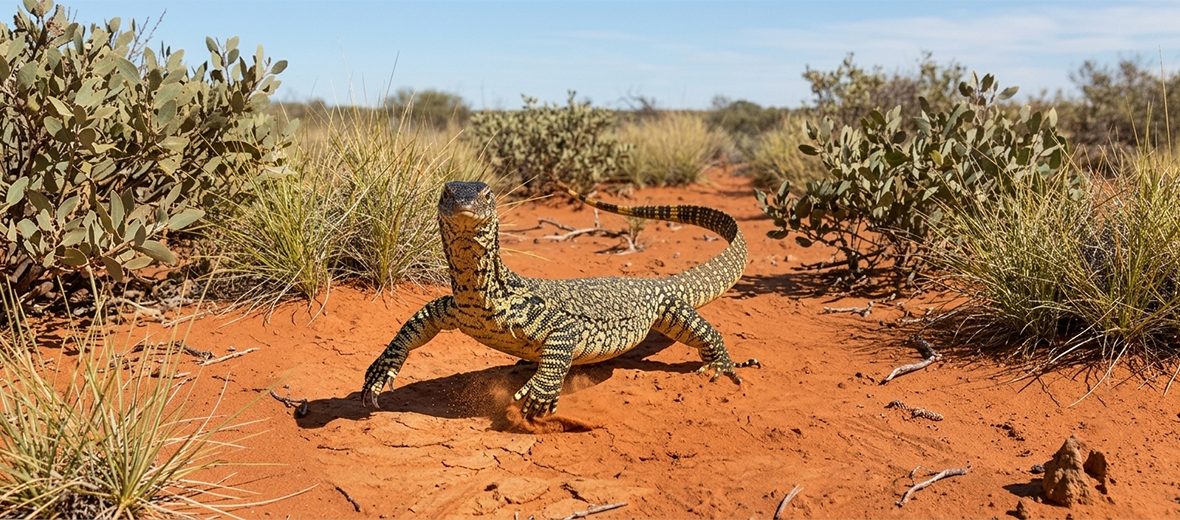
The sand goanna, aka Gould’s monitor, sand monitor, and racehorse goanna, is a large monitor lizard found throughout most of Australia. These lizards face the threat of predation by the invasive species known as the red fox. They also fall victim to consuming the deadly cane toad. Habitat loss and destruction at the hands of residential and commercial developments pose yet another threat. However, these lizards are abundant and widespread. Therefore, the IUCN lists them as Least Concern. Their population trend is listed as stable.
First the Stats…
Scientific name: Varanus gouldii
Weight: Up to 13 lbs.
Length: Up to 4.6 feet
Lifespan: Up to 18.3 years
Now on to the Facts!
1.) Unlike many other species of lizards, monitor lizards are not capable of caudal autonomy (having the ability to drop all or a portion of their tail to escape predation).
2.) They were first described by zoologist John Edward Gray in 1838.
3.) Their specific name, gouldii, is assumed to be a Latinized form of the surname of a friend and associate of the describing author, the English ornithologist John Gould, who was putting together specimens of fauna from Australia.
4.) In certain Aboriginal languages, these reptiles are called bungarra, a term also typically used by non-Aboriginal people in Western Australia. In Pitjantjatjara as well as other central Australian languages they are called “Tingka”.
5.) There are 2 recognized subspecies: Varanus gouldii flavirufus and Varanus gouldii gouldii.
But wait, there’s more on the sand goanna!
6.) They construct large burrows for shelter. Rock escarpments as well as tree hollows are also used for dwellings.
7.) Their preferred habitats possess thick shrubs and an abundance of tall trees.
Did you know…?
These monitors are seemingly immune to even the most potent snake venom. Even from the otherwise deadly inland taipan.
8.) Like other goannas, they are diurnal (active during the day).
9.) Insects, scorpions, centipedes, frogs, toads, lizards, snakes, mice, rats, birds, eggs, and carrion (dead animals) are all on the menu.
10.) After constructing up to a 2 foot tunnel, the female will lay her up to 17 eggs that hatch in up to 3 months. Other times, she will lay her eggs at the base of a termite mound for steady temperature control.
But wait, there’s still more on the sand goanna!
11.) Like all goannas and monitors, they possess a forked tongue, with which they “taste” the air. Scents are picked up on each side of the fork which, when retracted, brushes over the Jacobson’s organ, which identifies on which side the scent is stronger.
12.) When tracking prey, the side of the tongue that had the strongest scent guides the lizard in that direction.
13.) In a 2021 study it was shown that during the Miocene epoch, Komodo dragons hybridized with a common ancestor of V. gouldii, thus providing evidence that the Komodo dragon had, at 1 time, inhabited Australia.
Now a Short Sand Goanna Video!
Be sure to share & comment below! Also, check out the Critter Science YouTube channel. Videos added regularly. Be sure to like and subscribe!

Want to suggest a critter for me to write about? Let me know here.
Some source material acquired from: Wikipedia & IUCN

Leave a Reply