
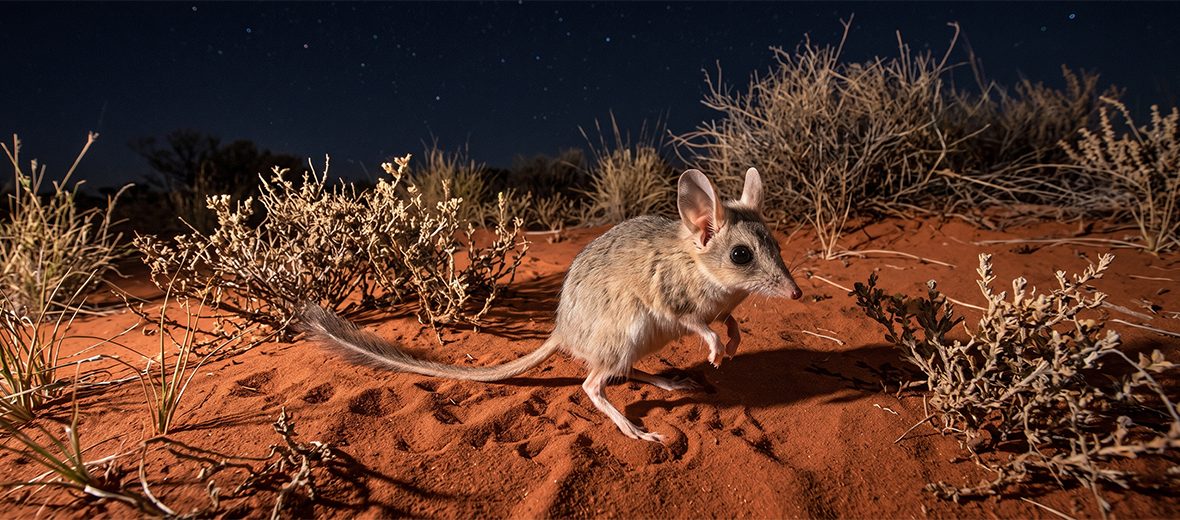
The kultarr, aka jerboa-marsupial or marsupial jerboa, is a diminutive insectivorous marsupial that hails from the arid interior of Australia. They face the ongoing threat of predation by feral cats and red foxes. Overgrazing by cattle and sheep degrades and compacts their preferred open desert and woodland habitats. Intense bushfires destroy their essential ground shelter, like fallen logs and leaf litter. Finally, the use of pesticides kills their prey in suburban and urban habitats. However, these little critters are still abundant enough to be listed as Least Concern by the IUCN. Their population trend is listed as decreasing throughout their range.
First the Stats…
Scientific name: Antechinomys laniger
Weight: Up to 1.06 ounces
Length: Up to 3.94 inches, plus up to a 5.91 inch tail
Lifespan: Up to 5.5 years
Now on to the Facts!
1.) Their preferred habitats are stony deserts, shrublands, woodlands, grasslands, and open plains.
2.) Rather than hibernating, these tiny marsupials enter into torpor (a restful state utilized to escape the heat).
3.) They are nocturnal (active at night).
4.) Beetles, cockroaches, crickets, spiders, and even dunnarts & antechinus are all on the menu.
5.) Their hind legs have evolved for a bipedal or hopping style movements that are used to evade predators and catch prey such as insects.
But wait, there’s more on the kultarr!
6.) These marsupials were first described by ornithologist John Gould in 1856.
7.) There are 2 additional species described, the gibber kultarr and the newly-identified long-eared kultarr.
Did you know…?
These little critters can hop at speeds of up to 8.57 mph.
8.) Females undergo up to a 17 day gestation (pregnancy) that yields up to 8 joeys.
9.) After developing further in their mom’s marsupium (pouch) for up to 20 days, the joeys will leave the marsupium and either cling to their mother’s back as she forages for food or stay behind in the burrow. They are fully weaned at up to 90 days.
10.) They travel up to 5,577 feet per night in search of food, shelter, and a mate.
But wait, there’s still more on the kultarr!
11.) Having evolved to live in a harsh, dry environment these marsupials have the ability to obtain their moisture requirements from the prey they eat and from licking dew from leaves.
12.) The various populations of kultarrs undergo drastic declines due to the impacts of flooding, causing the death of individuals through drowning and flooding of their burrows.
13.) In 2002, the New South Wales National Parks and Wildlife Service developed a verbose recovery plan for kultarrs under the “saving our species” program.
14.) Owls and reptiles are their only natural predators, but the real predatory threat comes from the afore-mentioned cats and foxes.
Now a Short Kultarr Video!
Be sure to share & comment below! Also, check out the Critter Science YouTube channel. Videos added regularly. Be sure to like and subscribe!

Want to suggest a critter for me to write about? Let me know here.
Some source material acquired from: Wikipedia & IUCN

Leave a Reply