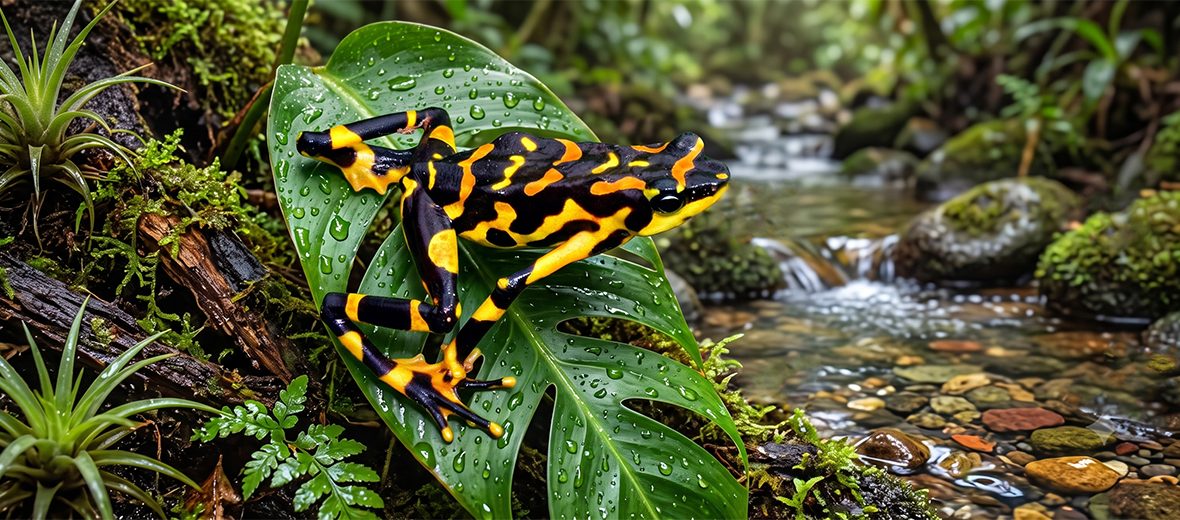
The Costa Rican variable harlequin toad, aka clown frog, is a rapidly declining species of true toad hailing from Quepos, Costa Rica. They once numbered in the 100s along individual streams. Now their existence hangs on by a thread. These toads face the threats of habitat loss and destruction at the hands of residential and commercial developments, along with farming, ranching, mining, and quarrying. Pollution from mine runoff is another threat faced. Dams and water management divide and flood their territory. Finally, their largest foe to date… Batrachochytrium dendrobatidis (Bd), aka the Chytrid fungus. This global threat has nearly completely wiped out this species. Chytrid has even been found in captive raised specimens. Due to all these threats, these toads are listed as Critically Endangered by the IUCN. Their population trend is listed as unknown at this time.
First the Stats…
Scientific name: Atelopus varius
Weight: Up to .11 ounce
Length: Up to 2.36 inches
Lifespan: Up to 12 years
Now on to the Facts!
1.) At 1 time, the Panamanian golden frog was considered a subspecies, but it has since been classified as its own species.
2.) Their preferred habitats are rocky banks, splash zones, and mossy crevices of high-gradient, fast-flowing streams in humid pre-montane, lower-montane, and rainforest environments.
3.) They can be found at up to 6,562 foot elevations.
4.) The aposematic coloration of these toads most likely serves as a warning to potential predators of the toxicity of their skin which houses tetrodotoxin, a potent neurotoxin capable of causing death if the poison comes into contact with the bloodstream.
5.) Ants, small beetles, gnats, flies, mites, and other random smaller invertebrates are all feasted upon.
But wait, there’s more on the Costa Rican variable harlequin toad!
6.) They were thought to be extinct throughout Costa Rica, however, in a 2019 assessment, 2 subpopulations were discovered in the country.
7.) Climate change is thought to play a large factor in the increased occurrence of Chytrid, as it provides the perfect breeding ground for the fungus.
Did you know…?
Their only known predator is a parasitic sarcophagid fly which places its larvae on the surface of the toad’s thigh. The larvae then proceeds to burrow inside the toad and eat it from within.
8.) These toads are diurnal (active during the day).
9.) The chytrid fungus infects and damages an amphibian’s skin, making it too thick to absorb water and vital salts like sodium and potassium. Without these essential electrolytes, the amphibian’s electrical heart signals fail, ultimately causing fatal cardiac arrest.
10.) Currently, Cleveland Metroparks Zoo, Chattanooga Zoo, Riverbanks Zoo and Garden, El Valle Amphibian Conservation Center, Gamboa Amphibian Research Center, and Manchester Museum / University of Manchester are all working to save these toads from extinction via ex situ conservation efforts.
Now a Short Costa Rican Variable Harlequin Toad Video!
Be sure to share & comment below! Also, check out the Critter Science YouTube channel. Videos added regularly. Be sure to like and subscribe!

Want to suggest a critter for me to write about? Let me know here.
Some source material acquired from: Wikipedia & IUCN