
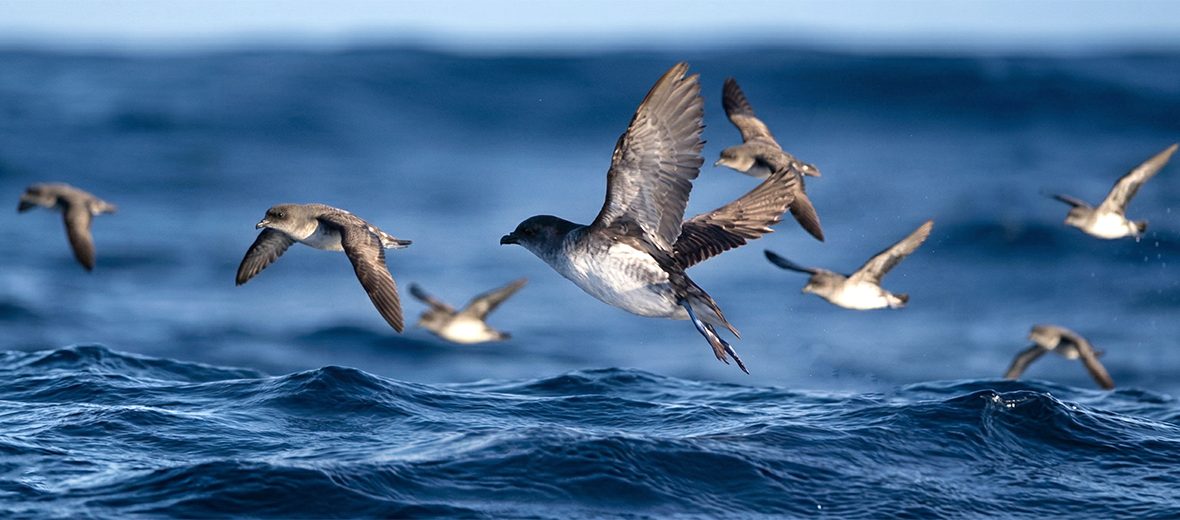
The common diving petrel, aka smaller diving petrel or the diving petrel, is an auk-like small petrel that dwells among the southern oceans. These birds face the threat of invasive species in the form of black rats, that are known to kill and eat their chicks. However, these seabird’s numbers are not terribly affected by this issue. Their population trend is listed as decreasing, though. However, they are abundant enough to be listed as Least Concern by the IUCN.
First the Stats…
Scientific name: Pelecanoides urinatrix
Weight: Up to 6.5 ounces
Length: Up to 9.8 inches
Wingspan: Up to 15 inches
Lifespan: Up to 22 years
Now on to the Facts!
1.) They are native to the South Atlantic islands and the islands of the subantarctic southern Indian Ocean, the islands & islets off New Zealand, and several south-eastern Australian islands.
2.) These petrels were formally described in 1777 by the German naturalist Johann Reinhold Forster.
3.) Diving petrels have expandable throat pouches that they use to carry food.
4.) Their specific name, urinatrix, hails from the Latin term, urinator, which means “diver”. The subspecies’ names include chathamensis, which refers to the Chatham Islands, and exsul, meaning “isolated” or “remote”.
5.) There are 6 recognized subspecies: P. u. urinatrix, P. u. chathamensis, P. u. exsul, P. u. dacunhae, P. u. berard, and P. u. coppingeri.
But wait, there’s more on the common diving petrel!
6.) Like other members of their family they catch their prey via wing-propelled diving.
7.) The diet of these petrels consists mostly of crustaceans and plankton but fish are also taken.
Did you know…?
These petrels can dive up to 200 feet and can hold their breath for up to 40+ seconds.
8.) They are primarily nocturnal (active at night).
9.) Pairs form monogamous (mate for life) relationships.
10.) Females lay a single egg that hatches in up to 55 days, and fledglings leave the nest at up to 59 days.
Now a Short Common Diving Petrel Video!
Be sure to share & comment below! Also, check out the Critter Science YouTube channel. Videos added regularly. Be sure to like and subscribe!

Want to suggest a critter for me to write about? Let me know here.
Some source material acquired from: Wikipedia & IUCN

Leave a Reply