

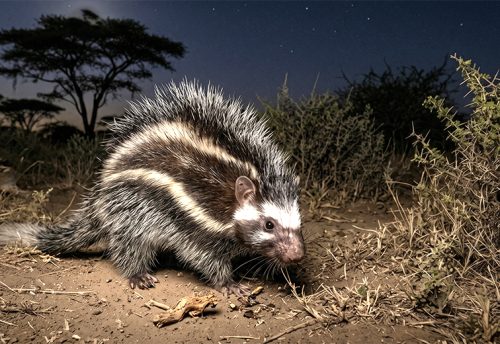
The desert hedgehog is 1 of the smallest species of hedgehog, after the African pygmy hedgehog. They dwell in northern Africa and the Middle East. These little critters face the threats of habitat loss and destruction at the hands of farming, ranching, residential, and commercial developments. Habitat division is another threat that can result in vehicle strike (being hit by vehicles). Insecticide use to kill pest insects and arachnids is accidentally ingested and can cause fatalities. In some regions they are also trapped and hunted for food. Finally, climate change that brings about severe droughts effect these critters by depleting their water supplies. However, despite all these threats, they are still listed as Least Concern by the IUCN. Their population trend is listed as stable as well.
First the Stats…
Scientific name: Paraechinus aethiopicus
Weight: Up to 18 ounces
Length: Up to 11 inches
Lifespan: Up to 10 years
Now on to the Facts!
1.) While these hedgehogs don’t enter into a formal hibernation, they do go into a state of torpor (a state of physical and mental inactivity, lethargy, or suspended animation) through the months of January and February.
2.) Insects, arthropods, juvenile mice and rats, and occasionally plant matter are all on the menu.
3.) Owls, eagles, desert foxes, wolves, jackals, desert cats, leopards, honey badgers, mongooses, and pythons all prey on these little critters.
4.) Their quills can cause minor physical pain, puncture wounds, and spread bacterial infections if they break the skin.
5.) Young hedgehogs go through a major, distinct shedding phase known as “quilling,” where they replace their smaller juvenile quills with larger, thicker adult quills.
But wait, there’s more on the desert hedgehog!
6.) Breeding takes place in March.
7.) Females undergo up to a 46 day gestation (pregnancy) that yields up to 6 hoglets.
Did you know…?
Their spines are not only used for self defense, but seeing as they are bendable, they also help cushion falls as they can absorb mechanical energy.
8.) Hoglets are born altricial (deaf and blind), with the quills located just under the skin, to prevent injury to the female during birth.
9.) After only a few hours, the young start to show spines, and after 21 days, their eyes open. Weaning takes place in up to 40 days.
10.) Like all hedgehogs, these critters are nocturnal (active at night).
Now a Short Desert Hedgehog Video!
Be sure to share & comment below! Also, check out the Critter Science YouTube channel. Videos added regularly!

Want to suggest a critter for me to write about? Let me know here.
Some source material acquired from: Wikipedia & IUCN

Leave a Reply