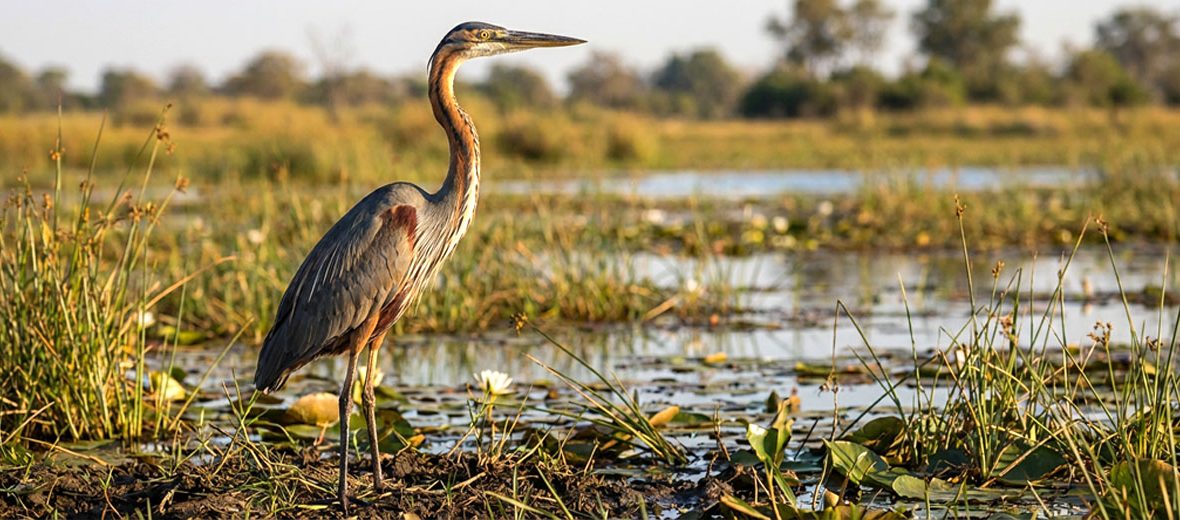
The Goliath heron, aka giant heron, can be found throughout much of Africa, with a few dwindling populations in southwestern and southern Asia. These large wading birds face the threats of habitat loss and destruction due to land reclamation, drainage, and development; human disturbance, which can result in nest abandonment; overfishing, which depletes their food source; land pollution; water pollution; pesticide use, that contaminates their food source; entanglement in fishing gear, such as getting caught in gillnets; kleptoparasitism, due to African fish eagles stealing food from them; siblicide (siblings killing each other in the nest), in that out of up to 5 hatchlings only 1 – 2 survive; and climate change, which can cause droughts and also flooding. However, despite all these adversities, these birds are abundant enough to be listed as Least Concern by the IUCN. Their population trend is listed as stable.
First the Stats…
Scientific name: Ardea goliath
Weight: Up to 11 lbs.
Length: Up to 5 feet
Wingspan: Up to 7.5 feet
Lifespan: Up to 22 years
Now on to the Facts!
1.) Their beak measures up to 9.4 inches long.
2.) They have a rather deep bark, typically described as “kowoork”, that can be heard for up to 1.24 miles away.
3.) Other calls include an “arrk” disturbance call; a “huh-huh” sound, made when crouching; and a “krooo” sound, made with their neck extended.
4.) These herons prefer pristine wetland habitats with no human disturbances.
5.) Goliath herons are diurnal (active during the day).
But wait, there’s more on the Goliath heron!
6.) Carp, catfish, mullet, and tilapia are all preyed on and subsequently swallowed whole.
7.) Fish that are caught and consumed can weigh as much as 2.16 lbs.!
Did you know…?
There are approximately 66,700+/- wild individuals remaining, to date.
8.) Besides fish, frogs, prawns, mice, rats, moles, lizards, snakes, insects, and even carrion (dead animals) are also preyed on.
9.) Due to their rather slow method of eating, kleptoparasitism (stealing food from another animal) runs rampant. Saddle-billed storks and pelicans often steal their food.
10.) The nest can measure up to 4.9 feet in diameter.
But wait, there’s still more on the Goliath heron!
11.) Females lay up to 5 eggs that hatch in up to 30 days. Chicks leave the nest in up to 80 days.
12.) The chicks are fed via regurgitation in the nest and, after a few weeks, are able to bill jab and practice defensive postures against one another.
13.) Around 62% of chicks that leave the nest make it to adulthood.
14.) The afore mentioned African fish eagles, white-tailed eagles, and crocodiles all prey on these herons.
Now a Short Goliath Heron Video!
Be sure to share & comment below! Also, check out the Critter Science YouTube channel. Videos added regularly. Be sure to like and subscribe!

Want to suggest a critter for me to write about? Let me know here.
Some source material acquired from: Wikipedia & IUCN