Critter Science
  • Zoology
    • Ecology
      • Animal Conservation
        • CITES: Protecting Wildlife
        • Dame Jane Goodall
        • Endangered Animals
        • Ex Situ Explained
        • In Situ Explained
        • IUCN Statuses
        • Steve Irwin
        • Zoological Branches
      • Animal Immortality and Regeneration
      • Chromatophores and Survival
      • Ecosystems
        • Animal Habitats
        • The Biomes
        • Coastal Erosion
        • Desert Biomes
        • Deserts and Wildlife
        • Ocean Habitats: Layers and Life
        • Rainforest Types
      • Evolution. The Facts.
        • Animal Devolution
        • Animal Mimicry
        • Convergent Evolution
        • Carl Linnaeus
        • Charles Darwin
        • Evolution of Amphibians
        • Evolution of Birds
        • Genetic Drift in the Animal Kingdom
        • Naturalism
        • Natural Selection
      • Genetic Pollution
        • Genetic Bottlenecks in Animal Populations
      • Invertebrate Families Explored
        • Arthropod Diversity and Adaptations
        • The Wonder and Warfare of Coral Reefs
        • What are Arachnids?
          • Spider Webs
      • Predator vs Prey
      • Producers and Consumers
      • Venom vs Poison
      • Vertebrate Families Explored
        • Amphibians: Unseen Guardians
        • Snakes vs Legless Lizards
        • What is a Marsupial?
      • The Wild Apothecary
    • Sustainability
      • Climate Change
      • Earth Day: Past, Present, Future
      • Global Warming
      • Pollution
        • Air Pollution
        • Chemical Pollution
        • Land Pollution
        • Light Pollution
        • Microplastics Pollution
        • Noise Pollution
        • Water Pollution
      • Recycling
        • Recycling Plastics
      • Renewable Energy
    • Animal Behavioral Patterns
      • Aposematic Coloration
      • Avian Communication
      • Animal Thermoregulation
      • Cetacean Communication
      • Cold-Adapted Hypermetabolism
      • Elephant Communication
      • Herpetofauna Communication
      • Primate Language: The Debate
      • The Framework of Ethology
      • The Hidden Sensory Realm
      • Types of Animal Dormancy
    • What are Species?
      • Animal Reproduction
      • Introduced Species
      • Invasive Species
      • Keystone Species
      • Lazarus Species: Rediscovered Life
      • Speciation
      • Species Complex
      • Understanding Animal Subspecies
    • About the Critterman
  • Daily Critter Facts
    • Amphibian Facts
      • Frog Facts
      • Newt Facts
      • Salamander Facts
      • Toad Facts
    • Arthropod Facts
      • Arachnid Facts
      • Insect Facts
    • Bird Facts
      • Flightless Bird Facts
      • Predatory Bird Facts
      • Scavenger Bird Facts
      • Wading Bird Facts
    • Cryptozoology
    • Fish Facts
      • Cephalopod Facts
      • Crustacean Facts
      • Jellyfish Facts
      • Reefs
      • Shark and Ray Facts
      • Shellfish Facts
    • Flying Mammal Facts
    • Gastropod Facts
    • Land Mammal Facts
      • Canine Facts
      • Feline Facts
      • Lagomorph Facts
      • Marsupial Facts
      • Mustelid Facts
      • Primate Facts
      • Rodent Facts
      • Ungulate Facts
    • Parasite Facts
    • Reptile Facts
      • Crocodilian Facts
      • Lizard Facts
      • Snake Facts
      • Turtle Facts
    • Sea Mammal Facts
      • Dolphin Facts
      • Porpoise Facts
      • Sea Lion Facts
      • Seal Facts
      • Whale Facts
    • Worm Facts
  • For Teachers
    • Animal Quizzes
      • Amphibian Quiz
      • Bird Quiz
      • Cat Quiz
      • Dog Quiz
      • Dolphin Quiz
      • Insect Quiz
      • Reptile Quiz
    • Amphibians vs Reptiles
    • Animal Skin and Scales
      • Claws, Nails, and Talons
      • Feather Anatomy, Function, & Types
      • Fur and Hair
    • Gecko Feet
    • The Enigmatic Purr
    • Animal Word Search
    • Butterfly Metamorphosis
      • World’s Largest Butterfly
      • World’s Largest Moth
    • The Cellular Structure of an Animal
    • Coloring Pages
    • Fish and Sharks
    • Frogs vs Toads
    • Insect vs Bug
    • Metamorphosis – A Frog’s Life Cycle
  • Study Guides
    • African Animals
    • Antarctica Animals
    • Asian Animals
    • Australian Animals
    • Central American Animals
    • European Animals
    • North American Animals
    • South American Animals
  • Diseases & Parasites
    • Bsal
    • Canine Distemper Virus (CDV)
    • Chronic Wasting Disease (CWD)
    • The Deadly Chytrid Fungus
    • All About Parasites
    • The Rabies Virus
    • Toxoplasmosis
    • White-Nose Syndrome
  • Contact
    • General Contact
    • Guest Article Submission
      • Guest Articles
        • Guest Articles – 2024
    • What Critter is This?
    • Animal Welfare Organizations
    • Privacy Policy
Subscribe
snake-necked turtle

The Snake-Necked Turtle

  • 9 February, 2023
  • Critterman
  • 2 Comments
  • 827 Views
  • 2 Likes
Daily Critter Facts, Reptile Facts, Turtle Facts

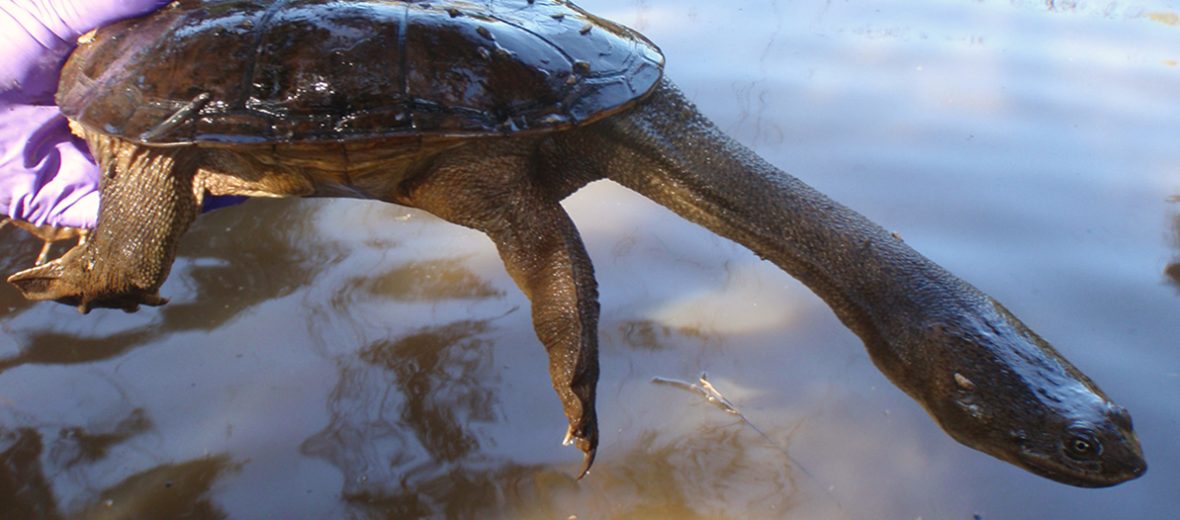
Living in and around the creeks, rivers, and freshwater & brackish water ponds along the Great Ocean Road, it’s the snake-necked turtle, aka eastern long-neck turtle. You can find them in southeastern Australia, west of Adelaide to New South Wales, Victoria, and north to the Fitzroy River of Queensland. These turtles are aptly named for their long necks that can be up to 75% as long as their shell! Snake-necked turtles are an Endangered species due to pollution and habitat loss. This article is on special request by Ryan.

First the Stats…

Scientific name: Chelodina longicollis
Weight: Up to 1.8 lbs.
Length: Up to 9.84 inches
Lifespan: Up to 37+ years

Now on to the Facts!

1.) These turtles are sexually dimorphic in that the females are larger than male’s plastrons and are shaped differently.

2.) Snake-necked turtles shed their shell and their skin as they grow. When swimming, the shed skin looks like a web-like slime around their body, head, neck, and legs.

3.) Snake-necks are diurnal (active during the day).

4.) Like other reptiles, they are ectothermic (their body temperature is dictated by the surrounding temperature).

5.) They eat a variety of invertebrates, like insects. They also eat fish, plankton, tadpoles, frogs, and crayfish.

But wait, there’s more on the snake-necked turtle!

6.) Snake-necked turtles are polygynandrous (promiscuous) in that they mate readily and with multiple partners.

7.) These unusual turtles catch prey by using what is known as a strike-and-gape action. They lower their hyoid bone to decrease water pressure and create a vacuum, sucking in their prey.

Did you know…?
When threatened, they can spray a pungent, stinky musk that can hit targets up to 3 feet away!

8.) When their environment gets too dry they sometimes estivate. This means they begin a long state of torpor (dormancy). When they estivate, they usually burrow into fallen leaves and debris on the forest floor, for an extended length of time, until the rains return.

9.) Females lay up to 24 hard-shelled eggs that hatch in up to 150 days.

10.) Unlike most turtles, temperature does not dictate gender.

But wait, there’s still more on the snake-necked turtle!

11.) Males are sexually mature at up to 8 years old, whereas females are mature at up to 12 years.

12.) Captive snake-necked turtles are easily tamed and will even take food from their keeper’s hands.

13.) Their predators are goannas, water rats, ravens, white-bellied sea eagles, and dingoes.

Now a Short Snake-Necked Turtle Video!

Be sure to share & comment below! Also, check out the Critter Science YouTube channel. Videos added regularly!

Want to suggest a critter for me to write about? Let me know here.

Australiapredatorpreyreptilesnake-neckedsnake-necked turtleturtlewater
Critterman

With over 51 years of critter experience to my credit and hundreds of zoology teaching hours to people around the world, I have amassed not only a continuing thirst for critter knowledge but a desire to teach others all I can about the majesty and wonder of our natural world. Critter Science is a culmination of such knowledge. I have hands on as well as book acquired intel on all kinds of critters. Whether they're on land, sea, or in the air. I will never say that I know everything about all animals. That's impossible, even for a savant. But, that being said, ask me any animal question and I'll answer it. If I don't know the answer, I'll get an answer for you!

The Riverine Rabbit
The Beautiful and Stealthy Orchid Mantis
Related Posts
  • eastern narrow-mouthed toad
    The Eastern Narrow-Mouthed Toad 12 June, 2026
  • California golden trout
    The California Golden Trout 11 June, 2026
  • drugstore beetle
    The Drugstore Beetle 10 June, 2026
2 Comments
  1. Reply
    Lezli W. August 23, 2024

    I was just wondering if these snake necked Turtles that I keep seeing things that say they’re only found in Australia and South America could have possibly been able to either find their way to The United States of America around the North Florida Area or Most likely been brought back from their native countries and entered into the waters of Wakulla Springs which runs out into several different bodies of fresh water Springs as well as sinks around Crawfordville, Florida 32327 as well as the Woodville Florida area fresh water sink holes in the 32305 zip code area!? I have a picture of one that looks exactly like the ones in these pictures that say it is a Snake Necked Turtle that most likely came from the Australian regions or somewhere around the South American region and I don’t see any other Turtle that looks even remotely close to the way this one I’ve seen so many of in Specifically Cherokee Sink down close to Wakulla Springs Lodge and Swimming Park with Glass Bottom Boat Tours that go out into the Beautiful crystal clear water where you’re actually able to look down at the glass bottom and see hundreds and hundreds of feet down to where the actual water comes out from the Springs its also in Crawfordville, Florida 32327 and is one of the largest Fresh Water Springs in the World. I recommend going to visit the Wakulla Springs Park & Lodge if you are interested in Fresh Water Springs and it will leave you breathless and not disappoint! I added the picture of one of the latest Turtles I was able to capture on my phone and hopefully you will be able to let me know for certain if this is indeed a snake necked Turtle like the ones that originated in Australia because I haven’t had any luck at all trying to find out from the people who live around here and I would greatly appreciate it if you could help to finally answer this question I’ve never had anyone who could give me a definite yes or no answer about this beautiful turtle of some kind 😀 Thank you so much for all the time you have taken to put this information out here for curious people such as myself who just enjoy learning new things about all kinds of different species of animals as well as new and/or different socialist (people) and their different cultures and religious beliefs or rituals they have that they’ve learned about as they were growing into adults, such as us in America celebrating Thanksgiving every November you know what I’m talking about, Okay I’m going to sign off for now and try to get some rest before the new day starts and Mr.Sunshine peeps from way up high in the gorgeous sky’s! Sorry for having such a long letter, I’m just very excited to think I might actually be on the right path to find answers about this creature I’ve been trying to figure out so many things about for such a very long time! Hopefully I will hear from you soon and I’m looking forward to it! Have a wonderful day, Thank you, Lezli W

    • Reply
      Critterman August 23, 2024

      Hi Lezli.

      Thank you for reaching out about this turtle species identification. That actually looks like a Florida softshell turtle. Softshell turtles also have long necks, just not as long as a snake-necked turtle. The 3 main differences between the 2 species being the slightly shorter neck, a smoother plastron (shell), and a pointed snout; which all define the Florida softshell turtle. The plastron of a snake-necked turtle is less smooth, their necks much longer, and their snout is more blunt.

      Take care and be well.

      Be sure to visit often for more cool critter stuff.

      P.S. I will be writing an article here on the Florida softshell turtle and it will be dedicated to you.

Leave a Reply Cancel Reply

Your email address will not be published. Required fields are marked *

  • Daily Critter Facts
  • Guest Articles
  • BYET
  • Teachers
  • Study Guides
  • Contact

Copyright © 2025, Critter Science. All Rights Reserved.