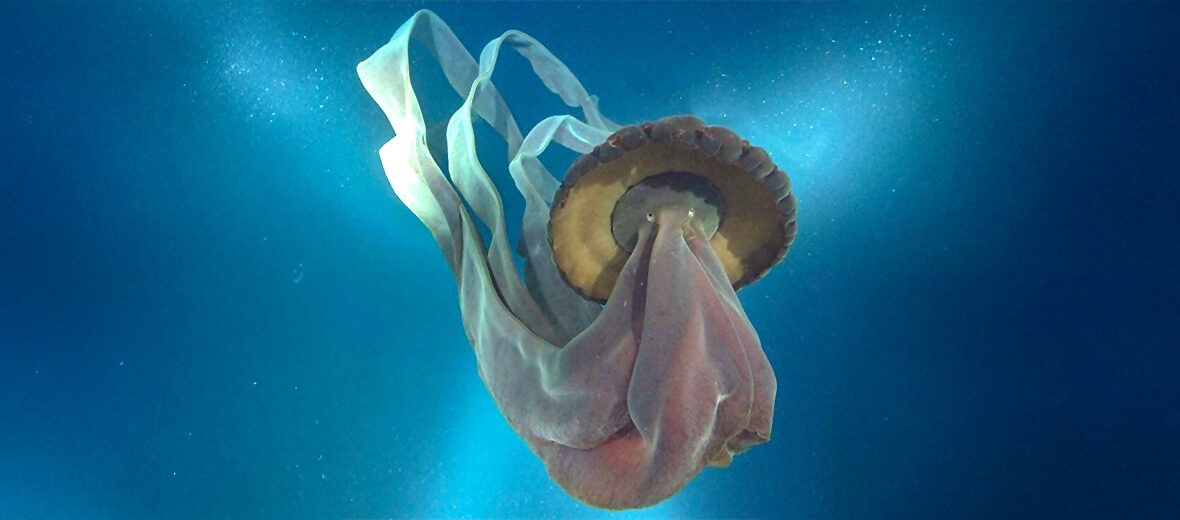
The phantom jellyfish, aka giant phantom jelly, is the only known species in the genus of deep sea jellyfish, Stygiomedusa. They belong to the Ulmaridae family. While not currently evaluated by the IUCN, these jellies likely face the threats of deep-sea fishing, mining, and oil exploration. Their population trend is unknown, but they are presumed to exist in all the world’s oceans, sans the Arctic Ocean. This article is on special request from my oldest son, Jon.
First the Stats…
Scientific name: Stygiomedusa gigantea
Weight: Up to 90 lbs.
Length: Up to 33+ feet, plus a bell size of 3.3 feet
Lifespan: Up to 6 months
Now on to the Facts!
1.) The Monterey Bay Aquarium Research Institute’s remotely operated underwater vessels have only sighted these jellies 27 times in 27 years.
2.) They are believed to be 1 of the largest invertebrate predators in the ecosystem.
3.) These jellyfish are typically only found in the ocean’s midnight zone, and twilight zone and dwell at the crushing depths of 21,867+/- feet.
4.) Their bodies being made of spongy tissue or jelly permits this species to withstand the incredible deep ocean pressure of 5,800 pounds per square inch!
5.) While previously not known to exist there, sightings of these jellyfish in the Antarctic Ocean have occurred with the aid of submersibles.
But wait, there’s more on the phantom jellyfish!
6.) The giant phantom jellyfish was first described in 1910 by Alfred Goldsborough Mayer in his book Medusae of the World.
7.) It is presumed that they will drift or swim upwards to expose themselves to ultraviolet radiation, in an attempt to rid themselves of parasites.
Did you know…?
There have only been an estimated 118 total sightings over a 110 year period.
8.) Plankton and small fish make up their diet.
9.) They have also been observed to dwell in the immediate area of hydrothermal vents where large amounts of zooplankton are plentiful.
10.) In a first-ever documented symbiotic relationship for an ophidiiform fish, scientists have documented that the sizable umbrella-shaped bell of of these jellyfish provides food and shelter for these small fish, while the fish in turn aids the jelly by removing parasites.
But wait, there’s still more on the phantom jellyfish!
11.) Just 1 parent can produce up to 100 medusa offspring.
12.) The offspring are produced within the parent but soon grow large enough to escape out their parent’s mouth to later transform into a polyp. They then reproduce asexually via budding or podocysts. Then they become larval medusae that feed on plankton. Eventually becoming adults.
Now a Short Phantom Jellyfish Video!
Be sure to share & comment below! Also, check out the Critter Science YouTube channel. Videos added regularly!

Want to suggest a critter for me to write about? Let me know here.
Some source material acquired from: Wikipedia & IUCN
Photo credit: Plankgolankgo