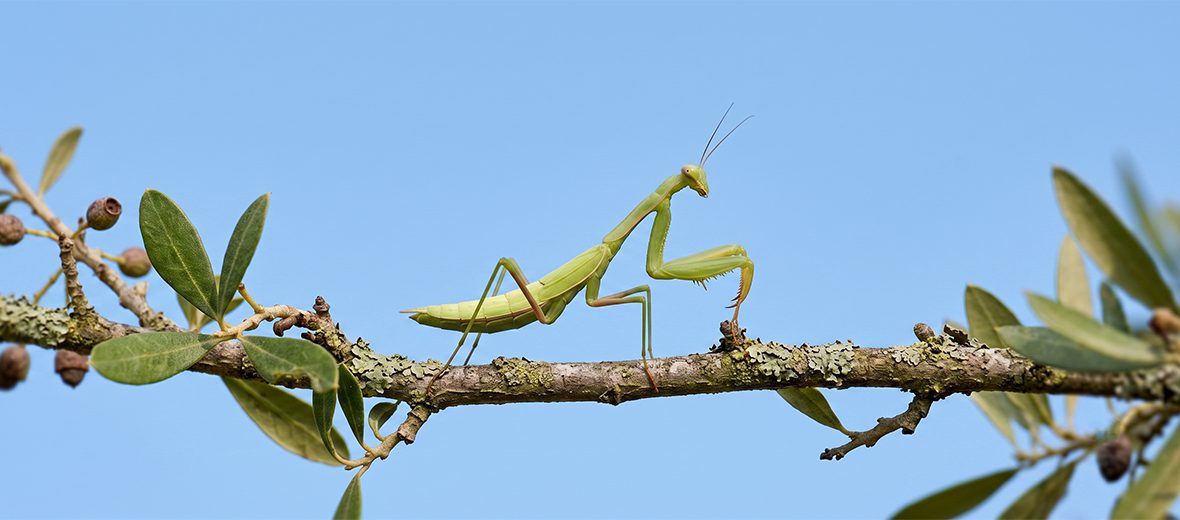
The European mantis is a species of praying mantis that can be found in Europe, Africa, Asia, and has been introduced to North America as well. Like all species of mantids they get the “Praying” part of their name from the positioning of their forelimbs. These insects are threatened by habitat loss and destruction at the hands of residential and commercial development, farming, and ranching. They are often persecuted as they are perceived as poisonous or venomous, and also an agricultural pest. Quite the contrary, they are an extremely beneficial insect predator. Accidental secondary poisoning also occurs, due to the consumption of a previously poisoned insect prey being consumed. However, these mantids are abundant and near globally distributed. Therefore they are listed as Least Concern by the IUCN. Their population trend is listed as unknown.
First the Stats…
Scientific name: Mantis religiosa
Weight: Up to .18 ounce
Length: Up to 3 inches
Wingspan: Up to 3.2 inches
Lifespan: Up to 196 days
Now on to the Facts!
1.) Just like all mantids, these critters can turn their heads up to 180º.
2.) They are sexually dimorphic in that females are larger than males. Females also live longer than males.
3.) Males are typically more active and agile, whereas females are physically more powerful.
4.) Females are too heavy for their wings to enable flight. So, only the males can fly.
5.) Mantids can show a strong deimatic display from very early on. This behavior can be seen throughout various groups of animals and is utilized to scare or startle potential predators to give the potential prey animals a chance to escape. A deimatic display is a threat display used for defense.
But wait, there’s more on the European mantis!
6.) These critters possess a tympanal auditory organ (ear) which is an unpaired structure located on the ventral side of the insect’s metathorax between the third pair of legs.
7.) Unlike other sound-processing organs found on various groups of insects, the metathoracic ear has a rather high sensitivity across high and low frequencies and is even capable of hearing ultrasonic frequencies. Therefore, this organ is termed a ‘true ear’.
Did you know…?
The wide variation in their coloration from varying shades of black, brown, green, and yellow has been the cause of numerous hypotheses and studies for over 100 years. But no accepted answer about reasoning, benefits, or mechanisms of this range in coloration or the change of coloration has been found.
8.) Green mantids are often found on fresh green grass, whereas brown specimens prefer brown grass burned by the sun. When they were forced to change the location as to no longer match their coloration, nearly all the ‘non-matching’ individuals were killed by predators like birds.
9.) The previous examination lends to the belief that their coloration variance is an evolutionary adaptation.
10.) It was also noted in 1907, by Karl Przibram that a change in temperature triggers a change in their coloration: individuals that hatched in a cold environment turned green after molting when heat and/or sunlight were provided. Without the sunlight and/or heat they stayed brown.
But wait, there’s still more on the European mantis!
11.) It only takes a few days after the final molt into adults before these insects start to show interest in the opposite sex.
12.) There are theories that the female pheromones are most potent in the heat and also that the male, as a thermophilic insect (1 that thrives in higher temperatures), is most active during the hotter part of the day.
Did you know…?
Even though they are an introduced species, they are the official state insect of Connecticut.
13.) When a female sees a male, she is quite likely to attack, kill, and eat him. Therefore, males are observed to be very slow and cautious in their approach; after eyeing a female, the male typically freezes and turns his head to look directly at her.
14.) Since the foveae in the male’s eyes face directly forwards, the male has the most accurate and detailed view of her and can watch her each and every move in case he has to make a hasty retreat.
15.) Bats, birds, rats, mice, reptiles, and amphibians all prey on these mantids.
Now a Short European Mantis Video!
Be sure to share & comment below! Also, check out the Critter Science YouTube channel. Videos added regularly. Be sure to like and subscribe!

Want to suggest a critter for me to write about? Let me know here.
Some source material acquired from: Wikipedia & IUCN