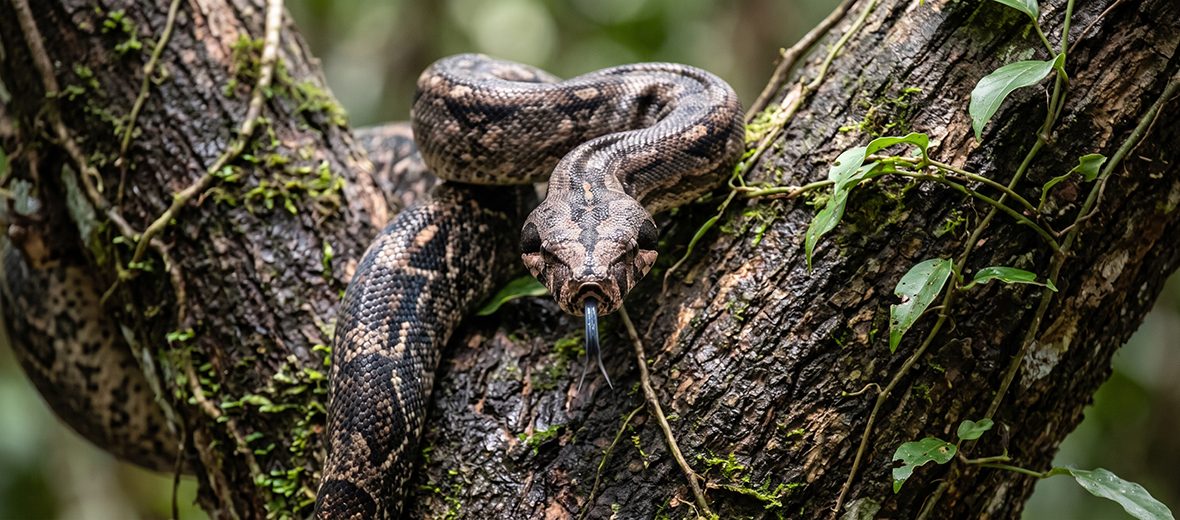
The Mexican west coast boa constrictor, aka Bateman’s Boa, hails from western Mexico. They were once regarded as conspecific with boa constrictor, and later with Boa imperator; however, in 2016, it was suggested on genetic grounds that these boas should be regarded as a separate species. Expanding human developments along the Mexican west coast continuously slice through these snake’s natural territory. Clear-cutting forests for agricultural use as well as infrastructure directly destroys their hunting grounds as well as their nesting sites. Because their range is bounded by specific geographical features along the western coast, displaced populations often have nowhere else to go when pushed from their home. Due to their relatively calm demeanor and gorgeous appearance, they are often collected from the wild for the illegal or unregulated reptile trade. Sadly, boas are heavily hunted and poached for their prized skins, which are processed into fashion accessories such as bags, belts, and boots, to name a few. Driven mostly by uneducated fear of their large size, humans often kill these non-venomous snakes on sight to protect domestic livestock, chickens, or property. However, due to the abundance of these snakes, they are listed as Not Evaluated by the IUCN.
First the Stats…
Scientific name: Boa sigma
Weight: Up to 13 lbs.
Length: Up to 6 feet
Lifespan: Up to 25+ years
Now on to the Facts!
1.) Wild populations are increasingly threatened by highly contagious pathogens such as Inclusion Body Disease (IBD), a fatal viral condition that can devastate boid (boa) populations.
2.) They were originally described as Constrictor constrictor sigma by renowned American herpetologist Hobart Muir Smith in 1943.
3.) Their preferred habitats are tropical dry forest ecoregions, though the northern populations also heavily occupy arid to semi-arid ecosystems, including Sonoran desertscrub, foothills thornscrub, desert grasslands, and oak woodlands, with a strong preference for riparian zones.
4.) They are also locally known as corúa, corúga, corúva, culebrón, or limacoa.
5.) Unlike other species of snakes, these boas are protected by rural Sonorans, because it is thought that killing them would cause the spring (aguaje) to dry up.
But wait, there’s more on the Mexican west coast boa constrictor!
6.) Mice, rats, squirrels, lizards, snakes, and birds are all on the menu.
7.) Hawks, eagles, owls, other boas, wild cats, coatis, caimans, and jaguars all prey on these snakes.
Did you know…?
They are considered by many as the guardians of water (guardiana del agua).
8.) Females undergo up to a 240 day gestation (pregnancy) that yields up to 25 juveniles.
9.) On their upper jaw, they have rows of teeth (2 outer rows along the jawline and 2 inner rows along the roof of the mouth) and on their lower jaw, they have 2 rows of teeth (1 on each side), totaling over 100 teeth.
10.) Like other boas, they are nocturnal (active at night).
Now a Short Mexican West Coast Boa Constrictor Video!
Be sure to share & comment below! Also, check out the Critter Science YouTube channel. Videos added regularly. Be sure to like and subscribe!
Buy My Book
Select the image below to see everywhere my book is sold.


Want to suggest a critter for me to write about? Let me know here.
Some source material acquired from: Wikipedia & IUCN