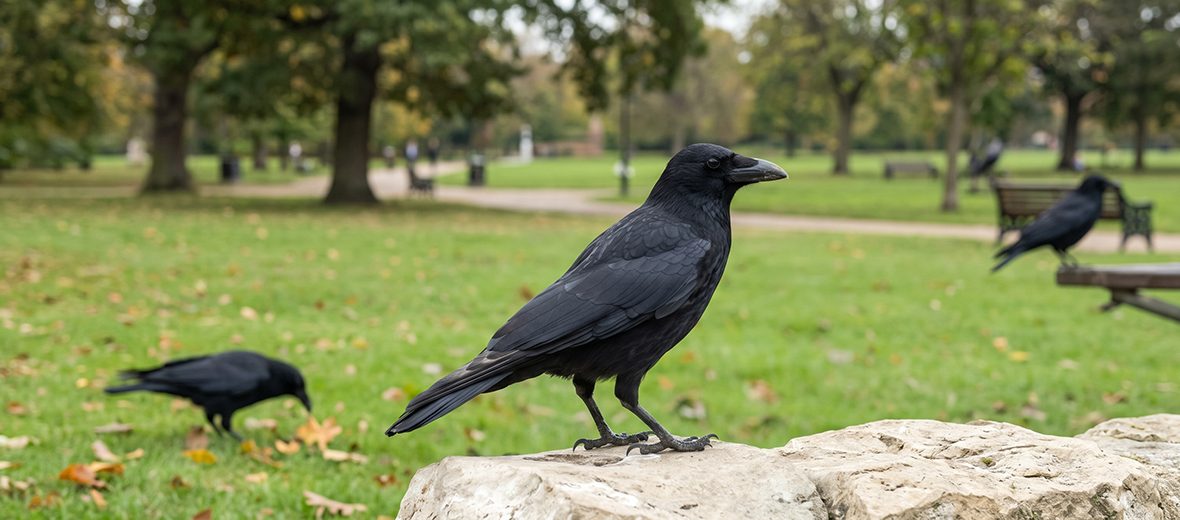
The carrion crow resembles the American crow, but is differentiated by a larger stature. They hail from Europe, Asia, and Africa. Farmers, landowners, and gamekeepers historically and currently target them as pests. They are frequently trapped or shot under specific legal general licenses to protect crops, young livestock, and the eggs or chicks of game birds. Carrion crows are highly susceptible to West Nile virus (WNV). Unlike some European bird species that show resistance, exposure to virulent strains of WNV often results in high mortality rates among corvids. In urban areas, their tendency to scavenge from household waste and dump sites exposes them to accidental poisoning, chemical pollutants, and pesticides. However, these highly intelligent and adaptable birds are very abundant and widespread, therefore they are listed as Least Concern by the IUCN. Their population trend is listed as stable as well.
First the Stats…
Scientific name: Corvus corone
Weight: Up to 1.43 lbs.
Length: Up to 20 inches
Wingspan: Up to 41 inches
Lifespan: Up to 10 years
Now on to the Facts!
1.) This species was originally described by Carl Linnaeus in his 1758 10th edition of Systema Naturae.
2.) Their binomial name hails from the Latin word corvus, which translates to “raven”, and Greek κορώνη korōnē, which translates to “crow”.
3.) The carrion crow is closely related to the hooded crow, but are differentiated by plumage coloration and geographic distribution; anatomically, behaviorally, and vocally though, they are almost indistinguishable.
4.) Their preferred habitats are open countrysides with scattered trees. However, they are highly adaptable and can be seen in urban and suburban settings as well.
5.) These birds are noisy, perching on a vantage point like a building or the top of a tree and calling 3 – 4 times in quick succession, with a slight pause between each series of croak-like calls. During each series of calls, they perform a gesture, raising their shoulders and bowing their head and neck downwards with each caw.
But wait, there’s more on the carrion crow!
6.) They can become tame near humans, and will often be found near areas of human activity or habitation, such as cities, moors, woodlands, sea cliffs, and farmlands, where they compete with other social birds like gulls, other corvids, and ducks for food in gardens and parks.
7.) Like other species of corvids, carrion crows actively harass predators and competitors that enter their territories or threaten them or their offspring, and engage in group mobbing behaviour as a method to defend themselves.
Did you know…?
There are an estimated 91,700,000 individuals, to date.
8.) Juveniles can be identified by their brownish plumage and blue eyes, both of which darken to black plumage and brown eyes as the crow grows older.
9.) As is the case with other corvids, carrion crows are incredibly intelligent. For instance, they can discriminate between numbers up to 30, easily switch between rules, and recognize human and crow faces. Given the difference in brain architecture in crows compared to primates, these abilities suggest that their intelligence is realized as a product of convergent evolution.
10.) They don’t only eat carrion (dead animals), they also feast on insects, earthworms, other invertebrates, mice, juvenile rats, voles, moles, frogs, toads, salamanders, fish, grain, fruits, seeds, nuts, human scraps, and eggs.
But wait, there’s still more on the carrion crow!
11.) Nests look like that of the common raven; that being a large, bulky, open cup-shaped structure.
12.) Females lay up to 4 eggs that hatch in up to 20 days.
Did you know…?
Eurasian eagle-owls, northern goshawks, peregrine falcons, golden eagles, red foxes, pine martens, and raccoons all prey on these birds.
13.) Incubation duties are left up to the female, while the male tends to the gathering of food.
14.) It is not uncommon for the offspring from the previous year to stay and help rear the new hatchlings. Rather than seeking out a mate, they look for food and assist the parents in feeding the young.
15.) These birds produce a distinct, harsh, and highly functional “caw,” “craa,” or “caa” calls.
Now a Short Carrion Crow Video!
Be sure to share & comment below! Also, check out the Critter Science YouTube channel. Videos added regularly. Be sure to like and subscribe!
Buy My Book
Select the image below to see everywhere my book is sold.


Want to suggest a critter for me to write about? Let me know here.
Some source material acquired from: Wikipedia & IUCN