
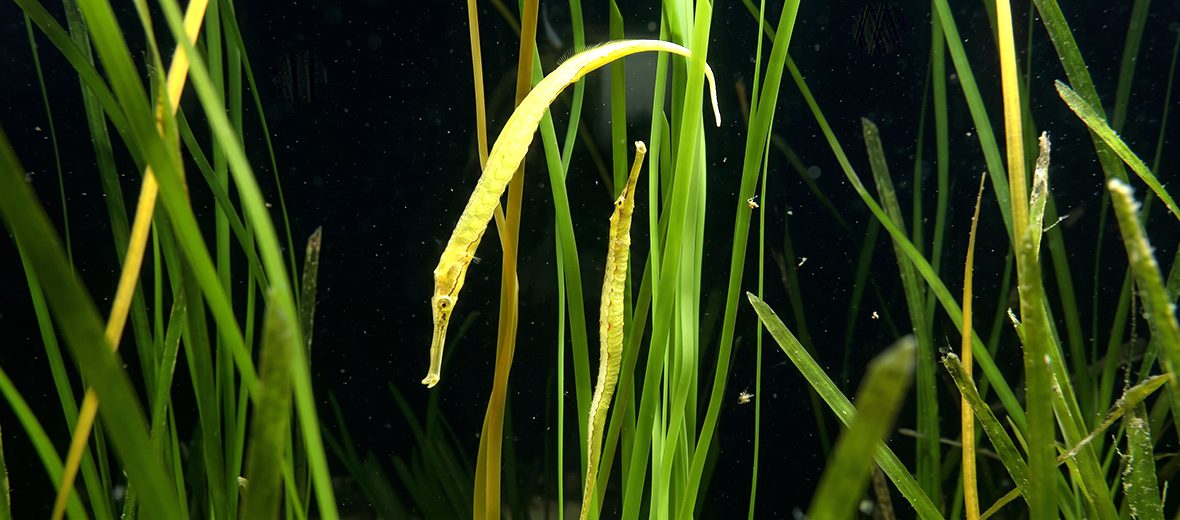
The pipefish can be found among reefs and oceanic grass beds the world over. The name Syngnathinae hails from Ancient Greek σύν (sún), meaning “together”, and γνάθος (gnáthos), meaning “jaw”, and refers to the fused jaw that the subfamily’s species have in common. They are part of the same family as seahorses and sea dragons. Coastal development, dredging, and industrial activities destroy vital seagrass beds and eelgrass meadows where they live, hide, feed, and breed. Water pollution in the form of agricultural runoff, urban chemicals, as well as algal blooms lower oxygen levels (hypoxia) in shallow waters, reducing feeding activity and stressing populations. Rising water temperatures, droughts, and severe floods alter freshwater flows into estuaries, caused by climate change, disrupts the zooplankton and copepods that they rely on for food. These unique creatures are also captured for use in Traditional Chinese Medicine (TCM) and are in demand for the marine aquarium trade. Non-selective fishing gear, bottom trawls, and dragging lines sweep through and destroy shallow habitats, accidentally catching or crushing slow-moving indiviuals. Non-native predators and/or competitors (like green crabs or aggressive species of fish) disrupt local communities and outcompete native pipefish for food and prey on them as well. Based on the individual species, these peculiar fishes are listed anywhere from Least Concern to Critically Endangered by the IUCN.
First the Stats…
Scientific name: Syngnathinae
Weight: Up to 3.99 ounces
Length: Up to 14 inches
Lifespan: Up to 10+ years
Now on to the Facts!
1.) Their preferred habitats are shallow coastal marine waters, particularly seagrass beds (like eelgrass), seaweed forests, and coral reefs.
2.) Seeing as they have a lack of strong swimming capability pipefish are often found in shallow waters that are rather easily disturbed by industrial runoffs and human recreational activities.
3.) Just like their seahorse relatives, the parenting and birthing duties are left to the male. The male, who provides all of the postzygotic care for his offspring, supplying them with nutrients and oxygen via a placenta-like connection.
4.) The evolution of male brooding among these fish is believed to be a result of the reproductive advantage bestowed to pipefish ancestors that learned to deposit their eggs onto the males, who were capable of escaping predation and also protect their young.
5.) In addition, the ability to transfer immune information from both the mother (in the egg) and the father (in the pouch), unlike other chordates in which only the mother can transfer the immune information, is believed to have an additive beneficial effect on offspring immunity.
But wait, there’s more on the pipefish!
6.) Courtship between the male and female involves a lengthy and complicated show of displays. For instance, in Syngnathus typhle, copulation is always preceded by a ritualized dance by both sexes.
7.) Their dance involves very conspicuous shaking as well as wriggling motions, especially in comparison to the species’ otherwise extremely secretive lifestyle.
Did you know…?
While most live in saltwater, some live in freshwater environments, such as the rainbow-bellied pipefish.
8.) Up to 700 eggs are produced in their lifetime.
9.) Fish, crabs, sea turtles, water birds, seals, and sea lions all prey on these fish.
10.) Numerous species exhibit polyandry, a breeding system in which 1 female mates with 2 or more males. This typically occurs with greater frequency in internal-brooding species of pipefishes than with external-brooding ones due to limitation in male brood capacity.
Now a Short Pipefish Video!
Be sure to share & comment below! Also, check out the Critter Science YouTube channel. Videos added regularly. Be sure to like and subscribe!

Want to suggest a critter for me to write about? Let me know here.
Some source material acquired from: Wikipedia & IUCN




Leave a Reply