
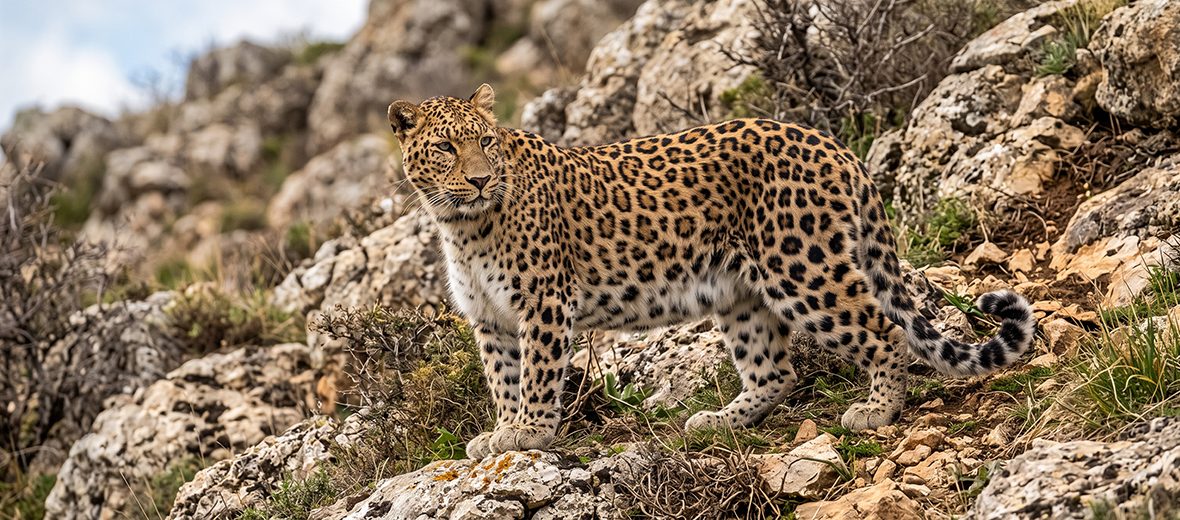
The Persian leopard, aka Anatolian leopard or Caucasian leopard, is a subspecies of leopard that hails from the Iranian Plateau and the surrounding region from eastern Anatolia and the Caucasus to the Hindu Kush. They face the threats of habitat loss and fragmentation at the hands of expanding human settlements, road construction, deforestation, and land-use changes which break up continuous territories. Vehicle strike (being hit by vehicles) is another threat faced. Illegal hunting and overexploitation of natural wild ungulates (like wild goats, mouflons, wild boars, and roe deer) dramatically reduce available prey. When their natural prey runs low, leopards will attack domestic livestock. This leads to retaliatory killings by local farmers and herders. Illegal hunting for fur, body parts, and/or trophies continues to pressure their population. Remnant border fences and active or legacy minefields (especially across the Caucasus and Zagros regions) often restrict movement and cause direct fatalities. Lastly, climate change further degrades the quality of subalpine and forest habitats via extreme droughts. These big cats are listed as Endangered by the IUCN. Their population trend is listed as decreasing as well. Enjoy Critter Science’s 2,100th critter article!
First the Stats…
Scientific name: Panthera pardus tulliana
Weight: Up to 198 lbs.
Length: Up to 6 feet, plus up to a 4 foot tail
Height: Up to 30 inches, at the shoulders
Lifespan: Up to 21 years
Now on to the Facts!
1.) These big cats were first described in 1856 by the French zoologist Achille Valenciennes.
2.) Their preferred habitats are subalpine meadows, temperate broadleaf, mixed forests, and rugged ravines at elevations of up to 12,500 feet.
3.) In addition to the previously mentioned prey animals, these cats also hunt onagers and chamois.
4.) They can leap horizontally, in a single bound, up to 30 feet! Their vertical leap distance measures up to 10 feet!
5.) In Azerbaijan, these leopards have been protected by law since 1969; in Armenia and in the Soviet Union, they have been protected by law since 1972.
But wait, there’s more on the Persian leopard!
6.) In 2001, a 5-year leopard conservation project was kicked off in the Caucasus, which supported systematic surveys in the region, the planning of new and enlargement of existing protected areas, training of border guards, and school education campaigns in Armenia and Azerbaijan; in addition, an anti-poaching unit was set up in Armenia.
7.) Mating season lasts from mid-January – mid-February.
Did you know…?
There are fewer than an estimated 1,100 adults remaining, to date.
8.) Females undergo up to a 106 day gestation (pregnancy) that yields up to 4 kittens (but usually just 2 – 3).
9.) In 2009, the Leopard Breeding and Rehabilitation Centre in Russia’s Sochi National Park was given 2 leopards from Turkmenistan as part of a leopard breeding and reintroduction program.
10.) Since that time, leopards have been brought from various zoos.
But wait, there’s still more on the Persian leopard!
11.) The offspring of these cats were released into the wild in 2016 as well as 2018, and included 3 males and 1 female into the Caucasus Biosphere Reserve, as well as 1 male and 1 female into Alaniya National Park located in North Ossetia – Alania.
12.) As of 2021 there are over 100 captive Persian leopards in zoos the world over, and the European Endangered Species Programme has a captive breeding program designed to sustain a backup population of these beautiful cats.
13.) These critters can run at speeds of up to 37 mph.
14.) When Roman statesman Marcus Tullius Cicero was serving as Governor of Cilicia in 50 BC, he frequently asked for leopards to be sent from Kibyratis in Anatolia, which were sadly then used for gladiators to fight; hence the scientific name hailing from his middle name.
Now a Short Persian Leopard Video!
Be sure to share & comment below! Also, check out the Critter Science YouTube channel. Videos added regularly. Be sure to like and subscribe!

Want to suggest a critter for me to write about? Let me know here.
Some source material acquired from: Wikipedia & IUCN

Leave a Reply