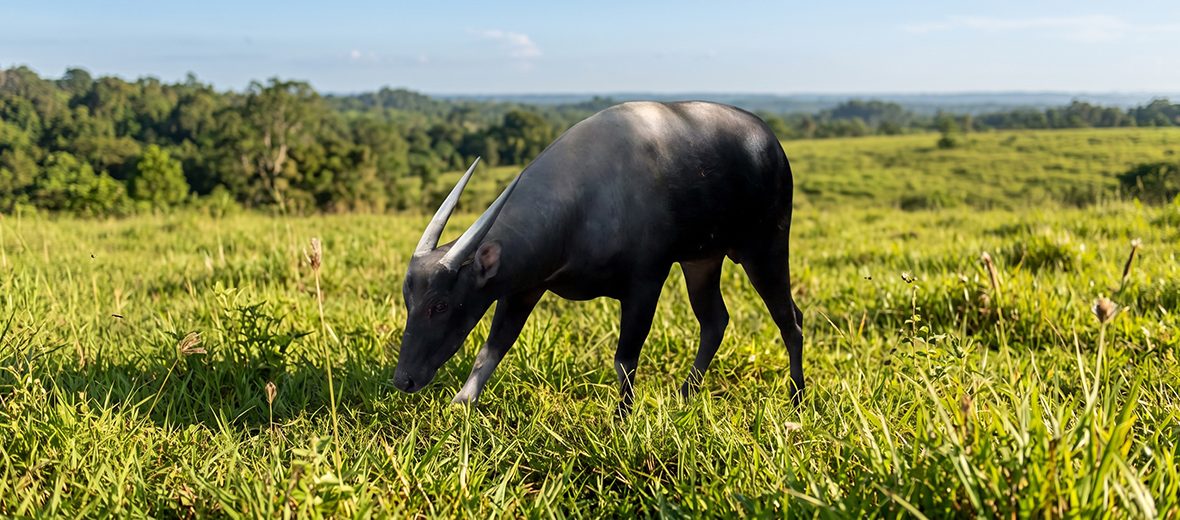
The anoa, aka dwarf buffalo or sapiutan, hails from the lowland and mountainous regions of Sulawesi. There are 2 recognized species: the mountain anoa and the lowland anoa. Both species face the threats of habitat loss and destruction at the hands of residential and commercial developments, farming, ranching, logging, mining, and quarrying. Hunting, however, is by far the most serious threat faced. Dams and water management also divide their territory. Due to these threats, the IUCN lists these ungulates as Endangered. Their populations are also decreasing.
First the Stats…
Scientific name: Bubalus
Weight: Up to 660 lbs.
Length: Up to 6 feet, plus up to a 16 inch tail
Height: Up to 39 inches, at the shoulders
Lifespan: Up to 35 years
Now on to the Facts!
1.) They are the smallest of the cattle species.
2.) These critters do not roam in herds like other buffalo species. They travel alone or in pairs.
3.) The horns of males measure up to 12 inches, while females measure up to 10 inches.
4.) Their diet consists of leaves, stems, fallen fruit, aquatic plants, ferns, grasses, palms, and ginger.
5.) The lowland anoa can be told apart from the mountain anoa by being bigger, having a triangular horn cross-section, far apart as opposed to thick and woolly hair, and always possessing white markings on the face and legs.
But wait, there’s more on the anoa!
6.) The mountain anoa has longer, woolier hair that molts every year, showing light spots on the head, neck, and limbs. The mountain anoa can be differentiated from the lowland by its smaller size, having a round horn cross-section, its thick and woolly hair, and sometimes having white markings on the face and legs.
7.) These critters are diurnal (active during the day).
Did you know…?
There are fewer than 5,000 wild individuals of both species remaining, to date.
8.) Females undergo up to a 10.5 month gestation (pregnancy) that yields a single calf.
9.) The calves are preyed on by reticulated pythons and civets.
10.) Habitat fragmentation may also be causing inbreeding and hybridization which can result in genetic pollution.
Now a Short Anoa Video!
Be sure to share & comment below! Also, check out the Critter Science YouTube channel. Videos added regularly. Be sure to like and subscribe!

Want to suggest a critter for me to write about? Let me know here.
Some source material acquired from: Wikipedia & IUCN

Leave a Reply