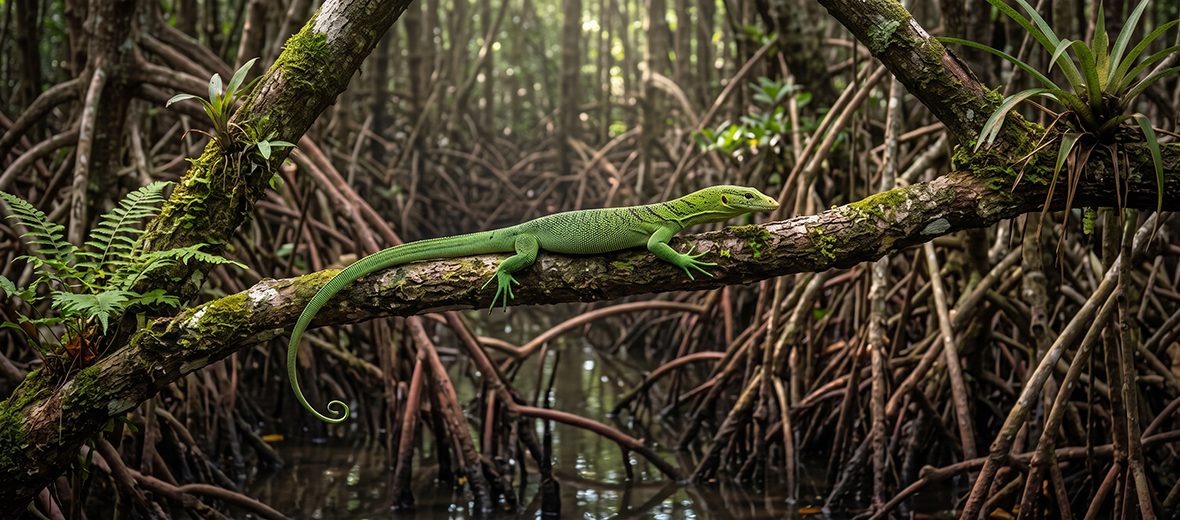
The emerald tree monitor, aka green tree monitor, emerald monitor, or wbl km, hails from Papua New Guinea and extreme northern Australia. These beautiful green lizards face the threat of overcollection for the pet trade. As strict arboreal (spend their lives in trees) reptiles, these monitors are entirely dependent on intact, dense canopy structures in lowland tropical rainforests, palm swamps, and mangroves. Deforestation driven by logging, agriculture (like palm oil plantations), and infrastructure development destroys their foraging grounds and nesting sites. Even when partial canopies remain, the removal of old-growth trees eliminates vital pathways and cover. A long-term emerging threat involves shifting global climate patterns due to climate change. Alterations in temperature and seasonal precipitation directly impact the structure of New Guinea’s rainforests and reduce the availability of their primary prey. However, despite these challenges, these lizards are abundant enough to be listed as Least Concern by the IUCN. Their population trend is listed as stable as well.
First the Stats…
Scientific name: Varanus prasinus
Weight: Up to 1.3 lbs.
Length: Up to 13 inches, plus up to a 26 inch tail
Lifespan: Up to 25 years
Now on to the Facts!
1.) These monitors were first described by John Edward Gray in 1831 as Monitor viridis. They were then redescribed by Schlegel 8 years later as Varanus prasinus.
2.) Their generic name Varanus hails from the Arabic word waral (ورل), which translates as “monitor”. The specific name, prasinus, is Latin and translates to “green”.
3.) The family Varanidae has been around for an estimated 112 million years, since the late Mesozoic era.
4.) These monitors prefer lowland tropical evergreen forests, palm swamps, and cocoa plantation habitats.
5.) They have a prehensile tail that is used to grip branches in their arboreal lifestyle.
But wait, there’s more on the emerald tree monitor!
6.) The soles of their feet are equipped with enlarged scales which help them when navigating trees.
7.) These monitors are among the few social monitors, dwelling in small groups, aka lounges, comprised of a dominant male, several females, and a few other subordinate males and juveniles.
Did you know…?
Like other monitor lizards, these monitors have specialized glands in their lower jaws that produce complex toxins. Their venom acts mainly as an anticoagulant—meaning it stops blood from clotting—and can cause a drop in blood pressure and/or local swelling. However, their sharp, serrated teeth often cause more immediate mechanical damage than the venom itself.
8.) Beetles, birds, centipedes, cockroaches, crabs, crickets, grasshoppers, katydids, mice, young rats, stick insects, and spiders are all on the menu. Fruit is also consumed, in rare circumstances while in captivity.
9.) Before consuming stick insects or rodents, these monitors will tear off the legs of their prey first.
10.) Despite a lack of aquatic adaptations, the Bronx Zoo has documented a captive emerald tree monitor swimming as well as foraging for food in shallow water.
But wait, there’s still more on the emerald tree monitor!
11.) Females lay upwards of 5 eggs in as many as 3 clutches throughout the year. Eggs hatch in up to 190 days.
12.) Arboreal snakes, and various raptors prey on these monitors.
Now a Short Emerald Tree Monitor Video!
Be sure to share & comment below! Also, check out the Critter Science YouTube channel. Videos added regularly. Be sure to like and subscribe!

Want to suggest a critter for me to write about? Let me know here.
Some source material acquired from: Wikipedia & IUCN