
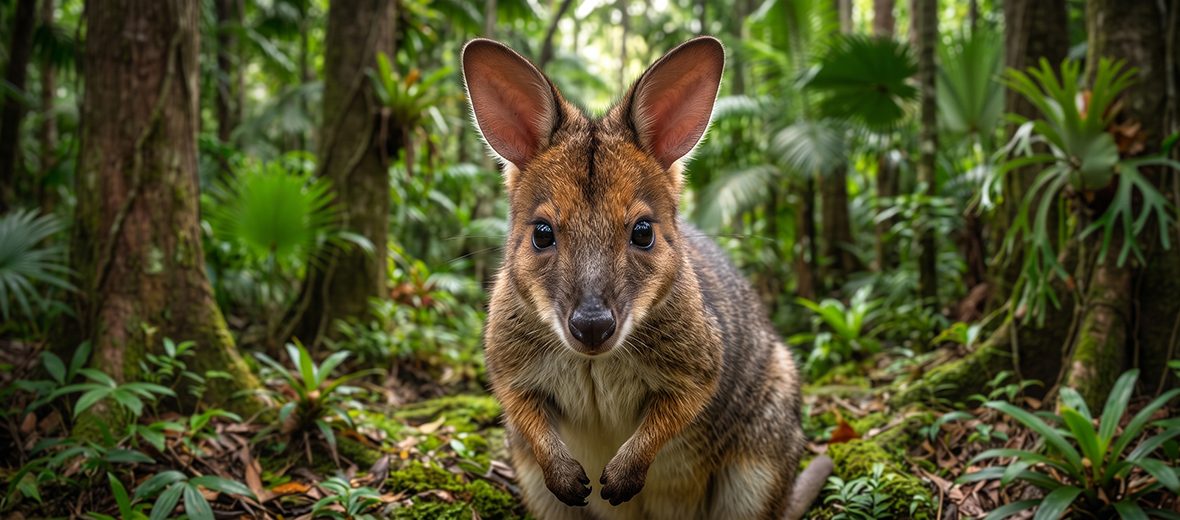
The red-legged pademelon, a member of the kangaroo family and who inhabits the rainforests, hails from the northeastern coast of Australia and in New Guinea. The clearing of lowland rainforest and dense understories for agriculture, residential development, and dairy farming has drastically reduced and disjointed their natural range. High-intensity logging operations exponentiate habitat fragmentation, and cuts off structural vegetation corridors that pademelons rely on to move safely between forest patches. While invasive weeds are generally harmful, broad-scale removal of thickets such as Lantana without immediate native replacement can strip pademelons of the essential protective ground cover they need to survive. Predation by feral cats, red foxes, wild dogs, and other animals near urban edges present a massive threat, especially to young joeys. Inappropriate or overly frequent bushfires cause degradation to the margins of tropical and subtropical rainforests. This burns away the dense understory of vines, ferns, and shrubs that they specifically rely on for camouflage as well as foraging. Further more, grazing competition from introduced species like feral pigs, European rabbits, horses, cattle, and various domestic livestock degrades the native vegetation and reduces food sources. Because these marsupials edge out of the forest to feed on grasses at dusk and at night, populations close to human settlements experience high rates of vehicle strike (being hit by vehicles). Lastly, long-term climate change alters rainfall patterns and intensifies cyclone activity, threatening the long-term health and structural integrity of the rainforest ecosystems they depend on. However, due to their abundant numbers and widespread distribution, they are listed as Least Concern by the IUCN. Their population trend is listed as decreasing though.
First the Stats…
Scientific name: Thylogale stigmatica
Weight: Up to 15.4 lbs.
Length: Up to 23 inches, plus up to a 18.5 inch tail
Lifespan: Up to 10 years
Now on to the Facts!
1.) They not only dwell among rainforests, but they’re also found near both sclerophyll (evergreen plant or vegetation with hard, thick, leathery leaves) and dry vine scrubs.
2.) Fallen and fresh leaves, berries, figs, as well as grasses are all readily consumed. Tree bark and even cicadas are also feasted upon.
3.) These marsupials are nocturnal (active at night).
4.) While typically solitary, they may gather in small groups called mobs for safety when grazing.
5.) They can reach speeds of up to 31 mph.
But wait, there’s more on the red-legged pademelon!
6.) Their natural predators are dingoes, tiger quolls, and pythons.
7.) After up to a 32 day oestrous cycle, females undergo up to a 30 day gestation (pregnancy) that yields a single joey.
Did you know…?
These critters are the only known mammal, that can eat the leaves of the Gympie Gympie, whose undersides are heavily coated in thousands of fine silica needles that can inject a potent neurotoxin if consumed.
8.) Joeys leave the pouch in up to 28 weeks.
9.) Female macropods enter a state of embryonic diapause if she becomes pregnant. This causes the blastocyst, or new embryo, to enter a state of suspended animation until its older sibling is old enough to leave the pouch. Once the original joey leaves, the blastocyst resumes development.
10.) A warning of approaching predators is given via the thumping of their hind legs.
Now a Short Red-Legged Pademelon Video!
Be sure to share & comment below! Also, check out the Critter Science YouTube channel. Videos added regularly. Be sure to like and subscribe!

Want to suggest a critter for me to write about? Let me know here.
Some source material acquired from: Wikipedia & IUCN

Leave a Reply