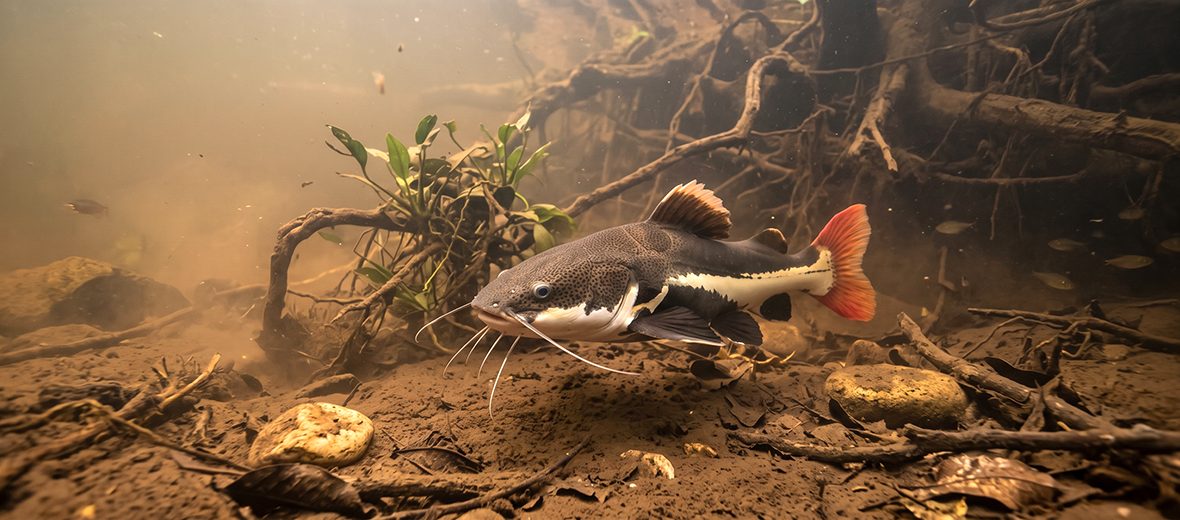
The redtail catfish, aka cajaro, banana catfish, or pirarara is the only extant species of its genus, Phractocephalus, that hails from South America. These fish face the threats of habitat loss and destruction at the hands of deforestation, agricultural runoff, and large-scale basin alterations that disrupt the slow-moving tributaries and floodplains where this species lives and hunts. Hydroelectric construction alters natural river flows, seasonal flood cycles, and migratory pathways. They are also targeted as a popular gamefish and utilized in minor commercial fisheries for local food markets. However, they are abundant enough to be listed as Least Concern by the IUCN. Their population trend is listed as unknown at this time.
First the Stats…
Scientific name: Phractocephalus hemioliopterus
Weight: Up to 123+ lbs.
Length: Up to 5.9 feet
Lifespan: Up to 28 years
Now on to the Facts!
1.) Due to the fact that these catfish are sold as tiny juveniles and the general public are not informed of their eventual massive size, these fish are often dumped into local water bodies when they outgrow even larger aquariums, thus contributing to an introduced or invasive species issue.
2.) In the wild, these catfish are preyed on by American crocodiles, caimans, giant otters, jaguars, and Orinoco crocodiles, to name a few.
3.) Live and dead fish, shrimp, prawns, crayfish, worms, frogs, salamanders, newts, fallen fruits, seeds, tree nuts from flooded forests, and basically anything else they can fit in their mouths is on the menu for these opportunistic feeders.
4.) They have been around for approximately 13.5 million years during the Miocene Epoch.
5.) These catfish communicate via a series of clicks that are made to ward off predators.
But wait, there’s more on the redtail catfish!
6.) Like many other catfish species, they are nocturnal (active at night).
7.) Even though they are slow moving, they are very territorial by nature.
Did you know…?
The current IGFA world-record for weight is from 2010 and belongs to Gilberto Fernandes, of Brazil, with an individual weighing-in at 123 lbs. 7 ounces).
8.) In Malaysia, they are considered an invasive species found primarily in the Perak River and Pahang River.
9.) It’s been stated that the South American tribes living in the forests do not eat the meat of redtail catfish as it is “black” in coloration. This is because in many indigenous cosmological systems, large predatory or dark scaleless fish are associated with water spirits.
10.) Females can produce upwards of 20,000 eggs each spawning session, that hatch in just 5 days.
Now a Short Redtail Catfish Video!
Be sure to share & comment below! Also, check out the Critter Science YouTube channel. Videos added regularly. Be sure to like and subscribe!

Want to suggest a critter for me to write about? Let me know here.
Some source material acquired from: Wikipedia & IUCN