
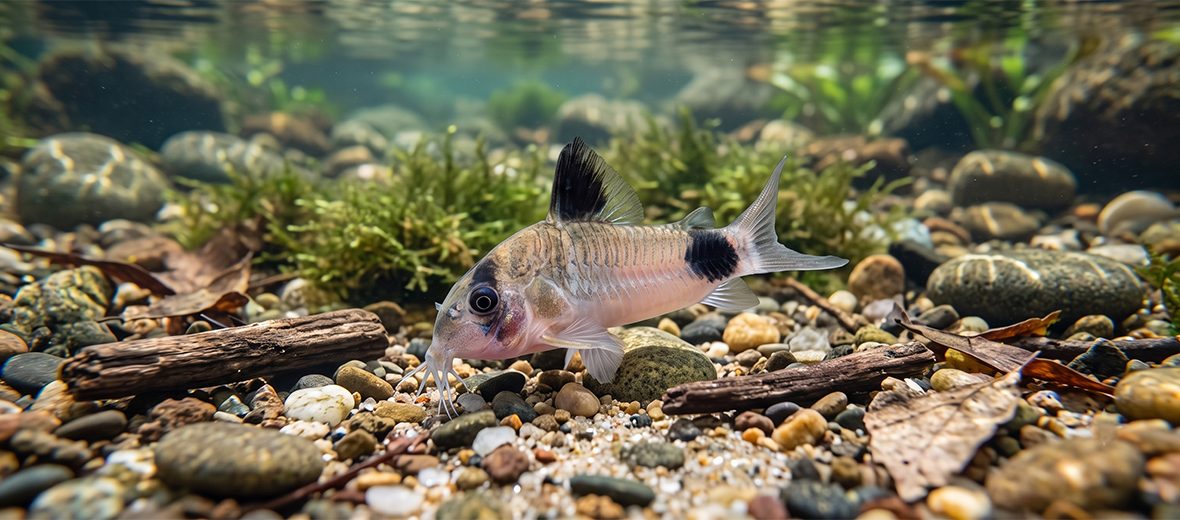
The corydoras, aka coridora, cory, or cory cat, a member of the armored catfish family, hails from South America. They can be found from east of the Andes mountains to the Atlantic coast. These freshwater fish come in a variety of shapes and color morphs. With a general lack of natural threats, sans water pollution and chemical pollution, these fish are listed as Least Concern by the IUCN. Their population trend is currently listed as stable.
First the Stats…
Scientific name: Corydoras
Weight: Up to .06 ounce
Length: Up to 4.7 inches
Lifespan: Up to 10 years
Now on to the Facts!
1.) Their name Corydoras hails from the Greek kory, meaning (“helmet”) and doras, meaning (“skin”).
2.) There are 160 species identified with hundreds more yet to be identified.
3.) They are typically given ‘C-numbers’, originally devised by Hans-Georg Evers for the German fishkeeping magazine DATZ in circa 1993. As of February 2014, 158 C-numbers have been issued, out of which 32 have been assigned official scientific names.
4.) Like other species of catfish, most species of corydoras are bottom-dwellers that forage in sand, gravel, or detritus for food.
5.) Corys are able to breathe both dissolved oxygen as well as atmospheric oxygen. This helps them when their aquatic environment only offers a hypoxic trait (lacking in oxygen).
But wait, there’s more on the corydoras!
6.) Bottom-dwelling insects, insect larvae, various worms, and some vegetable matter are all consumed. While not piscivores, they will feast on dead fish bodies.
7.) Their method of feeding is via searching the gravel bed with their sensory barbels and sucking up food items with their mouth. Many times burying their snout up to their eyes.
Did you know…?
Seeing as they are catfish, they do possess mildly venomous pectoral fin spines. Their defensive sting is comparable to a bee sting, causing localized pain and minor swelling, but they are not dangerous or life-threatening to humans.
8.) During reproduction the female will attach her mouth to the male’s genital opening, creating the well-known “T-position” many Corydoras show during courtship. The female will then drink the sperm. The sperm rapidly moves through her intestines and is discharged together with her eggs into a pouch formed by her pelvic fins.
9.) Up to 300 eggs are laid by the female each breeding season.
10.) Being a peaceful fish and well suited to tropical freshwater community aquariums, they get along well with most other species of fish and are not aggressive.
11.) These fish are diurnal (active during the day).
Now a Short Corydoras Video!
Be sure to share & comment below! Also, check out the Critter Science YouTube channel. Videos added regularly. Be sure to like and subscribe!

Want to suggest a critter for me to write about? Let me know here.
Some source material acquired from: Wikipedia & IUCN

Leave a Reply