
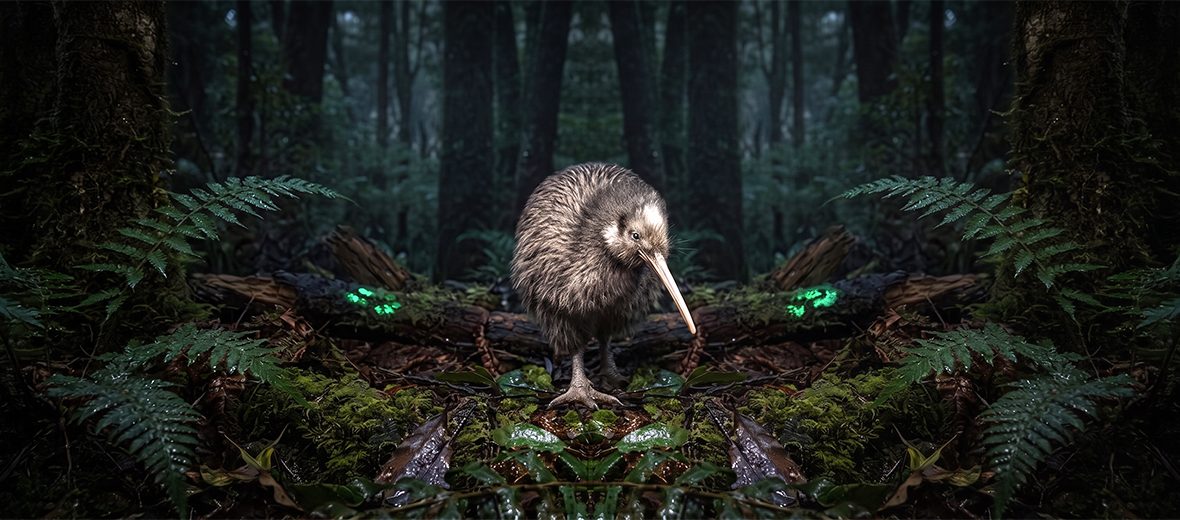
A fascinating and iconic flightless bird, the southern brown kiwi, aka tokoeka or common kiwi, hails from the south island of New Zealand. Like other species of kiwi, these birds face the ongoing threat of the impact of introduced varieties of predators such as stoats, dogs, cats, ferrets, and brushtail possums. Avian diseases and pathogens are other potential threats, mainly with chicks held in captivity or in high-density crèche sites. The Haast population is currently at risk from stochastic (random) events due to their small population size and isolation, and they suffer from low fecundity (the natural capacity and physical potential to produce offspring). With a small and decreasing population, these flightless birds are listed as Vulnerable by the IUCN. Their population trend is listed as decreasing.
First the Stats…
Scientific name: Apteryx australis
Weight: Up to 8.6 lbs.
Length: Up to 22 inches
Wingspan: Up to 2 inches
Lifespan: Up to 45 years
Now on to the Facts!
1.) Up until circa 2000s they were considered to be conspecific (part of the same biological species) with the north island brown kiwi, and still are in some circles.
2.) There are 2 recognized subspecies, with a few conservationists arguing for a 3rd: A. a. australis, A. a. lawryi, and Apteryx occidentalis.
3.) As is the case with other kiwis, they lack a preen gland, and their feathers have no aftershafts or barbules.
4.) Like other kiwis, they are nocturnal (active at night).
5.) Not only do they communicate vocally for defense, but they also sing duets with one another, with the male producing a shrill “kee-wee” or “kee-kee” and the females producing a hoarse “kurr kurr”.
But wait, there’s more on the southern brown kiwi!
6.) Earthworms, beetle larvae, snails, yabbies, spiders, centipedes, orthoptera (grasshoppers), eels, and amphibians are all happily feasted upon.
7.) Their lateral nostrils at the tip of their beak help give them their keen sense of smell.
Did you know…?
There are only an estimated 27,000 wild individuals remaining, to date.
8.) They rely on their sense of smell more often than sound or smell.
9.) Females can lay up to 3 eggs, but usually just 1, that hatch in up to 90 days.
10.) An egg can weigh in as much as .95 lb, which is up to 20% of the female’s body weight.
11.) The preferred habitats for these kiwis are temperate and sub-tropical forests, grasslands, shrublands, and sand dunes.
Now a Short Southern Brown Kiwi Video!
Be sure to share & comment below! Also, check out the Critter Science YouTube channel. Videos added regularly. Be sure to like and subscribe!

Want to suggest a critter for me to write about? Let me know here.
Some source material acquired from: Wikipedia & IUCN

Leave a Reply