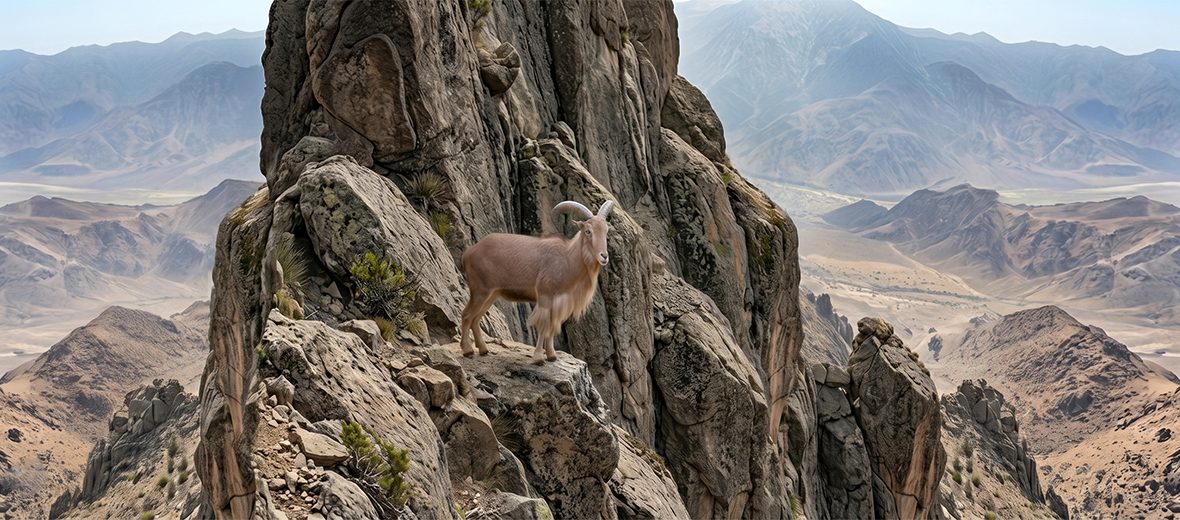
The Barbary sheep, aka aoudad, mouflon, waddan, or arwi (in the Berber languages), hails from Africa but has been introduced to North America and Europe. They face the threats of habitat loss and destruction at the hands of farming, ranching, logging, and wood collection. Poaching for meat and leather is another issue they face. Invasive species, in the form of domesticated farm animals like sheep, goats, and cattle outcompete these sheep for food. Finally, severe droughts brought on by climate change dry up available water holes. The IUCN lists these critters as Vulnerable. Their population trend is listed as decreasing.
First the Stats…
Scientific name: Ammotragus lervia
Weight: Up to 320 lbs.
Length: Up to 5 feet
Height: Up to 3.7 feet
Lifespan: Up to 20 years
Now on to the Facts!
1.) Their horns can grow to over 30 inches long.
2.) Besides the other locales these sheep have also been introduced to La Palma (in the Canary Islands), and have spread throughout the northern and central parts of the island, where they have become a serious threat to the endemic vegetation.
3.) During the winter of 1957 – 1958, 42 individuals were released in the Palo Duro Canyon in Texas for the sole purpose of attracting hunters to the region.
4.) Even though they have not yet been officially recorded in Australia, they are considered a pest species in Queensland, with the potential of establishing a presence in the wild.
5.) There are 6 subspecies recognized: A. l. ornata, A. l. sahariensis, A. l. blainei, A. l. angusi, A. l. fassini, and A. l. lervia.
But wait, there’s more on the Barbary sheep!
6.) These sheep prefer to dwell among mountainous regions.
7.) They graze and browse on bushes, grasses, and lichens.
Did you know…?
These critters can obtain a standing jump of up to 7 feet!
8.) Even though they can obtain all their needed moisture from the foods they eat, if standing water is happened upon, they will drink and wallow in it.
9.) These ungulates are crepuscular (active at dawn and dusk).
10.) There are only an estimated 10,000 wild individuals remaining, to date.
But wait, there’s still more on the Barbary sheep!
11.) Once hunted only by leopards, lions, and caracals, now they are also hunted by feral dogs and humans.
12.) Their binomial name Ammotragus lervia hails from the Greek ἄμμος ámmos (meaning “sand”, referring to their sand-colored coat) and τράγος trágos (meaning “goat”).
13.) Females undergo up to a 160 day gestation (pregnancy) that yields a single lamb.
14.) While weaned at up to 4 months of age, lambs typically begin eating vegetation at just 2 weeks old.
Now a Short Barbary Sheep Video!
Be sure to share & comment below! Also, check out the Critter Science YouTube channel. Videos added regularly. Be sure to like and subscribe!

Want to suggest a critter for me to write about? Let me know here.
Some source material acquired from: Wikipedia & IUCN