
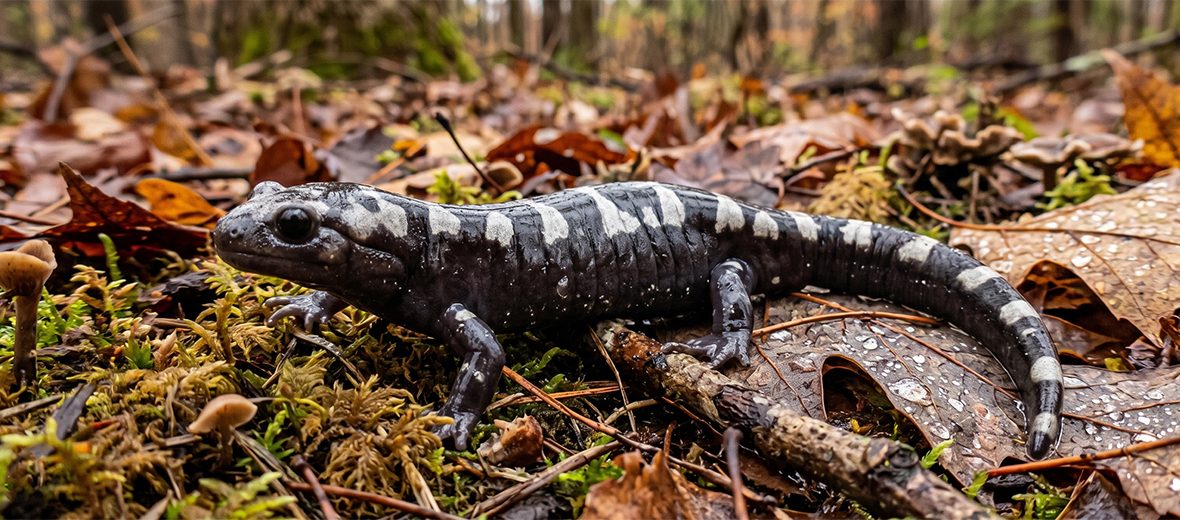
The marbled salamander is a species of mole salamander that is found throughout the eastern half of the United States. Unfortunately, these salamanders face the threats of habitat loss and destruction at the hands of residential and commercial developments, farming, ranching, and logging (which destroys their forests). Roads and railroads not only divide their territory, they also can cause vehicle strike )being hit by vehicles). Many of these sites have become more and more isolated, and could eventually result in detrimental levels of inbreeding and reduced chances of re-establishment for locally depleted subpopulations. However, despite these challenges, these salamanders are still listed as Least Concern by the IUCN. Their population trend is listed as stable as well.
First the Stats…
Scientific name: Ambystoma opacum
Weight: Up to .53 ounce
Length: Up to 4.3 inches, including their tail
Lifespan: Up to 12 years
Now on to the Facts!
1.) Their preferred habitats are damp woodlands, forests, and locations with soft, wet soil.
2.) Not being adept at burrowing, they rely on existing burrows with which to reside within instead.
3.) Protecting various wetlands is paramount to the survival of these salamanders. Conservationists recommend leaving a buffer zone of forested areas around various wetlands to improve survivorship of these salamanders.
4.) Males typically have a better rate of survival than females.
5.) In the northern portions of their range, these sallies undergo torpor (a hibernation state some amphibians partake in that is meant to avoid the colder winter months).
But wait, there’s more on the marbled salamander!
6.) These salamanders hatch early and, in the southern portions of their range, will metamorphose quickly (sometimes in as little as 2 months, compared to their nothern cousins). This gives them an advantage over some other salamanders.
7.) Like most salamanders and nearly all mole salamanders, they are mostly fossorial, spending most of their time in burrows or under logs, stones, and leaf litter.
Did you know…?
They are the state salamander of North Carolina.
8.) Females have clutches of up to 200 eggs. She will also stay with her eggs till the nest floods.
9.) The female will wrap her body around the eggs to form a bowl shape in order to retain water over the eggs. Water needs to make extended contact with the eggs in order for them to begin the hatching process.
10.) That being said, if disturbed, the female will abandon her eggs if threatened by a predator or otherwise bothered.
But wait, there’s still more on the marbled salamander!
11.) Even though most of these salamanders will return to their place of birth to lay eggs, some have been documented traveling nearly 2 miles away.
12.) Due to this dispersal, this means that it’s important to see these populations as a larger metapopulation rather than focusing simply on a single wetland area. A metapopulation consists of a group of spatially separated populations of the same species which interact, or meet up, at some point.
Did you know…?
These salamanders have been found to display prominent biofluorescence under ultraviolet light along the bones in their digits and the cloacal (rectum) region of both males and females. They also have mucus-like secretions that fluoresce green as well.
13.) The larvae are typically positively phototactic until fully developing their rear legs. Then they switch behaviors and become negatively phototactic. Positively phototactic means they move towards the light–like a moth–and negatively phototactic means they move away from light.
14.) Adults feed on worms, insects, centipedes, various other arthropods, snails, slugs, and other salamanders such as spotted salamanders. Larvae feed on zooplankton, and copepods, but larger ones will eat crustaceans like brine shrimp, aquatic insects, snails, worms, and eggs & larvae of other amphibians.
15.) If threatened, they are capable of caudal autonomy (they can drop their tail). They also have the ability to produce noxious chemicals from glands at the base of their tail. These toxins are a noxious, milky secretion excreted from granular glands and can cause irritation or illness if ingested by animals.
Now a Short Marbled Salamander Video!
Be sure to share & comment below! Also, check out the Critter Science YouTube channel. Videos added regularly. Be sure to like and subscribe!

Want to suggest a critter for me to write about? Let me know here.
Some source material acquired from: Wikipedia & IUCN

Leave a Reply