
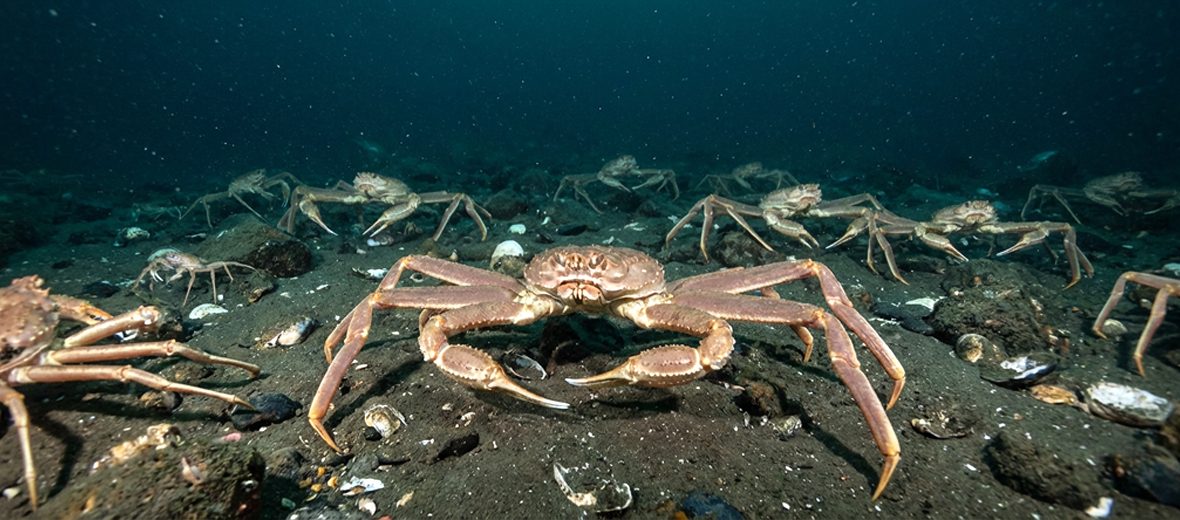
The snow crab, aka queen crab or spider crab, dwells as far north as the Arctic Ocean and as far south as California. These crustaceans face the threats of overfishing and over harvesting, climate change, that causes warming ocean temperatures, a faster metabolism, and lack of available food. The parasitic infection (parasite Hematodinium) which affects all sizes of crabs, killing them within 1 – 1.5 years and rendering them sickly and unmarketable. Plus, long-term exposure to reduced pH has also been shown to reduce the survival rates of juveniles. However, these crabs remain abundant, for now, and are not currently evaluated by the IUCN. Their population trend is listed as volatile. In some locales their numbers are decreasing. In others, they are increasing.
First the Stats…
Scientific name: Chionoecetes opilio
Weight: Up to 2.5 lbs.
Length: Up to 6.5 inches, plus up to a 39 inch leg span
Lifespan: Up to 20 years
Now on to the Facts!
1.) The generic name Chionoecetes means snow inhabitant.
2.) The Bering Sea population experienced a catastrophic decline, dropping approximately 84% from 11.7 billion in 2018 to 1.9 billion in 2022. This led to the first-ever closure of the Alaska snow crab season in 2022-2023.
3.) Scientists believe this collapse was driven by a marine heatwave that increased metabolic demand and caused starvation, rather than their decline being from overfishing.
4.) There are 7 known subspecies of these crabs: Chionoecetes angulatus, Chionoecetes bairdi, Chionoecetes elongatus, Chionoecetes japonicus, Chionoecetes pacificus, Chionoecetes tanneri, and Chionoecetes opilio.
5.) These crabs are prepared and eaten as a dish in many different styles the world over.
But wait, there’s more on the snow crab!
6.) Other crustaceans, bivalves, brittle stars, polychaetes, phytobenthos, foraminiferans, annelid worms, and mollusks are all on the menu.
7.) In turn they are preyed on by halibut, cod, larger snow crabs, seals, squid, and Alaskan king crabs.
Did you know…?
The crab industry brings in up to $160,000,000 annually.
8.) Females undergo up to a 2-year gestation (pregnancy) and lay up to 100,000 eggs each season.
9.) While there is no single cause for their decline in certain areas, some theories suggest warmer water temperatures, brought on by climate change, that speeds up their metabolism and drives away their food sources, causing them to either starve or eat one another, and overfishing is the second largest driver of declining populations.
10.) It’s unknown whether the Bering Sea snow crab populations will ever recover, but scientists and policymakers will have to act fast if improvement is to occur.
Now a Short Snow Crab Video!
Be sure to share & comment below! Also, check out the Critter Science YouTube channel. Videos added regularly. Be sure to like and subscribe!

Want to suggest a critter for me to write about? Let me know here.
Some source material acquired from: Wikipedia & IUCN

Leave a Reply