
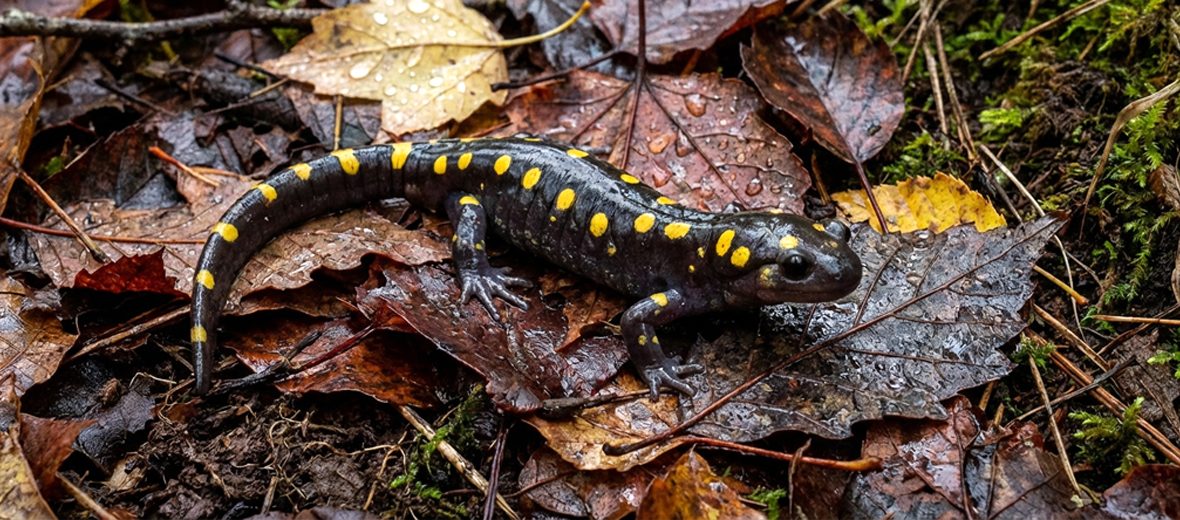
The spotted salamander, aka yellow-spotted salamander, is a species of mole salamander that hails from eastern Canada and eastern United States. These salamanders face the threats of habitat loss and destruction at the hands of deforestation from the logging industry; roads and railroads that divide their territory and can result in vehicle strike (being hit by vehicles); water pollution; air pollution; land pollution; and, as a result of diminishing habitats and subsequent vernal pools, inbreeding. This thins out their blood line and can cause low birth rate and infertility. However, despite all this, they are still abundant enough to be listed as Least Concern by the IUCN. Their population trend is currently listed as stable.
First the Stats…
Scientific name: Ambystoma maculatum
Weight: Up to .6 ounce
Length: Up to 9.8 inches, including their tail
Lifespan: Up to 30 years
Now on to the Facts!
1.) Sexual dimorphism exists in these salamanders in that females are larger and have brighter spots.
2.) Their scientific name Ambystoma hails from amblys (Greek) for blunt; -stoma (Greek) meaning mouth; or anabystoma (New Latin) meaning “to cram into the mouth”; and maculatum – macula (Latin) meaning spot; or maculosus (Latin) for spotted.
3.) They prefer mature forests with a wide availability of ponds or ephemeral vernal pools that are used for breeding sites.
4.) Being fossorial, they spend a majority of their time residing in the burrows of other animals.
5.) During the winter, they brumate (a kind of hibernation) underground till March – May.
But wait, there’s more on the spotted salamander!
6.) In North Amherst, Massachusetts, U.S. these salamanders make the harrowing trek across Henry Street to get to their breeding pools. In an effort to help them cross the road officials built tunnels called Henry Street salamander tunnels that run under the road, so they can cross withouth fear of death.
7.) Several defenses are deployed against predators. They can undergo caudal autonomy (drop their tail), and they also secrete a poison from glands located in their back and neck. Camouflage is also employed.
Did you know…?
Their embryos have been discovered to have symbiotic algae (Chlorococcum amblystomatis) living in and around their bodies, they are the only known example of vertebrate cells hosting an endosymbiont microbe.
8.) If a predator manages to dismember a leg, their tail, or even parts of their brain, head, or organs, these salamanders can grow back all new parts, although this takes an incredible amount of energy. The new parts are almost completely indistinguishable from the originals. This is similar to the axolotl, but not quite as thorough.
9.) Landmark learning and use of geotaxis is relied upon to get from their burrow(s) to their breeding pool(s). Geotaxis is the innate behavioral movement or orientation of an animal in response to gravity.
10.) Earthworms, slugs, snails, spiders, millipedes, centipedes, insects, other invertebrates, and algae are all on the menu. Larger salamanders will also cannibalize smaller ones if food is scarce.
But wait, there’s still more on the spotter salamander!
11.) Females lay up to 300 eggs in a gelatinous mass in water. These eggs hatch in up to 60 days.
12.) Photosynthetic algae are present inside the egg capsules of the developing salamander embryos, which enhances growth. However, the widely used herbicide, atrazine, has been found to dramatically lower hatching success rates by eliminating the symbiotic algae associated with the egg masses.
13.) Raccoons, skunks, turtles, snakes, and sometimes salmonoid fish all prey on these salamanders.
Now a Short Spotted Salamander Video!
Be sure to share & comment below! Also, check out the Critter Science YouTube channel. Videos added regularly. Be sure to like and subscribe!

Want to suggest a critter for me to write about? Let me know here.
Some source material acquired from: Wikipedia & IUCN

Leave a Reply