
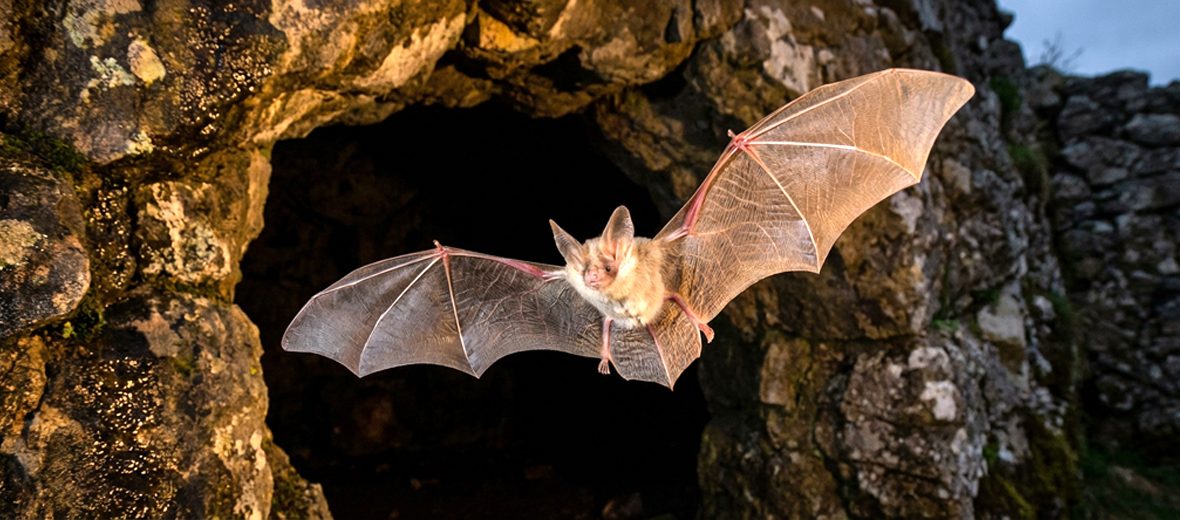
The ghost bat is the only Australian species of bat that preys on larger vertebrates, like rats, mice, birds, frogs, lizards, and microbats. These bats face the threats of habitat loss and destruction at the hands of farming, ranching, mining, and quarrying; hunting; trapping; human disturbances, seeing as they are very easily disturbed by passers by and will fly away (even during the day) and can then be preyed on by raptors; and invasive species, like the cane toad (of which they are highly susceptible to their poison. The IUCN lists these bats as Vulnerable. Their population trend is listed as decreasing as well.
First the Stats…
Scientific name: Macroderma gigas
Weight: Up to 5.1 ounces
Length: Up to 4.7 inches
Wingspan: Up to 2 feet
Lifespan: Up to 20 years
Now on to the Facts!
1.) George Dobson is credited with first scientifically describing these bats in 1880, publishing his findings after examining specimens from the Göttingen Museum, Gerard Krefft had seen and documented them in 1879, and Robert Austin even earlier in 1854.
2.) Like so many other nocturnal (active at night) bats, they utilize echolocation to assist in not only finding prey but in finding their way around at night.
3.) They have large eyes that also assist them in nighttime navigation.
4.) These bats are known for their unique hunting behavior, which includes ambushing prey from perches and utilizing their powerful jaws to capture and consume various prey types.
5.) Their primary call is a ‘dirrup dirrup’ sound that resembles that of a fairy wren. The juvenile bats make a continual twittering sound as they call to their mother for food.
But wait, there’s more on the ghost bat!
6.) Pregnant females have 2 sets of teats, 1 pair beneath the armpits provide milk from the mammary glands and another pair at the pubic area. The pubic teats do not produce milk, instead they act as perching points for the new-born to be carried in flight by the mother.
7.) Females undergo up to a 3+ month gestation (pregnancy) that yields a single pup.
Did you know…?
Throughout their patchy range there are only an estimated 6,000 individuals remaining.
8.) Hunting occurs via a ‘sit and wait’ technique while they’re suspended from a tree or other vegetation. Their large ears allow these bats to hear prey moving on the ground.
9.) Field observations at Pine Creek using nightscope equipment reported seeing these bats suspended from a tree and dropping to catch large locusts detected moving through grass at up to 65.66 feet distances.
10.) Once located, a prey animal is held down via the thumb claws and killed via a single bite to the neck. The prey is killed on the ground or on the wing (in mid flight), and taken to a perch to be consumed, at an overhanging rock or smaller cave.
But wait, there’s still more on the ghost bat!
11.) They prefer to dwell in and among habitats with caves, old mines, rock crevices, and sometimes large trees (primarily palms).
12.) The continuing advance of the cane toad is highly implicated as the cause of these bat’s rapid decline. Any place where the cane toad exists, the bats are not present.
Did you know…?
While not nearly as fast as a free-tailed bat, these critters are designed more for stealth than speed.
13.) A new species of parasite, the tick Argas macrodermae, was discovered on several specimens of ghost bats, but as a microchiropteran they’re usually quite free of external parasitic organisms.
14.) Feral cats, foxes, pythons, birds of prey, quolls, and large frogs are all known to prey on these bats.
15.) Barbed wire fencing poses a great threat to these critters as they become easily entangled in the barbs, that tear their wings; rendering them unable to fly.
Now a Short Ghost Bat Video!
Be sure to share & comment below! Also, check out the Critter Science YouTube channel. Videos added regularly. Be sure to like and subscribe!

Want to suggest a critter for me to write about? Let me know here.
Some source material acquired from: Wikipedia & IUCN

Leave a Reply