
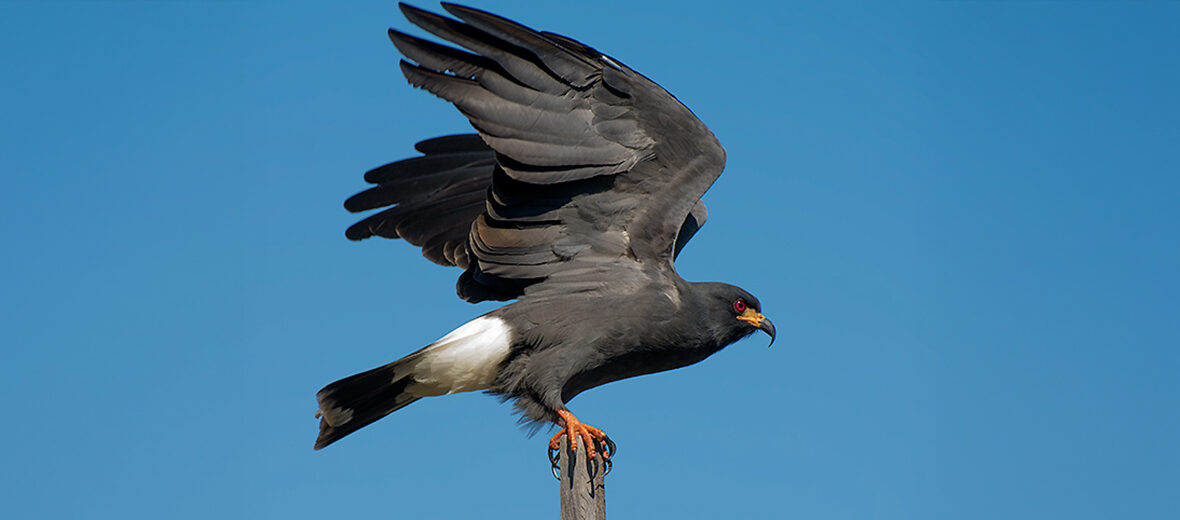
The snail kite is a species of raptor that hails from South America, Central America, the Caribbean, and Florida. They face the threats of habitat loss and destruction at the hands of drainage and development, which affects nesting and foraging; changes in water levels, which can cause nest collapse or make them vulnerable to predators; poor water quality from agricultural and urban runoff; and human disturbance, like harassment near nesting sites. However, they are abundant enough to be listed as Least Concern by the IUCN. Their population trend is listed as stable.
First the Stats…
Scientific name: Rostrhamus sociabilis
Weight: Up to 20 ounces
Length: Up to 19 inches
Wingspan: Up to 47 inches
Lifespan: Up to 24 years
Now on to the Facts!
1.) These raptors can reach flight speeds of up to 28 mph.
2.) French ornithologist Louis Jean Pierre Vieillot first described the snail kite in 1817.
3.) They are sedentary birds that only migrate north for the winter in the southern-most regions of South America.
4.) Due to the drainage & habitat loss and destruction of the Everglades, these birds were 1 of the first species put on the US Fish and Wildlife Service’s endangered species list on March 11, 1967.
5.) These birds feast almost exclusively on apple snails. However, they will also eat other snail species, as well as crayfish, small snakes, small turtles, and carrion (dead animals).
But wait, there’s more on the snail kite!
6.) Nesting takes place in bushes or directly on the ground.
7.) Females lay up to 4 eggs that hatch in up to 30 days.
Did you know…?
There are approximately 2,000,000 wild individuals existing, to date.
8.) Both parents participate in incubating the eggs and nurturing their young.
9.) With the introduction of the large, Pomacea maculata (a larger species of apple snail) in Florida the individuals there developed larger bodies and beaks to better eat said snails. This is a case of rapid evolution.
10.) They are preyed on (based on their range) Burmese pythons, reticulated pythons, African rock pythons, green anacondas, and yellow anacondas. Raccoons and skunks also prey on their eggs.
Now a Short Snail Kite Video!
Be sure to share & comment below! Also, check out the Critter Science YouTube channel. Videos added regularly!

Want to suggest a critter for me to write about? Let me know here.
Some source material acquired from: Wikipedia & IUCN
Photo credit: Dario Sanches