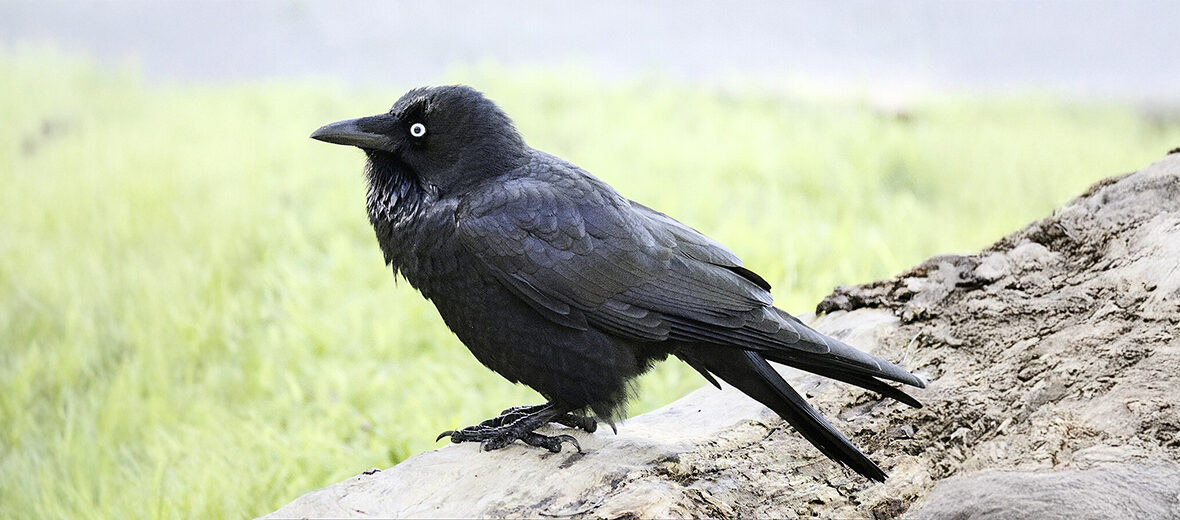
The little raven hails from southeastern Australia. As is the case with all Australian species of Corvus, the black feathers have a grey base. Their iris is also white on the adult birds. These birds face the threats of habitat loss; persecution as they are often seen as a pest of agricultural crops; poisoning; shooting; trapping; and they are also at risk of consuming human garbage. However, they are abundant enough to be listed as Least Concern by the IUCN. Their population trend is listed as increasing. This article is dedicated to my friend, Raven.
First the Stats…
Scientific name: Corvus mellori
Weight: Up to 1.5 lbs.
Length: Up to 19.69 inches
Wingspan: Up to 39 inches
Lifespan: Up to 20 years
Now on to the Facts!
1.) Gregory Mathews first described the little raven in 1912. Although named early in the 20th century, this species was only recognized as distinct from the Australian raven in 1967.
2.) Eye color changes with age: nestlings up to 3 months old have blue-grey eyes, juveniles aged from 3 – 11 months have brown eyes, and immature birds have hazel eyes with blue eye-rings around the pupil until age 1 year and eleven months. The eyes then turn white when they mature into adults.
3.) Their call is a harsh, guttural “ark-ark-ark-arrk” or “kar-kar-kar-karrr”.
4.) They prefer habitats with scrub brush, agricultural areas, grazing pastures, woodlands, treeless plains, coasts, and suburbs.
5.) The nest is a thin cup of sticks with a layer of bark, grass and wool to create a thick mat, and are built up to 33 feet in taller trees.
But wait, there’s more on the little raven!
6.) Females lay up to 6 eggs that hatch in up to 20 days.
7.) Chicks leave the nest in up to 41 days.
Did you know…?
Like all corvids, these ravens are capable of vocal mimicry, but this mimicry is mostly recorded in captivity and very rarely in the wild. That’s correct, they can recreate sounds like a parrot.
8.) Centipedes (which ravens behead before eating), cicadas, caterpillars, grasshoppers, millipedes, spiders, carrion, and human refuse are all consumed; along with the occasional crop delicacy.
9.) These ravens have also been observed preying on fairy penguin nests on Phillip Island.
10.) Little ravens are diurnal (active during the day).
Now a Short Little Raven Video!
Be sure to share & comment below! Also, check out the Critter Science YouTube channel. Videos added regularly!

Want to suggest a critter for me to write about? Let me know here.
Some source material acquired from: Wikipedia & IUCN
Photo credit: Thomas Jaeger

Leave a Reply