
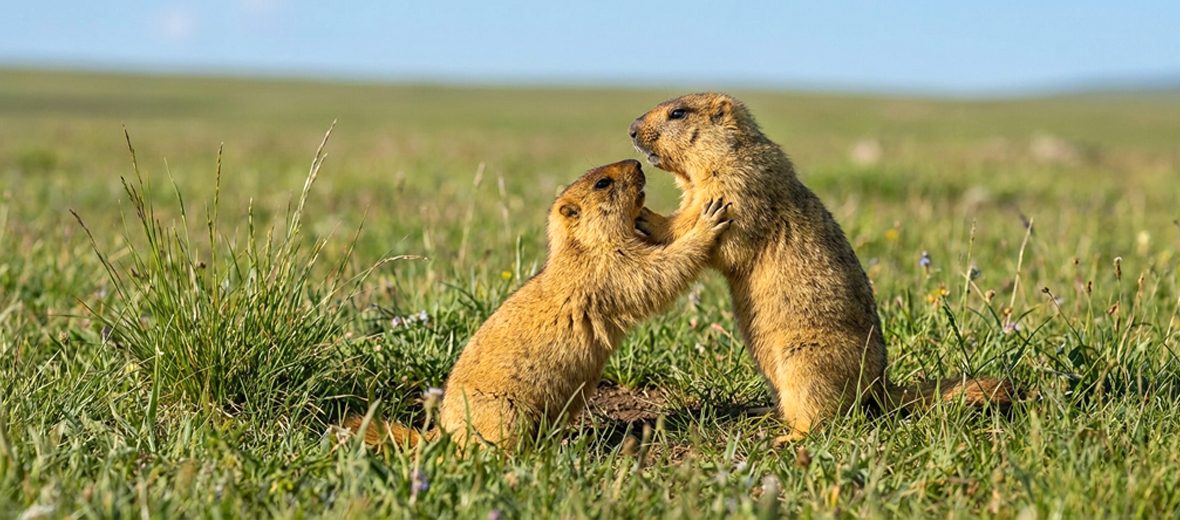
The Himalayan marmot dwells in the alpine grasslands throughout the Himalayas and on the Tibetan Plateau as well. They can be found in China, India, Nepal, and Pakistan. These rodents face the threats of human disturbance in the form of tourism, and with it being fed by humans, which interrupts their natural feeding cycle; roads and railroads, which can cause habitat division and results in vehicle strike (being hit by vehicles); being natural hosts of Yersinia pestis (the plague bacterium) these rodents can also succumb to the plague (that’s right, the actual black plague); feral dogs, that can yield undue amounts of predation; hunting, for food and traditional medicine; and climate change, that can cause a lack of snow cover, which insulates their burrows and can result in freezing and premature waking from hibernation. However, despite these challenges, they are listed as Least Concern by the IUCN. Their population trend is listed as stable and increasing.
First the Stats…
Scientific name: Marmota himalayana
Weight: Up to 20.3 lbs.
Length: Up to 28 inches, plus up to a 5.9 inch tail
Lifespan: Up to 17 years
Now on to the Facts!
1.) These marmots were first described by British naturalist and ethnologist Brian Houghton Hodgson in 1841.
2.) They are among the largest marmots in the world, with the Olympic marmot being number 1.
3.) Himalayan marmots can be seen at elevations of up to 18,000.
4.) Short grass steppes and/or alpine habitats, typically above the tree line, but below the permanent snow line are preferred.
5.) Hibernation occurs from late autumn to early spring; lasting, on average for 7.5 months.
But wait, there’s more on the Himalayan marmot!
6.) Marmot colonies can comprise up to 30 families of up to 30 individuals per family!
7.) They prefer to graze on the softer parts of grassy plant species such as Carex, Agrostis, Deschampsia, Koeleria; & flowering species like Euphrasia, Gentiana, Halenia, Iris potaninii, Polygonum, Primula, Ranunculus, Saussurea, and Taraxacum.
Did you know…?
Burrows can be up to 32 feet deep!
8.) Much to their eventual dismay, these critters love to interact with humans who feed them. However, this leads to the loss of instinctual behaviors, such as searching for food, which can bring about starvation. This also opens them up for predation from invasive and natural predators.
9.) Females (aka a madness) undergo up to a 1-month gestation (pregnancy) that yields up to 11 pups.
10.) Tibetan wolves, red foxes, golden eagles, and snow leopards are their natural predators.
11.) These rodents are diurnal (active during the day).
Now a Short Himalayan Marmot Video!
Be sure to share & comment below! Also, check out the Critter Science YouTube channel. Videos added regularly!

Want to suggest a critter for me to write about? Let me know here.
Some source material acquired from: Wikipedia & IUCN



Leave a Reply