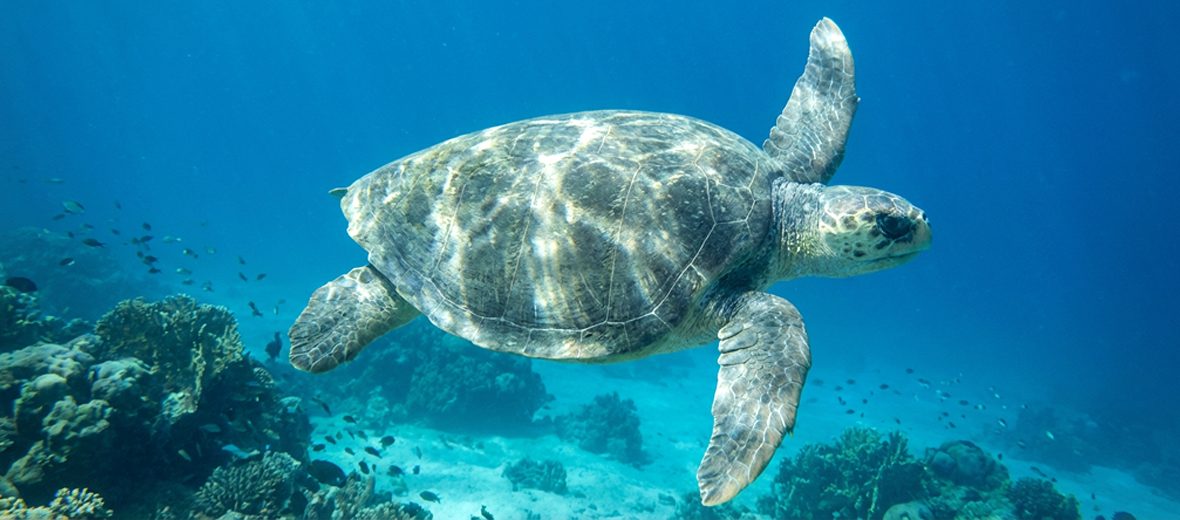
The flatback sea turtle, aka Australian flatback sea turtle, is the only sea turtle listed as Data Deficient by the IUCN. These turtles hail from northern Australia, Papua New Guinea, and Indonesia. They face the threats of habitat loss and destruction at the hands of residential and commercial developments; over-collection of their eggs; getting caught in long lines and fishing nets; pollution, that can introduce plastic bags and other trash into the water that can be mistaken as food; and microplastics pollution, which is obtained from the animals they eat. Their population trend is listed as unknown at this time.
First the Stats…
Scientific name: Natator depressus
Weight: Up to 200+ lbs.
Length: Up to 38 inches
Lifespan: Up to 100+ years
Now on to the Facts!
1.) These sea turtles were first described by American herpetologist Samuel Garman in 1880.
2.) They are the sole species in the Natator genus, with no subspecies denoted.
3.) Their name comes from their smooth, flat-domed carapace.
4.) Flatbacks reside in waters of no more than 200 foot depths.
5.) While technically omnivorous (eats plant and animal matter), they tend to be more carnivorous (eat meat). Their diet consists of soft corals, sea cucumbers, jellyfish, shrimp, mollusks, and other invertebrates. But sea grass is sometimes grazed on.
But wait, there’s more on the flatback sea turtle!
6.) They are faced with aerial, terrestrial, and aquatic predators. On land, the hatchlings are preyed on by dingos, red foxes, feral dogs, and feral pigs. At sea juveniles face crabs, while adults face off with sharks and saltwater crocodiles. Seabirds also prey on the hatchlings on land and at sea.
7.) The female mates every 2 – 3 years. Mating takes place at sea, meaning that the males never return to shore again.
Did you know…?
Hatchlings come into the world with grey backs, dark outlined scutes, a white belly, and blue eyes.
8.) Females lay up to 50 eggs per clutch, at up to 3 clutches per season.
9.) Eggs hatch in up to 55 days, and it takes up to 3 days to dig their way up to the surface of the nest.
10.) Temperature dictates the turtle’s gender, just as it does in all turtles. If the temperature is below 84°F the yield will consist of males, if the temperature is higher than 84°F the clutch will produce females.
But wait, there’s still more on the flatback sea turtle!
11.) They are the least endangered of all of the sea turtles.
12.) In Kakadu National Park, a monitoring program has been set up for these turtles.
Now a Short Flatback Sea Turtle Video!
Be sure to share & comment below! Also, check out the Critter Science YouTube channel. Videos added regularly!

Want to suggest a critter for me to write about? Let me know here.
Some source material acquired from: Wikpedia & IUCN