
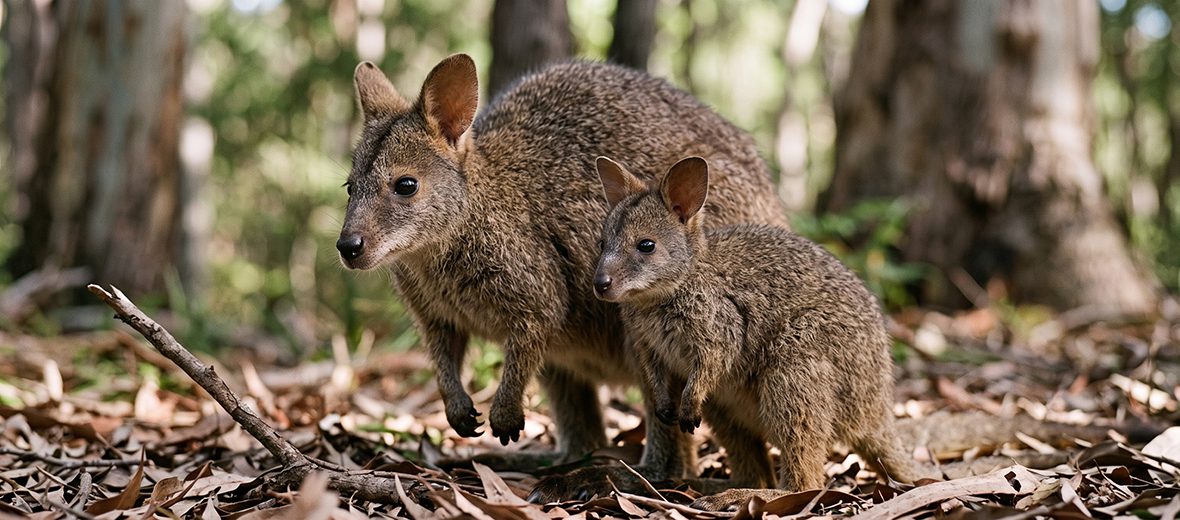
The parma wallaby hails from northeastern New South Wales, Australia, near the border with Queensland. They’ve also been introduced to Kawau Island in New Zealand. The land clearing and habitat loss has been reduced since European colonization by land clearing for agriculture, urban development and logging. Some land clearing continues, though at reduced levels. 43% of the known range occurs in conservation reserves, and thus protected from clearing. Just over half the range of these critters is among State Forests or private forests used for timber production. Forestry activities that involve thinning or vegetation removal are very likely to reduce the quality of habitat for them. They are also susceptible to the effects of forest fires because, apart from killing some animals directly, fire removes much of the dense understory vegetation that they require for shelter. Fires that are too intense and/or that recur too frequently prevent the re-development of habitat for these wallabies. Finally, climate change is expected to cause increases in temperature, incidence and severity of drought, and of wildfires, with ‘serious’ consequences. These threats put the parma wallaby at a Vulnerable status with the IUCN. Their population trend is listed as decreasing as well.
First the Stats…
Scientific name: Notamacropus parma
Weight: Up to 13 lbs.
Length: Up to 21.4 inches, plus up to a 21.6 inch tail
Lifespan: Up to 15 years
Now on to the Facts!
1.) These wallabies, like others, are also threatened by predation from the red fox and feral cats, which are an invasive species.
2.) Being both shy and elusive, they were thought to be extinct until their rediscovery in the 1960s.
3.) Birds of prey, dingoes, monitor lizards, and snakes are all natural predators of these wallabies.
4.) They were first described by British naturalist and bird artist John Gould in circa 1840.
5.) Their epithet parma hails from a word from a New South Wales Aboriginal language, however the exact source of the word and language have not yet been identified.
But wait, there’s more on the parma wallaby!
6.) These critters are the smallest member of the genus Notamacropus (marsupials in the family Macropodidae, commonly known as wallabies).
7.) In 1965, workers on Kawau Island, New Zealand (near Auckland), trying to control a plague of introduced tammar wallabies, were amazed to discover that some of the wallabies were not truly tammars, but a magnificently surviving population of parma wallabies–a species long-thought extinct.
Did you know…?
There are only an estimated 8,000 wild individuals remaining, to date.
8.) In 1967 it was found that they still existed in the forests near Gosford, New South Wales. Continued investigations showed that they were alive and well, and even though uncommon, they were found in forests along the Great Dividing Range from near Gosford & nearly at the Queensland border.
9.) The Kawau Island populations are smaller than their Australian relatives, even when provided with ample food. This is due to competition, for limited food resources on the island, which selects for smaller individuals, an example of the evolutionary phenomenon of insular dwarfism.
10.) Their preferred habitats are wet sclerophyll (hard-leaved) forests, thick undergrowths, and grassy patches, however, these wallabies are also sometimes found among dry eucalypt forests and even rainforests.
But wait, there’s still more on the parma wallaby!
11.) These wallabies are mostly nocturnal (active at night).
12.) Grasses, herbs, and sedges make up their diet.
13.) Females undergo up to a 36 day gestation (pregnancy) that yields a single joey.
14.) The joey is incredibly small, weighing in at just .018 ounce! They continue their development in mom’s marsupium (pouch) for an additional 40 weeks before being weened and leaving to start life on their own.
Now a Short Parma Wallaby Video!
Be sure to share & comment below! Also, check out the Critter Science YouTube channel. Videos added regularly. Be sure to like and subscribe!

Want to suggest a critter for me to write about? Let me know here.
Some source material acquired from: Wikipedia & IUCN

Leave a Reply