Critter Science
  • Ecology
    • Animal Conservation
      • Apex Awakening
      • CITES: Protecting Wildlife
      • Dame Jane Goodall
      • Endangered Animals
      • Ex Situ Explained
      • In Situ Explained
      • IUCN Statuses
      • Steve Irwin
      • Zoological Branches
    • Animal Immortality and Regeneration
    • Chromatophores and Survival
    • Ecosystems
      • Animal Habitats
      • The Biomes
      • Coastal Erosion
      • Desert Biomes
      • Deserts and Wildlife
      • Earth’s Living Canopies
      • Ocean Habitats: Layers and Life
      • Rainforest Types
    • Evolution. The Facts.
      • Animal Devolution
      • Animal Mimicry
      • Convergent Evolution
      • Carl Linnaeus
      • Charles Darwin
      • Evolution of Amphibians
      • Evolution of Birds
      • Genetic Drift in the Animal Kingdom
      • Naturalism
      • Natural Selection
    • Genetic Pollution
      • Genetic Bottlenecks in Animal Populations
    • Invertebrate Families Explored
      • Arthropod Diversity and Adaptations
      • Cephalopod Consciousness
      • Insect vs Bug
      • The Wonder and Warfare of Coral Reefs
      • What are Arachnids?
        • Spider Webs
    • Predator vs Prey
    • Producers and Consumers
    • Venom vs Poison
    • Vertebrate Families Explored
      • Amphibians: Unseen Guardians
      • Bone and Cartilage
      • Snakes vs Legless Lizards
      • The Triumph of the Ratites
      • What is a Marsupial?
    • The Wild Apothecary
  • Zoology
    • Sustainability
      • Climate Change
      • Earth Day: Past, Present, Future
      • Global Warming
      • Pollution
        • Air Pollution
        • Chemical Pollution
        • Land Pollution
        • Light Pollution
        • Microplastics Pollution
        • Noise Pollution
        • Water Pollution
      • Recycling
        • Recycling Plastics
      • Renewable Energy
    • Animal Behavioral Patterns
      • Aposematic Coloration
      • Avian Communication
      • Animal Thermoregulation
      • Beyond DNA: The Animal Accent
      • Cetacean Communication
      • Cold-Adapted Hypermetabolism
      • Elephant Communication
      • Herpetofauna Communication
      • Primate Language: The Debate
      • The Framework of Ethology
      • The Hidden Sensory Realm
      • Types of Animal Dormancy
    • What are Species?
      • Animal Reproduction
      • Introduced Species
      • Invasive Species
      • John Edward Gray
      • John Gould
      • Keystone Species
      • Lazarus Species: Rediscovered Life
      • Monotypic Species
      • Speciation
      • Species Complex
      • Understanding Animal Subspecies
    • About the Critterman
  • Daily Critter Facts
    • Amphibian Facts
      • Frog Facts
      • Newt Facts
      • Salamander Facts
      • Toad Facts
    • Arthropod Facts
      • Arachnid Facts
      • Insect Facts
    • Bird Facts
      • Flightless Bird Facts
      • Predatory Bird Facts
      • Scavenger Bird Facts
      • Wading Bird Facts
    • Cryptozoology
    • Fish Facts
      • Cephalopod Facts
      • Crustacean Facts
      • Jellyfish Facts
      • Reefs
      • Shark and Ray Facts
      • Shellfish Facts
    • Flying Mammal Facts
    • Gastropod Facts
    • Land Mammal Facts
      • Canine Facts
      • Feline Facts
      • Lagomorph Facts
      • Marsupial Facts
      • Mustelid Facts
      • Primate Facts
      • Rodent Facts
      • Ungulate Facts
    • Parasite Facts
    • Reptile Facts
      • Crocodilian Facts
      • Lizard Facts
      • Snake Facts
      • Turtle Facts
    • Sea Mammal Facts
      • Dolphin Facts
      • Porpoise Facts
      • Sea Lion Facts
      • Seal Facts
      • Whale Facts
    • Worm Facts
  • For Teachers
    • Animal Quizzes
      • Amphibian Quiz
      • Bird Quiz
      • Cat Quiz
      • Dog Quiz
      • Dolphin Quiz
      • Insect Quiz
      • Reptile Quiz
    • Amphibians vs Reptiles
    • Animal Skin and Scales
      • Claws, Nails, and Talons
      • Feather Anatomy, Function, & Types
      • Fur and Hair
      • Gecko Feet
    • The Enigmatic Purr
    • Animal Word Search
    • Butterfly Metamorphosis
      • World’s Largest Butterfly
      • World’s Largest Moth
    • The Cellular Structure of an Animal
    • Coloring Pages
    • Fish and Sharks
    • Frogs vs Toads
      • Metamorphosis – A Frog’s Life Cycle
    • Tunnels and Burrows
    • The Science of Naming Animals
    • Study Guides
      • African Animals
      • Antarctica Animals
      • Asian Animals
      • Australian Animals
      • Central American Animals
      • European Animals
      • North American Animals
      • South American Animals
  • Diseases & Parasites
    • Understanding Bird Flu
    • Bsal
    • Canine Distemper Virus (CDV)
    • Chronic Wasting Disease (CWD)
    • The Deadly Chytrid Fungus
    • Plagues of the Wild: Epizootic Diseases
    • All About Parasites
      • Toxoplasmosis
    • The Rabies Virus
    • White-Nose Syndrome
  • Contact
    • Critter Identification
    • General Contact
    • Guest Article Submission
      • Guest Articles
        • Guest Articles – 2024
    • Animal Welfare Organizations
    • Privacy Policy
BUY MY BOOK
American green tree frog

The American Green Tree Frog

  • 2 September, 2026
  • Critterman
  • No Comments
  • 0 Views
  • 0 Likes
Amphibian Facts, Daily Critter Facts, Frog Facts

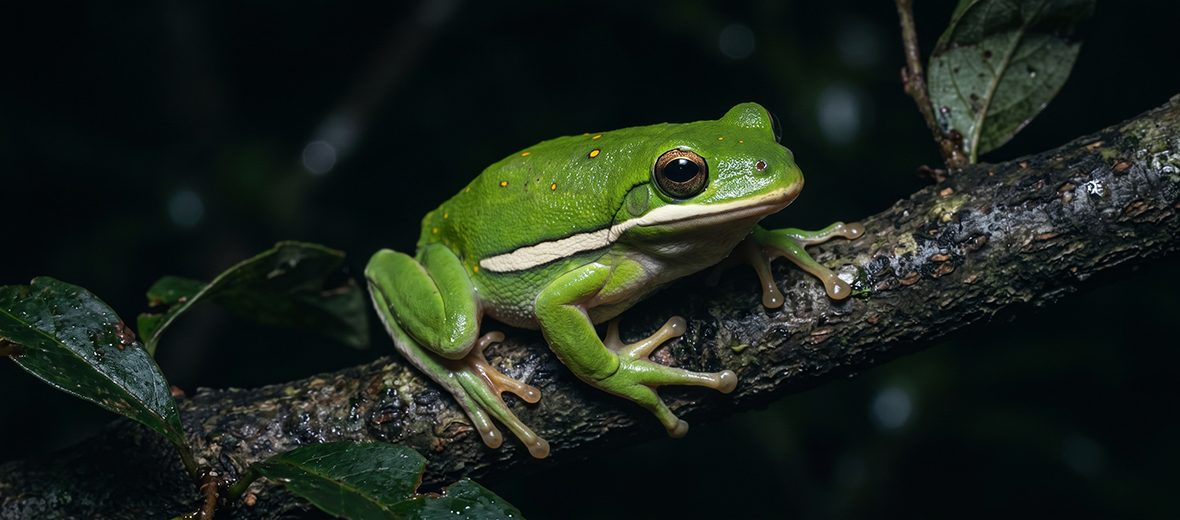
The American green tree frog is an arboreal species of New World tree frog belonging to the family Hylidae. They are usually found throughout the central and southeastern United States. These frogs face the threat of wetland destruction due to draining or altering shallow ponds, swamps, and sloughs which reduces available breeding and foraging grounds. Their permeable skin makes the tadpoles and adults highly susceptible to water pollution in the form of agricultural runoff, pesticides, and elevated salt levels in freshwater systems. Finally, light pollution disrupts their nighttime behaviors, mating call timing, and natural evening activity cycles. However, these frogs are still quite abundant and therefore listed as Least Concern by the IUCN. Their population trend is listed as stable.

First the Stats…

Scientific name: Hyla cinerea
Weight: Up to .18 ounce
Length: Up to 2.5 inches
Lifespan: Up to 6 years

Now on to the Facts!

1.) Like so many other species of frog, these critters are nocturnal (active at night).

2.) They can be bright green to reddish-brown in coloration.

3.) These frogs are often mistaken for the green frog, which also lives throughout the southeastern United States.

4.) To escape predation, they will leap into the water or scale trees.

5.) Like most frog species, they are sexually dimorphic in that females are larger than males. This is an evolutionary adaptation that allows the female to be able to carry the male on her back while in amplexus (their mating position).

But wait, there’s more on the American green tree frog!

6.) During the mating competitions, the males will listen in on neighboring rival males and either adjust the timing of their signal or remain silent to intercept call signals and mate with approaching females.

7.) Females can have up to 400 eggs per clutch and produce multiple clutches each season, totalling up to 1,000 eggs. The eggs hatch into tadpoles in up to 14 days. The tadpoles metamorphose into adults in up to 63 days.

Did you know…?
Frogs respirate (breathe) in part through their skin. They also don’t drink standing water, but rather absorb water through their permeable skin.

8.) The male’s call is a loud, rhythmic, and nasal “queenk… queenk… queenk”. It is said to resemble an abrupt honk, a mechanical bark, or the ringing of a distant cowbell.

9.) Their preferred habitats are moist, open-canopies near permanent or semi-permanent fresh water sources like ponds, marshes, lakes, and swamps.

10.) Seeing as the majority of amphibians have narrow habitat tolerances and migration constraints, these tree frogs desperately need alternative shelters for survival as forest canopies recover from fires and destruction from residential and commercial developments.

But wait, there’s still more on the American green tree frog!

11.) Ants, beetles, crickets, cockroaches, flies, grasshoppers, mosquitoes, spiders, and other small invertebrates are all on the menu.

12.) In a study, it was found that frogs find prey more appealing when it moves more than when it stays still. The more it wiggles, the tastier it must be.

13.) While in captivity, these nervous and easily frightened frogs often do not do well with frequent handling. Some specimens do seem to tolerate it on occasions, but handling frequency should be determined on an individual basis.

14.) Their loud choruses can be heard from up to 2 miles away!

Now a Short American Green Tree Frog Video!

Be sure to share & comment below! Also, check out the Critter Science YouTube channel. Videos added regularly. Be sure to like and subscribe!

Subscribe


Want to suggest a critter for me to write about? Let me know here.

Some source material acquired from: Wikipedia & IUCN

Trending
The Saddle-Billed Stork

American green tree frogamphibiansfrogfrogsnorth americatree frogtree frogstreefrogUnited States
Critterman

With over 51 years of critter experience to my credit and hundreds of zoology teaching hours to people around the world, I have amassed not only a continuing thirst for critter knowledge but a desire to teach others all I can about the majesty and wonder of our natural world. Critter Science is a culmination of such knowledge. I have hands on as well as book acquired intel on all kinds of critters. Whether they're on land, sea, or in the air. I will never say that I know everything about all animals. That's impossible, even for a savant. But, that being said, ask me any animal question and I'll answer it. If I don't know the answer, I'll get an answer for you!

The Potter Wasp
Related Posts
  • potter wasp
    The Potter Wasp 1 September, 2026
  • pale field rat
    The Pale Field Rat 31 August, 2026
  • sea scallop
    The Sea Scallop 28 August, 2026

Leave a Reply Cancel Reply

Your email address will not be published. Required fields are marked *

  • Daily Critter Facts
  • Guest Articles
  • BYET
  • Teachers
  • Study Guides
  • Contact

Copyright © 2026, Critter Science. All Rights Reserved.