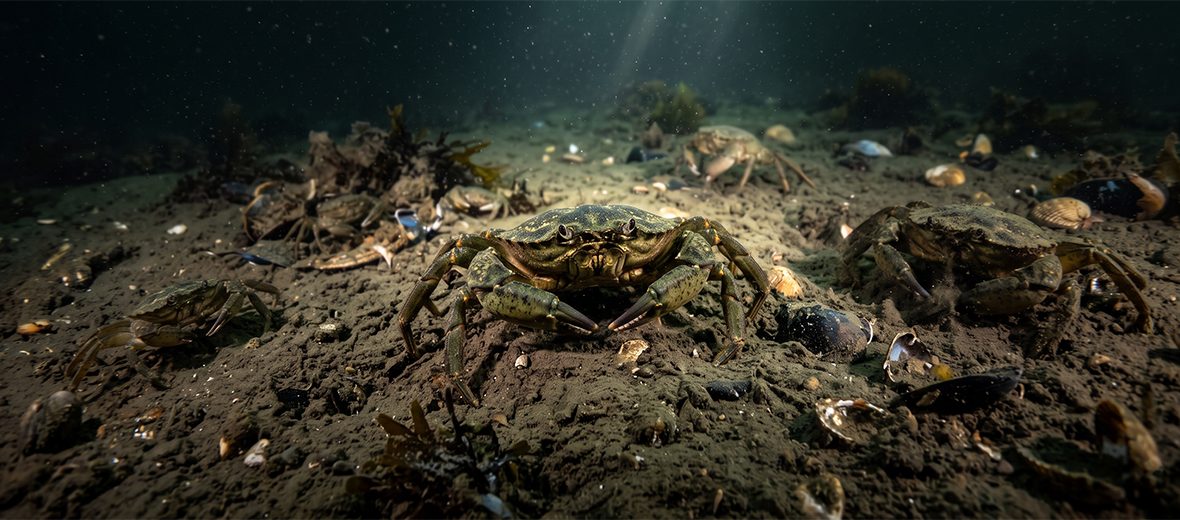
The European green crab, aka shore crab or green shore crab, is a widespread invasive species, that is listed among the 100 of the world’s worst invasive alien species. While native to the north-east Atlantic Ocean and Baltic Sea, in Europe, they have colonized similar habitats in Asia, Australia, South Africa, South America, and both Atlantic and Pacific Coasts of North America. The most severe ecological and economic damage is caused in North America, particularly along the Northwest Atlantic (New England and Eastern Canada) and the Northeast Pacific (from California up to Alaska). These crabs disrupt local ecosystems by heavily preying on native shellfish and damaging commercial fisheries. As a result of their being invasive, they are listed as Not Evaluated by the IUCN. Their population trend is listed as increasing as well.
First the Stats…
Scientific name: Carcinus maenas
Weight: Up to 3 ounces
Length: Up to 2.4 inches, and a width of up to 3.5 inches
Lifespan: Up to 6 years
Now on to the Facts!
1.) While they bear the name “green”, they actually come in a variety of colors like green, brown, grey, and even red.
2.) Red specimens are stronger and more aggressive, however are less tolerant of environmental stressors, like low salinity or hypoxia (low oxygen content in the water).
3.) They were first scientifically described and named Cancer maenas by the Swedish zoologist and botanist Carl Linnaeus in 1758.
4.) These crabs didn’t start to expand their range until 1993, before quickly expanding northward, reaching Oregon in 1997, Washington in 1998, and British Columbia in 1999, extending their total range by 470 miles in just 10 years.
5.) European green crabs live in all types of protected and semiprotected marine and estuarine habitats. This includes those with mud, sand, or rocky substrates, submerged aquatic vegetation, and emergent marsh. However, soft bottom habitats are preferred.
But wait, there’s more on the European green crab!
6.) Their tolerance for varying degrees of salinity is matched by their ability to also handle various temperatures as well, from 32ºF – 86°F.
7.) Females can produce upwards of 400,000 eggs that hatch in up to 4 months.
Did you know…?
These crabs can eat up to 20+ .5 inch sized clams per day, as well as oysters and mussels.
8.) They can travel by a variety of means, including ballast water, ships’ hulls, packing materials used to ship live marine organisms, bivalves moved for aquaculture, rafting, migration of crab larvae on ocean currents, and the movement of submerged aquatic vegetation for coastal zone management initiatives.
9.) Besides clams, oysters, and mussels, they also prey on polychaete worms, and small crustaceans, up to their own size. They also feast on algae and plant matter.
10.) Some studies have shown that the native blue crab in eastern North America, is able to control populations of European green crabs. For instance these crabs aren’t found in the Chesapeake Bay, where blue crabs frequent.
But wait, there’s still more on the European green crab!
11.) In their native range of Europe, these crabs are mostly used as an ingredient in soups and sauces.
12.) In New England where the green crab populations are high, a variety of groups have looked into using green crabs in cuisine. In 2019, The Green Crab Cookbook was released; it included recipes for green crab stock, soft-shell green crab, their roe, and their meat.
13.) They are fished on a small scale in the northeast Atlantic Ocean, with about 1,323 tons being caught annually, primarily in France and the United Kingdom.
Now a Short European Green Crab Video!
Be sure to share & comment below! Also, check out the Critter Science YouTube channel. Videos added regularly. Be sure to like and subscribe!

Want to suggest a critter for me to write about? Let me know here.
Some source material acquired from: Wikipedia & IUCN


Leave a Reply