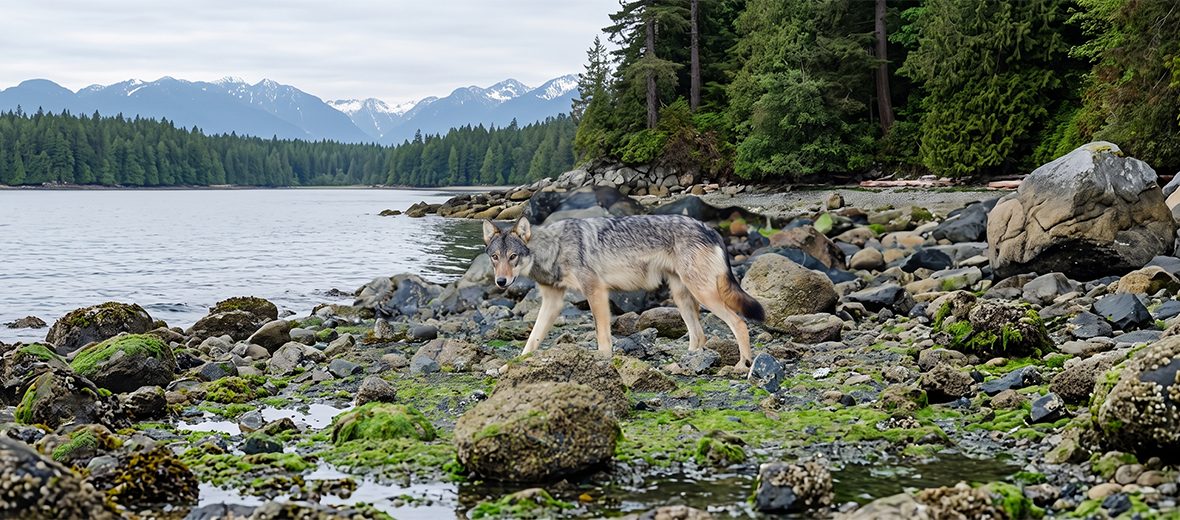
The Vancouver Coastal Sea wolf, aka Vancouver Island wolf, coastal wolf, or sea wolf, is a subspecies of grey wolf, endemic to the coastal regions of the Pacific Northwest. These wolves face the threat of retaliatory killing and the historical culling that occurs because they sometimes prey on domestic livestock or pets. Logging and road development breaks up their forest environments, increases human access and reduces isolated spaces. This also can result in vehicle strike (being hit by vehicles). They are also frequently blamed by local groups for declines in other vulnerable species such as the Vancouver Island marmot, igniting pressure for population control. However, despite these threats these canids are listed as Least Concern by the IUCN. Their population trend is listed as stable to increasing.
First the Stats…
Scientific name: Canis lupus crassodon
Weight: Up to 132 lbs.
Length: Up to 5 feet, plus up to a 20 inch tail
Height: Up to 32 inches, at the shoulders
Lifespan: Up to 12 years
Now on to the Facts!
1.) What makes these wolves so unique is their semi-aquatic lifestyle, which includes a diet that is based almost entirely on marine life.
2.) Salmon–which comprises up to 25% of their diet–is readily consumed, along with herring eggs. Clams, mussels, barnacles, crabs, otters, seals, minks, beavers, and even black-tailed deer are also preyed on.
3.) They use their powerful jaws to crush and open hard-shelled animals.
4.) These wolves hail from southern Alaska, down along the coast of British Columbia, including dwelling within the Great Bear Rainforest.
5.) Due to being strong swimmers, they also dwell among several islands in the Salish Sea, including their primary home, Vancouver Island.
But wait, there’s more on the Vancouver Coastal Sea wolf!
6.) With regards to eating salmon, they only eat the head to potentially avoid a bacterial infection known as “salmon poisoning” which can be fatal to canids.
7.) These wolves also scavenge for food alone the shoreline and eat items such as abalone and whale carcasses.
Did you know…?
They can swim up to 7.5 miles and often travel between islands.
8.) These canids were first described by American zoologist Eugene Raymond Hall in 1932.
9.) Due to their mostly aquatic diet, these wolves are smaller in stature than other wolf subspecies.
10.) Pressures that commercial hunting put on these wolves was brought to international attention when “Takaya”, a male wolf whose uncommonly solitary life was heavily documented, including in the 2019 documentary Takaya: Lone Wolf, was fatally shot on March 24, 2020, by a hunter.
But wait, there’s still more on the Vancouver Coastal Sea wolf!
11.) Females undergo up to a 75 day gestation (pregnancy) that yields up to 8 pups.
12.) At 3 weeks, pups feast on small amounts of regurgitated solid food. In 5 weeks, weaning begins as milk consumption drops & solid or regurgitated meat becomes a larger part of their diet. At 8 – 10 weeks, weaning is complete, and pups stop nursing entirely, transitioning completely to solid foods.
Now a Short Vancouver Coastal Sea Wolf Video!
Be sure to share & comment below! Also, check out the Critter Science YouTube channel. Videos added regularly. Be sure to like and subscribe!

Want to suggest a critter for me to write about? Let me know here.
Some source material acquired from: Wikipedia & IUCN