
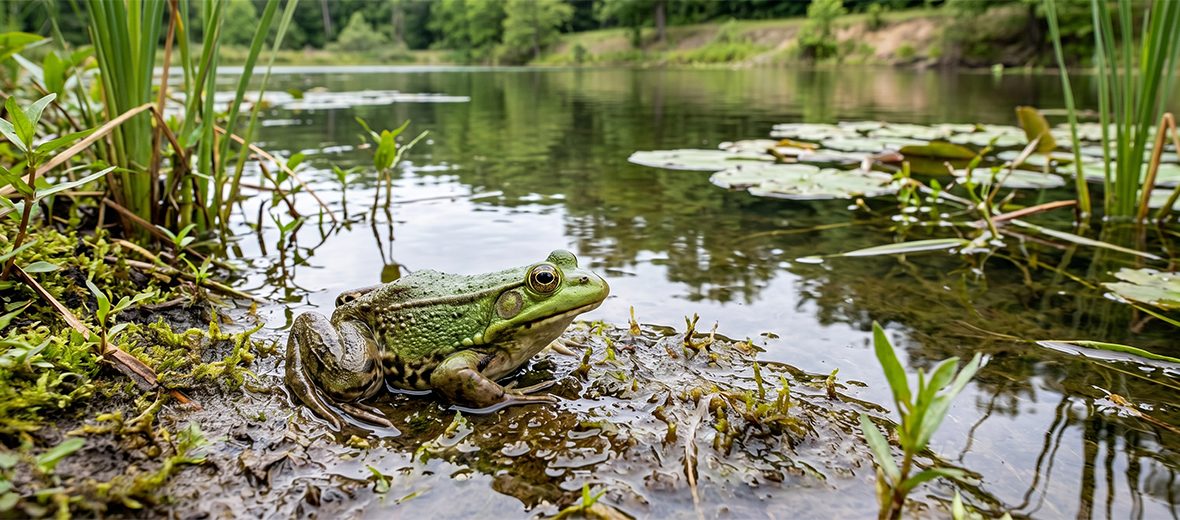
The green frog hails from eastern Canada and the eastern half of the United States. These frogs are known for their territoriality towards other frogs. They face the threats of habitat loss and destruction at the hands of residential and commercial developments, as well as wetlands conversion for various uses. Road salts that are used during the winter are inadvertently washed into the bodies of water that house the tadpoles causing an increase in chloride concentrations, which affects larval survival, causing developmental abnormalities, behavioral issues, and lower time-to-mortality. Finally, pesticides used to kill insects also can kill these frogs and the developing tadpoles. However, these frogs are abundant enough to be listed as Least Concern by the IUCN. Their population trend is listed as stable.
First the Stats…
Scientific name: Lithobates clamitans
Weight: Up to 3 ounces
Length: Up to 4 inches
Lifespan: Up to 10 years
Now on to the Facts!
1.) These frogs were first described by French naturalist Pierre André Latreille in 1801.
2.) They can tolerate a variety of habitats such as shallow freshwater ponds, ditches along road-sides, lakes, swamps, streams, and vernal pools (temporary winter wetlands that dry up by summer or fall).
3.) Road construction has impacted these frogs by dividing their territories and increasing the chance of vehicle strike (being hit by vehicles) when trying to cross the roads.
4.) Insects, spiders, fish, crayfish, shrimp, smaller frogs, tadpoles, small snakes, slugs, and snails are all on the menu. However, these frogs will attempt to eat anything that moves and will also fit in their mouth.
5.) Researchers have shown that wild green frog populations—found in both polluted suburban ponds and untouched forest habitats—can change sex as a survival mechanism to ensure the species’ continued existence.
But wait, there’s more on the green frog!
6.) Unlike most other frogs, there is no sexual dimorphism in these frogs. This means that males and females are the same size, whereas in most frogs the female is typically larger than the male in order to precipitate amplexus (mating positioning of frogs).
7.) Females lay up to 2 clutches of 7,000 eggs per clutch, each season.
Did you know…?
Due to the increasing destruction of their habitat, deforestation, climate change, diseases (such as Chytrid), and chemical contaminants, amphibian population declines and extinctions might be as high as 211 times the background extinction rate.
8.) Tadpoles take up to 360 days to metamorphose into adult frogs.
9.) Males will wrestle with one another in order to defend their territory. Resident male frogs will also create loud splashing noises by jumping up and down in water or by sitting in place and quickly kicking their hind legs.
10.) Tadpoles are preyed on by turtles, dragonfly larvae, giant water bugs, and more, while adults are hunted by crows, ducks, herons, and snakes.
Now a Short Green Frog Video!
Be sure to share & comment below! Also, check out the Critter Science YouTube channel. Videos added regularly. Be sure to like and subscribe!

Want to suggest a critter for me to write about? Let me know here.
Some source material acquired from: Wikipedia & IUCN

Leave a Reply