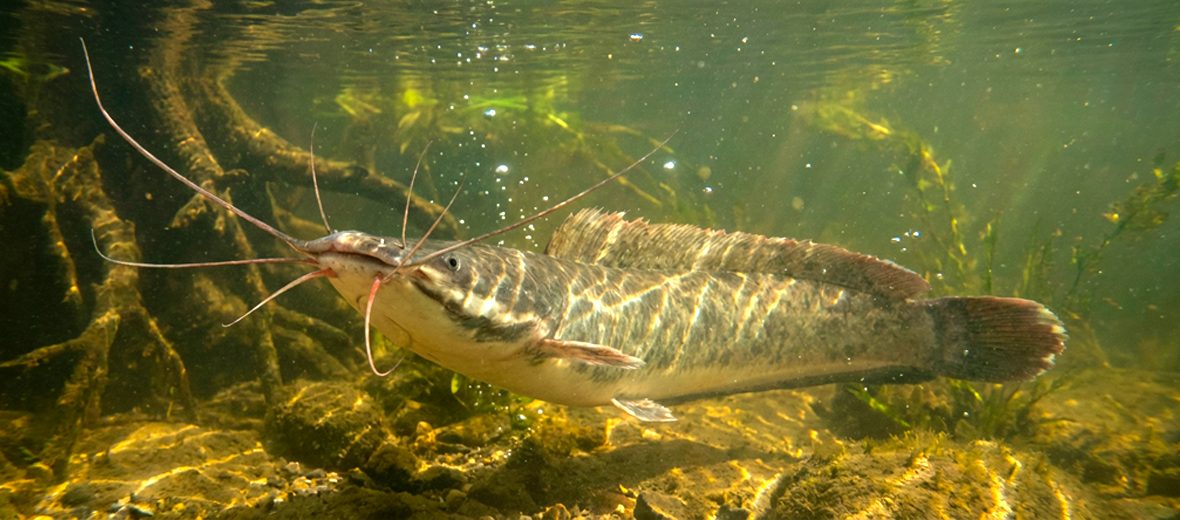
The African sharptooth catfish is a highly invasive species of air breathing catfish hailing from Africa. However, they have been introduced to Europe, Asia, South America, and North America. Often living in unsanitary conditions, they face the threats of parasites and disease from trematodes, nematodes, and cestodes. They also face the dangers of agricultural runoff and heavy metals (e.g., lead, aluminum, iron). As a counter threat, these catfish, being an invasive species, can hybridize with other catfish species, causing outbreeding depression (negative effects of hybridization) and genetic pollution. They are also banned in most countries and labeled as injurious wildlife. The IUCN lists these fish as Least Concern. Their population trend is listed as increasing.
First the Stats…
Scientific name: Clarias gariepinus
Weight: Up to 130 lbs.
Length: Up to 5.7 feet
Lifespan: Up to 25 years
Now on to the Facts!
1.) Another common name for these fish is lele dumbo, which is given by the people in Indonesia.
2.) These critters are nocturnal (active at night).
3.) Insects, plankton, snails, crabs, shrimp, other invertebrates, birds, reptiles, amphibians, rats, mice, other fishes, eggs, fruit, seeds, and carrion (dead animals) are all on the menu.
4.) Due to their large mouth, they have been known to take birds as large as coots and swallow them whole!
5.) Because they are able to breathe air, like the betta fish can, they are able to traverse stretches of dry land to escape drying pools of water and make it to the next river, stream, lake, pond, or swamp unscathed.
But wait, there’s more on the African sharptooth catfish!
6.) Because they grow fast and can tolerate a wide variety of water conditions, these fish were thought to be a suitable source for aquaculture.
7.) These fish have been hybridized with vundu because they produce a sterile fish with white meat that is preferred by customers.
Did you know…?
These catfish are capable of producing a loud croaking sound, similar to a crow’s caw.
8.) Females are capable of producing upwards of 300,000 eggs each season.
9.) Development of eggs and larvae is quick, and the larvae are able to swim up to 72 hours after fertilization.
10.) As a result of their typically poor habitat conditions, these catfish are hosts to several species of digeneans, in addition to other endoparasites (internal) and ectoparasites (external).
Now a Short African Sharptooth Catfish Video!
Be sure to share & comment below! Also, check out the Critter Science YouTube channel. Videos added regularly. Be sure to like and subscribe!

Want to suggest a critter for me to write about? Let me know here.
Some source material acquired from: Wikipedia & IUCN