
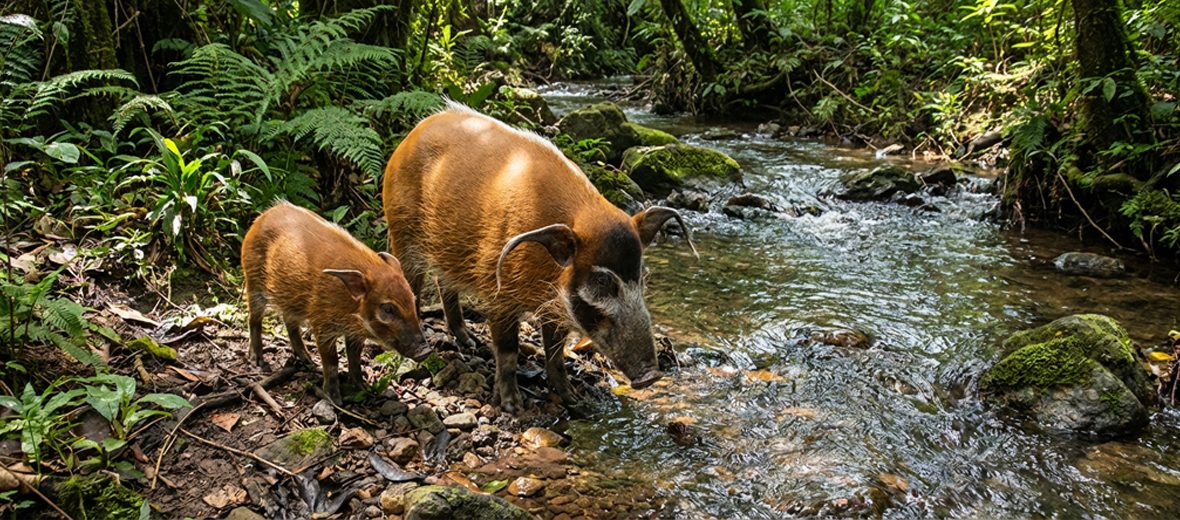
The red river hog, aka bushpig, is a wild member of the pig family that dwells in Africa. Most of their habitats are in the Guinean and Congolian forests. Their preferred biomes are rainforests near rivers, lakes, and swamps. These critters face the threats of hunting, for their meat, and trapping, for trade. Despite these threats, they are abundant enough to be listed as Least Concern by the IUCN. Their populations are decreasing though.
First the Stats…
Scientific name: Potamochoerus porcus
Weight: Up to 254 lbs.
Length: Up to 57 inches, plus up to an 18 inch tail
Height: Up to 31 inches, at the shoulders
Lifespan: Up to 20 years
Now on to the Facts!
1.) These swines are nocturnal (active at night) and crepuscular (active at dawn and dusk).
2.) They dwell in small groups of up to 10 individuals, led by an adult male and multiple females, as well as their offspring. Although groups of up to 30 have been documented.
3.) The male protects his harem against other males and predators, such as leopards, lions, spotted hyenas, and large rock pythons.
4.) Roots, bulbs, tubers, fruit, seeds, nuts, water plants, grasses, herbs, fungi, eggs, carrion (dead animal), plant remains, insects, snails, lizards, snakes, turtles, domestic piglets, goats, and sheep are all on the menu.
5.) After up to a 37 day oestrus (menstration cycle) females will breed and undergo up to a 120 gestation (pregnancy) that yields up to 6 piglets.
But wait, there’s more on the red river hog!
6.) Piglets weigh in at only 32 ounces at birth.
7.) In up to 6 months their yellowish stripes and spots fade to their adult reddish coloration.
Did you know…?
Due to the fact that their populations face risks from intense hunting for the commercial bushmeat trade, particularly in the Congo Basin, conservation efforts have been put in place to protect them from being over-hunted.
8.) Using their large muzzle to snuffle about in the soil in search of food, as well as scraping the ground with their tusks and fore-feet, they have been known to cause damage to agricultural crops, like cassava and yams.
9.) They communicate nearly continuously via grunts and squeals with a vocal range that can signal alarm, distress, or passive communication.
10.) These hogs are excellent swimmers and frequently wade in rivers and streams, which lends to their name. They are capable of swimming underwater for short distances, surfacing to breathe about every 15 seconds.
Now a Short Red River Hog Video!
Be sure to share & comment below! Also, check out the Critter Science YouTube channel. Videos added regularly. Be sure to like and subscribe!

Want to suggest a critter for me to write about? Let me know here.
Some source material acquired from: Wikipedia & IUCN


Leave a Reply