
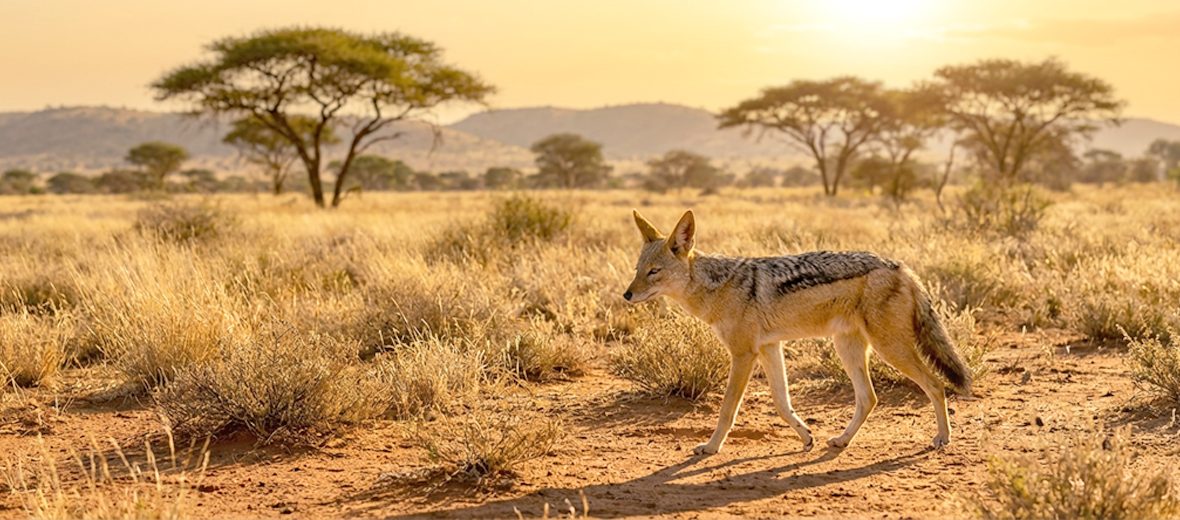
The black-backed jackal is a mid-sized species of jackal that plays an important role in African folklore, often depicted as a cunning and adaptable trickster. They hail from eastern and southern Africa. These critters face the threats of hunting, for their meat; trapping, for fear of livestock predation; persecution for being predators of said livestock; and disease, such as rabies. However, they are abundant and widespread, thus given the IUCN listing of Least Concern. Their population trend is listed as stable as well.
First the Stats…
Scientific name: Lupulella mesomelas
Weight: Up to 29 lbs.
Length: Up to 32 inches, plus up to a 16 inch tail
Height: Up to 19 inches, at the shoulders
Lifespan: Up to 12 years
Now on to the Facts!
1.) Sadly, these jackals are very susceptible to rabies, and are responsible for transmission of the disease to domestic stock. However, population control efforts appear mostly ineffective and probably only succeed in producing a temporary reduction in local numbers. Rabies in jackals may be better controlled through oral vaccination techniques, and via immunization of domestic dogs, rather than by culling.
2.) They were first scientifically described by German naturalist Johann Christian Daniel von Schreber in 1775.
3.) These canines have occupied eastern and southern Africa for at least 2 – 3 million years (since the Pliocene epoch).
4.) Dwelling in a wide variety of habitats (including the scorching African desert habitats) is a specialty of these critters, as their kidneys are well adapted for water deprivation.
5.) As is evident by their well-developed carnassial shear and the longer cutting blade of their premolars, these jackals are more adapted to a carnivorous diet.
But wait, there’s more on the black-backed jackal!
6.) Rats, mice, hares, reptiles, birds, young antelopes, duikers, springboks, mongooses, wildcats, jackass penguins, impalas, gazelles, warthogs, and insects are all on the menu.
7.) There are 2 subspecies recognized. The east African black-backed jackal and the Cape black-backed jackal.
Did you know…?
Adult dik-diks and Thomson’s gazelles appear to be at the upper limit of their killing abilities.
8.) They are monogamous (mate for life) and also territorial.
9.) A mated pair will quite aggressively expel any intruders. But most conflicts are avoided due to their frequent calls that advertise their territory.
10.) These canines produce a number of sounds such as cackling, growling, whining, woofing, yelling, and yelping.
But wait, there’s still more on the black-backed jackal!
11.) Females undergo up to a 60 day gestation (pregnancy) that yields up to 9 pups.
12.) Pups are weaned at up to 9 weeks and can hunt for themselves by 6 months.
Did you know…?
These jackals can carry diseases such as the previously mentioned rabies, canine parvovirus, canine distemper, canine adenovirus, Ehrlichia canis, and African horse sickness.
13.) Just like most canids, these jackals cache (store) surplus food.
14.) African wolves, honey badgers, spotted hyenas, brown hyenas, leopards, and African wild dogs all prey on these jackals.
15.) The Tswana people have typically made hats and cloaks out of these jackal’s hides. Between 1914 – 1917, jackal pelts (nearly 50,000 a year) were produced in South Africa.
Now a Short Black-Backed Jackal Video!
Be sure to share & comment below! Also, check out the Critter Science YouTube channel. Videos added regularly. Be sure to like and subscribe!

Want to suggest a critter for me to write about? Let me know here.
Some source material acquired from: Wikipedia & IUCN