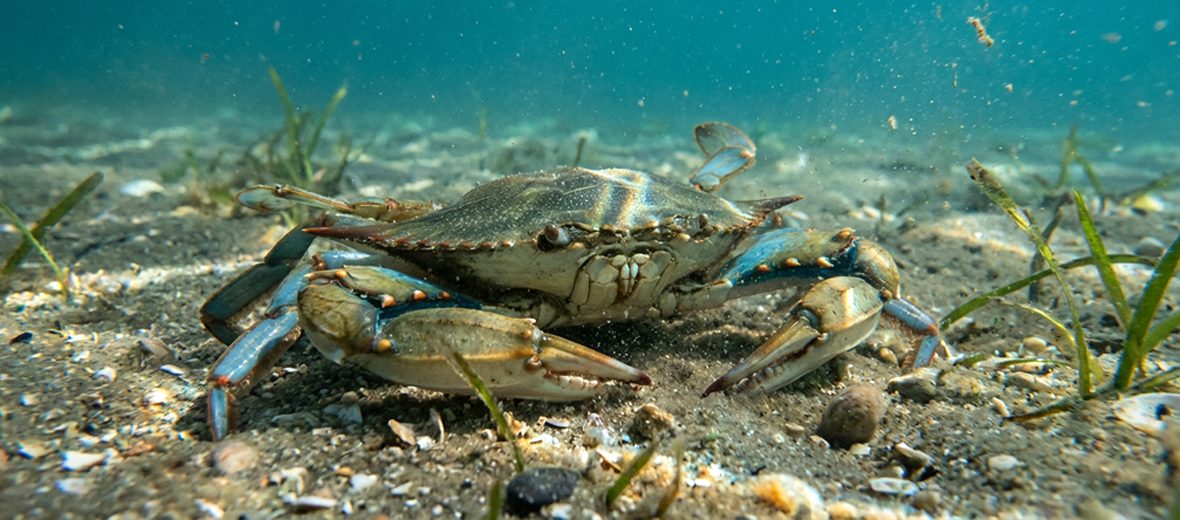
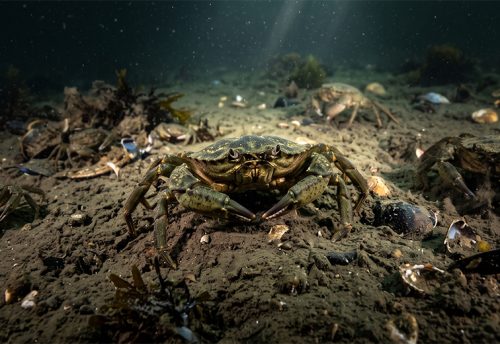
The Atlantic blue crab, aka blue crab or Maryland blue crab, hails from the western Atlantic Ocean and the Gulf of Mexico, and has been introduced to international waters. These crabs face the threats of overfishing; habitat loss and destruction; climate change, that can lead to severe weather; and microplastics pollution. However, they are abundant enough to be listed as Least Concern by the IUCN. Their population trend is listed as decreasing. In the Mediterranean they are considered an invasive species that impacts local ecosystems and fisheries in some locales.
First the Stats…
Scientific name: Callinectes sapidus
Weight: Up to 2 lbs.
Length: Up to 9 inches across
Lifespan: Up to 8 years
Now on to the Facts!
1.) These crustaceans are Maryland’s largest commercial fishery and have officially been designated Maryland’s state crustacean.
2.) The genus name Callinectes hails from the Ancient Greek κάλλος (kállos), which translates to ‘beautiful’, and νήκτης (nḗktēs), which translates to ‘swimmer’. The specific epithet sapidus is Latin and means ‘savory’.
3.) Blue crabs are sexually dimorphic (males and females look notably different). Males and females are easily distinguished by the shape of their abdomen, aka the “apron”, and by the color differences in the chelipeds, aka claws.
4.) Females, aka “Sooks”, have a broad abdomen, similar to the shape of the dome of the United States Capitol. Males, aka “Jimmies”, have a narrow abdomen that looks like the Washington Monument.
5.) Their primary predators are eels, drum, bass, spot, trout, some sharks, rays, and naturally humans.
But wait, there’s more on the Atlantic blue crab!
6.) Clams, mussels, oysters, crustaceans, annelids, small fish, and plants are all on the menu.
7.) They are afflicted by numerous ailments such as viruses, bacteria, microsporidians, ciliates, and others.
Did you know…?
Blue crabs were an important food item for Native Americans and English settlers in the Chesapeake Bay area in the 1600s.
8.) Females produce upwards of 2 million eggs each brood, and they can have up to 3 broods per year.
9.) A several hundred mile migration is undertaken each year to their breeding grounds.
10.) In the 21st century, most commercial crabs have been centered in 4 states: Louisiana, Maryland, North Carolina, and Virginia.
But wait, there’s still more on the Atlantic blue crab!
11.) 2010 showed the largest harvest value of blue crabs at an estimated $205,000,000.
12.) Unfortunately, species other than blue crabs are frequently caught incidentally in crab pots, including other crabs, conch, fish, and sea turtles.
13.) Due to their commercial and environmental value, blue crabs are the subject of management plans over much of their range. In 2012, the blue crab population in Louisiana was recognized as a certified sustainable fishery by the Marine Stewardship Council.
14.) The Southern Maryland Blue Crabs, a professional baseball team located in Waldorf, Maryland was named after these crabs.
Now a Short Atlantic Blue Crab Video!
Be sure to share & comment below! Also, check out the Critter Science YouTube channel. Videos added regularly. Be sure to like and subscribe!

Want to suggest a critter for me to write about? Let me know here.
Some source material acquired from: Wikipedia & IUCN
Photo credit: Wendy Kaveney

Leave a Reply