
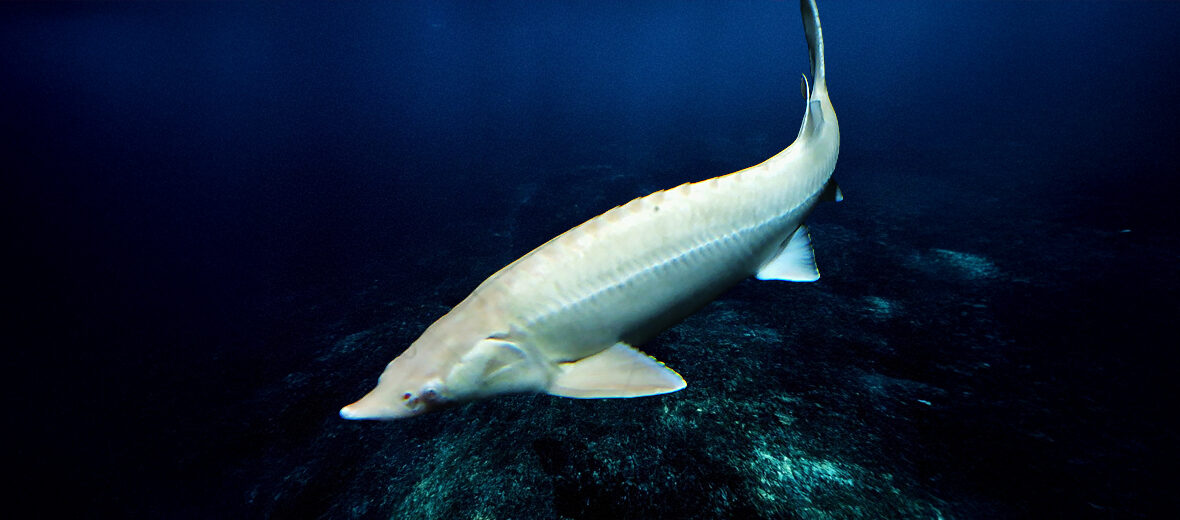
The European sea sturgeon, aka Atlantic sturgeon or common sturgeon, is considered the largest freshwater sturgeon species, while the Beluga sturgeon is considered the largest of them all. They can be found in the Black Sea and Baltic Sea. These fish face the threats of habitat loss and destruction at the hands of mining and quarrying; vehicle strike, being hit by shipping vessels; hunting; trapping; habitat division at the hands of of dams and other water management programs. The IUCN lists these fish as Critically Endangered. Their population trend is listed as decreasing.
First the Stats…
Scientific name: Acipenser sturio
Weight: Up to 880 lbs.
Length: Up to 20 feet
Lifespan: Up to 100+ years
Now on to the Facts!
1.) Like many other sturgeons, these critters spawn in the rivers inland from the coastal regions.
2.) As is the case for other sturgeon species, they can tolerate a wide spread in salinities and spend most of their lives in saltwater, however migrate to spawn in freshwater locations.
3.) These fish were locally abundant in Europe and were caught extensively for their caviar until the first decades of the 20th century, due to overfishing.
4.) They have been a protected species in Europe since 1982.
5.) Despite their current estimated distribution, they have become so increasingly rare that they only breed in the Garonne river basin in France.
But wait, there’s more on the European sea sturgeon!
6.) Conservation projects involving these fish include reintroductions, based on specimens from aquaculture, with the first releases back in 1995.
7.) From 2012 – 2015, 87 sturgeons were experimentally released in the Rhine river near Nijmegen.
Did you know…?
There are only an estimated 750 individuals remaining, to date.
8.) Using the barbels, located on the underside of their mouth, they search for and readily consume polychaete worms and crustaceans.
9.) Due to their slow breeding rates, recovery for the European sturgeon is a long process that might take up to 50 years.
10.) Females spawn several million eggs each spawning event. However, they only spawn every 3 – 4 years.
But wait, there’s still more on the European sea sturgeon!
11.) Eggs hatch in up to a week.
12.) Catfish, perch, and pike prey on the eggs and juveniles; while harbor porpoises, large sharks, and seals sometimes prey on adults.
Now a Short European Sea Sturgeon Video!
Be sure to share & comment below! Also, check out the Critter Science YouTube channel. Videos added regularly!

Want to suggest a critter for me to write about? Let me know here.
Some source material acquired from: Wikipedia & IUCN
Photo credit: iNaturalist

Leave a Reply