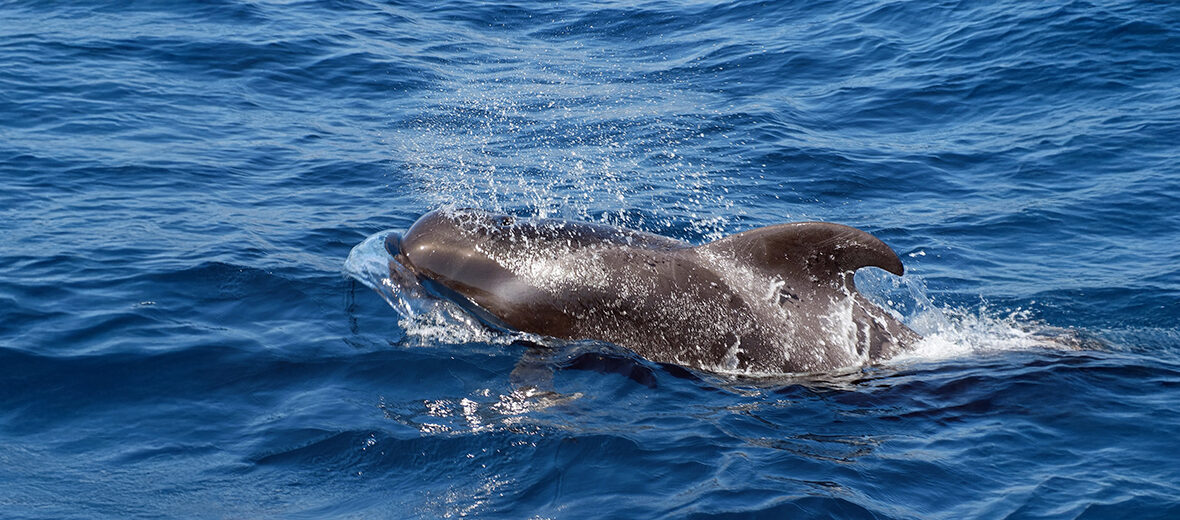
The short-finned pilot whale belongs to the genus Globicephala, which it shares with the long-finned pilot whale. They aren’t actually whales at all. These cetaceans are actually dolphins. Sadly, they have been exploited for centuries in the western North Pacific. They currently face the threats of overfishing and over harvesting; water pollution; noise pollution; microplastics pollution; drowning by getting caught in longlines; and climate change, that causes extreme storms and warming of ocean water. However, these dolphins are abundant enough to be listed as Least Concern by the IUCN. Their population trend is listed as unknown, however.
First the Stats…
Scientific name: Globicephala macrorhynchus
Weight: Up to 8,800 lbs.
Length: Up to 24 feet
Lifespan: Up to 45 years
Now on to the Facts!
1.) John Edward Gray first described the short-finned pilot whale in 1846.
2.) Other common names they go by are blackfish and the pothead whale. However, these names are also a kind of catchall for other species as well, such as the dwarf sperm whale and false killer whale.
3.) They are believed to be a single species with 3 divergent types: the Shiho, Naisa, and Atlantic short-finned pilot whales.
4.) However, the Shiho and Naisa forms are actually subspecies of short-finned pilot whales, with the Shiho clade having diverged approximately 17.5 thousand years ago (during the Pleistocene Epoch).
5.) The Atlantic clade is believed to have diverged from the Naisa approximately 12.5 years ago (during the beginning of the Holocene Epoch).
But wait, there’s more on the short-finned pilot whale!
6.) They dwell in both coastal and pelagic waters in temperate and tropical regions of the Atlantic, Indian, and Pacific Oceans.
7.) Once frequently seen off of Southern California, these critters disappeared from the area after a strong El Niño year in 1982 and 1983, and have since been seen infrequently, primarily during warm-water years such as 1991, 1993, 1997, 2014, and 2015.
Did you know…?
The effects of tourist activities on pilot whales has not been well studied, however some evidence suggests that the impact of underwater noise from whale-watching boats can have the potential to drastically disrupt communication at close range.
8.) These critters are economically important in the whale-watching industry of some areas of the world, like Madeira, Hawaii, and the Canary Islands.
9.) Pods of up to 30 individuals are often seen, although groups of up to several hundred have been reported in the Caribbean.
10.) They are known for their socializing and playful behavior at the water’s surface, like lobtailing (slapping their flukes on the water’s surface) and spy-hopping (poking their heads above the surface).
But wait, there’s still more on the short-finned pilot whale!
11.) Some individuals have also been seen making various altruistic behaviors, like alloparental care, in which nonparent whales aid in taking care of young that are not their own.
12.) The males are polygynous, meaning they will mate with multiple females at 1 time and throughout their lives.
Did you know…?
They can dive to depths of up to 3,340 feet and stay submerged for up to 21 minutes at a time.
13.) The females begin having calves every 5 – 8 years, averaging about 4 – 5 calves in their lifetime.
14.) It is believed that they forage for fish, octopuses, and squids.
15.) Pilot whales are often referred to as the ‘cheetahs of the deep’ for their high-speed pursuits of squid at depths of hundreds of feet.
But wait, there’s still a bit more on the short-finned pilot whale!
16.) Orcas are their only known predator. Sans humans.
17.) In areas where populations are seen near the coast, like off the Canary Islands, Madeira, and Hawaii, they can be studied using photo-identification. This method helps researchers identify unique markings and scars on the whales’ dorsal fins, which are used to recognize individuals.
Did you know…?
Due to their close social bonds, rescue attempts following strandings are not always successful, as these dolphins will often re-strand themselves upon hearing the calls of their group members still on shore.
18.) Historically, pilot whales have had very low survival rates in captivity, with less than half surviving past 24 months.
19.) An exception to this rule, Bubbles, a female short-finned pilot whale who was displayed in Marineland, and ultimately at Sea World California, living to be somewhere in her 50s when she eventually died on June 12, 2016.
20.) These critters are included in the Memorandum of Understanding Concerning the Conservation of the Manatee and Small Cetaceans of Western Africa and Macaronesia (Western African Aquatic Mammals MoU) & the Memorandum of Understanding for the Conservation of Cetaceans and Their Habitats in the Pacific Islands Region (Pacific Cetaceans MoU).
Now a Short Short-Finned Pilot Whale Video!
Be sure to share & comment below! Also, check out the Critter Science YouTube channel. Videos added regularly!

Want to suggest a critter for me to write about? Let me know here.
Some source material acquired from: Wikipedia & IUCN
Photo credit: Martina Nolte, Lizenz