
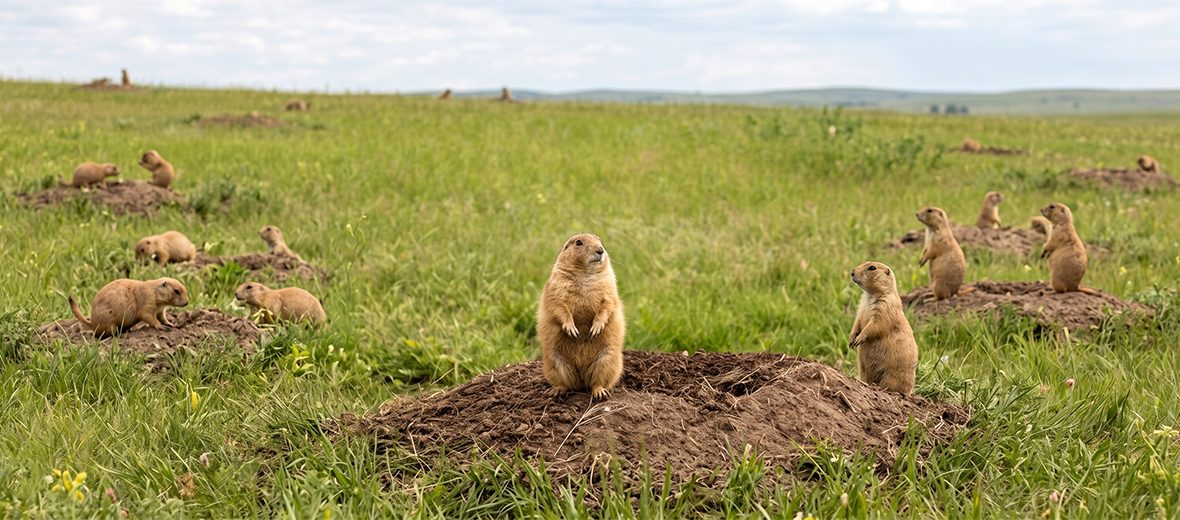
The black-tailed prairie dog is a member of the squirrel family. They hail from the U.S./Canada border in the north to the U.S./Mexico border in the south. These rodents are threatened by the Sylvatic plague which was introduced to North America around 1899 and first reported in these prairie dogs in 1940. This is a serious threat seeing as its pervasiveness and efficacy can kill more than 99% of prairie dogs in a colony, and numbers never seem to fully recover once decimated. This disease is spread by plague-ridden fleas that are brought into the colony. Habitat loss and destruction is yet another threat faced. It’s estimated that about 36% of the land area in regions utilized by prairie dogs has been covered by water developments, urban expansions, croplands, and improved pastures. Other threats faced are that of trapping, shooting, and poisoning. For most of the 20th century, Animal Damage Control, its forerunners, and other control agencies have worked very hard to eliminate prairie dogs over wide expanses. Despite all this, these rodents are abundant enough to be listed as Least Concern by the IUCN. However, their population trend is listed as decreasing.
First the Stats…
Scientific name: Cynomys ludovicianus
Weight: Up to 3 lbs.
Length: Up to 13 inches, plus up to a 4 inch tail
Lifespan: Up to 10 years
Now on to the Facts!
1.) These critters are diurnal (active during the day).
2.) They don’t hibernate in winter, however, they will enter into a state of torpor (a sleep like state) during the cold winter evenings.
3.) Losing 20% of their body weight during the fall and winter seasons as they enter into torpor is common.
4.) These rodents prefer shortgrass prairies, mixed-grass prairies, sagebrush steppes, and desert grasslands.
5.) Prairie dog coteries (a small, close-knit group) typically take up about 1 square acre and consist of up to 13 individuals. But colonies can consist of up to several thousand individuals divided up into wards.
But wait, there’s more on the black-tailed prairie dog!
6.) Burrows can be up to 5 feet deep and in a single colony there can be up to 57 burrows!
7.) There are 3 types or styles of burrows: domed mounds, rimmed crater mounds, and entrances lacking structures around them.
Did you know…?
A single prairie dog can eat up to 7 lbs. of vegetation in a month.
8.) These rodents feast mainly on various types of grasses. But they will also eat shrubs and even forbes.
9.) They have very sensitive hearing at low frequencies which allows them to detect predators early, especially within their burrows. Their hearing can range from 29 Hz to 26 kHz, and they can hear as low as 4 Hz.
10.) These rodents utilize a sophisticated system of vocalizations to describe specific predators. Their calls carry specific information as to what the predator is, how big it is, and how fast it’s approaching. This is an advanced form of grammar.
But wait, there’s still more on the black-tailed prairie dog!
11.) During the mating season, timing is of the essence for the male, as females enter into estrus for just 1 day.
12.) Females undergo up to a 34 day gestation (pregnancy) that yields up to 8 pups. However, 4 are more common.
13.) Infanticide (killing of the pups) can account for up to 39% of infant mortality and is often times carried out by the lactating female.
14.) Their primary predators are American badgers, bobcats, coyotes, golden eagles, ferruginous hawks, red-tailed hawks, rattlesnakes, and black-footed ferrets.
Now a Short Black-Tailed Prairie Dog Video!
Be sure to share & comment below! Also, check out the Critter Science YouTube channel. Videos added regularly. Be sure to like and subscribe!

Want to suggest a critter for me to write about? Let me know here.
Some source material acquired from: Wikipedia & IUCN


Leave a Reply