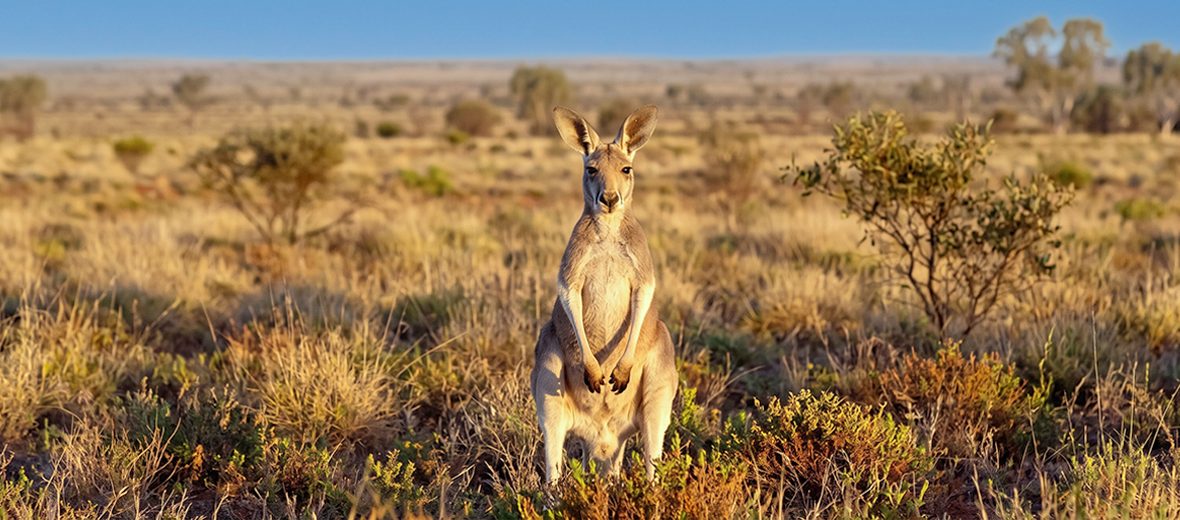
The red kangaroo is not only the largest species of kangaroo, but they’re also the largest terrestrial mammal native to Australia, and the largest extant marsupial in the world. They can be found throughout mainland Australia, sans the more fertile areas, like southwestern Australia, the eastern and southeastern coasts, as well as the rainforests along the northern coast. Having such a large range has its pitfalls though. Land clearing for agriculture, housing, and mining fragments native vegetation, restricting movement and limiting access to seasonal feeding areas. They are legally harvested for meat and leather under strictly regulated government quotas. They’re also culled by farmers using pest permits to mitigate damage to fencing and overgrazing on pastoral lands. The construction of rural roads running through remote areas drastically impacts the species. They are highly susceptible to vehicle strikes (being hit by vehicles), due to their attraction to the greener vegetation that grows on rain-fed roadsides. Even though they are highly adapted to dry environments, extended and extreme periods of drought places major stress on their populations. Severe droughts, brought about by global warming, dry out necessary food sources, causing sharp, temporary drops in regional populations and even temporarily halting female reproductive cycles. Climate change also causes intensified bushfires and shifting weather patterns which increase juvenile mortality rates and degrades the sparse tree cover, saltbushes, or mulga bushes they rely on for essential shelter during peak afternoon heat. Introduced species—such as sheep, cattle, goats, and wild rabbits—directly compete with these kangaroos for scarce vegetation and water resources in arid rangelands. However, despite these challenges, these critters are abundant enough to be listed as Least Concern by the IUCN. Their population trend is listed as stable as well.
First the Stats…
Scientific name: Osphranter rufus
Weight: Up to 203 lbs.
Length: Up to 5.3 feet, plus up to a 4 foot tail
Height: Up to 6.9 feet (standing)
Lifespan: Up to 22 years
Now on to the Facts!
1.) They were first described by the French zoologist Anselme Gaëtan Desmarest in 1822.
2.) Kangaroos have a 300° field of vision, due to the positioning of their eyes.
3.) These critters can survive for several months without ever drinking standing water, and in some cases, they can go indefinitely without a direct water source during cooler periods and an abundance of succulents.
4.) If absolutely forced onto a completely dry diet without any water-retaining succulent plants, they can survive for up to 2 weeks without any standing water intake.
5.) They graze on green vegetation, primarily fresh grasses, forbs, succulents, and other dicotyledonous flowering plants, and can get enough water even when most plants look brown and dry.
But wait, there’s more on the red kangaroo!
6.) While typically dwelling in smaller troops, mobs of up to 1,500 individuals can sometimes be seen.
7.) These kangaroos are primarily crepuscular (active at dawn and dusk), but they can also be nocturnal (active at night).
Did you know…?
While typically being able to jump upwards of 30 feet, when excited or being pursued these roos can obtain jumping distances of up to 45 feet, and reach speeds of up to 43 mph!
8.) They rely on small saltbushes or mulga bushes for shelter during the extreme heat rather than caves or rocky outcrops.
9.) When forage is poor and rainfall scarce, kangaroos will travel up to 19 miles to more desireable feeding grounds. A study of kangaroos in central Australia found that a majority of them stayed close to remaining vegetation but dispersed to locate fresh plants after it rained.
10.) Dingoes, saltwater crocodiles, and wedge-tailed eagles are their primary predators.
But wait, there’s still more on the red kangaroo!
11.) These critters are skilled swimmers, and often flee into waterways if threatened by a terrestrial predator. If pursued into the water, a kangaroo will often use its forepaws to hold the predator underwater in an attempt to drown it.
12.) The females have the rare ability to delay the birth of their joey until their previous joey has left the pouch. This is called embryonic diapause.
Did you know…?
The formation of the milk produced by the mother varies according to the needs of the joey. In addition, mothers may have up to 3 generations of offspring simultaneously; a young-at-foot suckling from an elongated teat, a joey in the pouch attached to a second teat and a blastula in an arrested development inside the uterus.
13.) Females undergo up to a 34 day gestation (pregnancy) that yields a single joey. Once born, the joey will migrate to mom’s marsupium (pouch) to continue developing for an additional 235 days.
14.) These critters have also been documented engaging in alloparental care. This is a behavior in which a female may adopt another female’s joey. This is a common parenting behavior seen in several other animal species such as elephants, primates, and wolves.
15.) Like all Australian wildlife, they are protected by legislation, but are so numerous that there is regulated harvests of their hides and meat. Hunting permits and commercial harvesting are controlled under nationally approved management plans, geared at maintaining populations and managing them as a renewable resource.
Now a Short Red Kangaroo Video!
Be sure to share & comment below! Also, check out the Critter Science YouTube channel. Videos added regularly. Be sure to like and subscribe!
Buy My Book
Select the image below to see everywhere my book is sold.

Want to suggest a critter for me to write about? Let me know here.
Some source material acquired from: Wikipedia & IUCN