
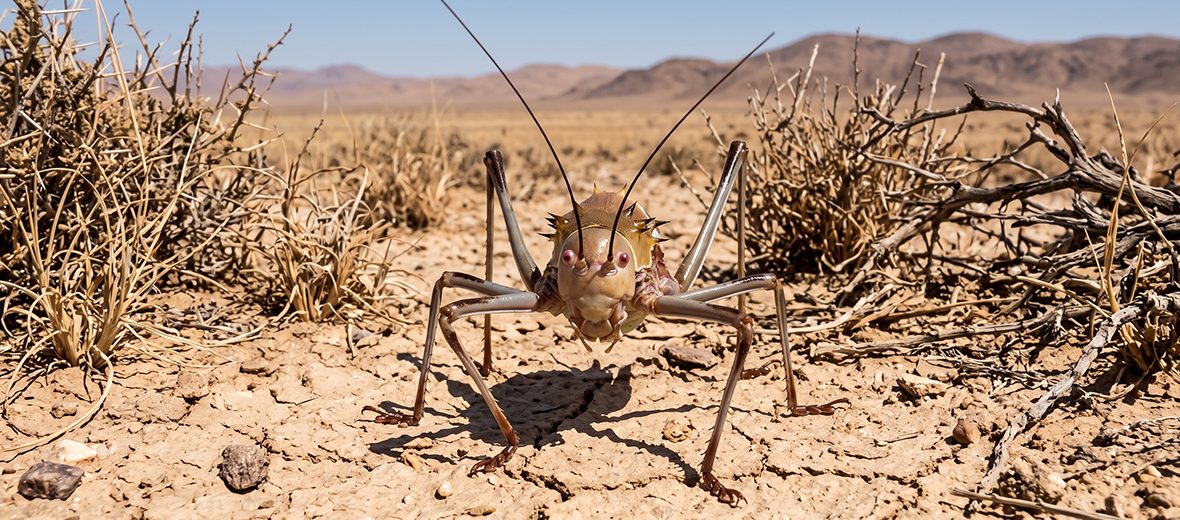
The Calbali bush-cricket, aka armored katydid, armored ground cricket, armored bush cricket, corn cricket, setotojane, and koringkriek, hails from portions of Angola, Namibia, Botswana, Zimbabwe and South Africa. They face the threat of habitat loss and destruction at the hands of agriculture, deforestation, and changing land use in arid savannas. These katydids also can achieve high population densities, and they transform into a devastating agricultural pest. They swarm corn, sorghum, and millet fields across Southern Africa, driving severe crop destruction. In response, they face targeted human threats, including: pesticides and traps solely meant to kill them in order to cull their numbers. However, due to their widespread distribution and their sporadic pest status, these insects are listed as Least Concern by the IUCN. Their population trend is listed as unknown at this time.
First the Stats…
Scientific name: Acanthoplus discoidalis
Weight: Up to .11 ounce
Length: Up to 1.97 inches
Lifespan: Up to 1 year
Now on to the Facts!
1.) Their powerful mandibles can inflict a painful bite and are initially meant to cut through thick and tough folliage.
2.) Another defensive response is to regurgitate (throw up) their stomach contents on their attacker.
3.) These crickets are omnivorous (eat plant and animal matter).
4.) They are also diurnal (active during the day).
5.) Females lay up to 21 egg pods in her lifetime.
But wait, there’s more on the Calbali bush-cricket!
6.) Egg pods can house up to 15 eggs each.
7.) Eggs hatch in up to 9 months
Did you know…?
When threatened, they can produce and squirt up to .003 ounce of hemolymph as a deterrent. This is called autohaemorrhaging, and they can project the liquid up to 2.4 inches.
8.) In really rough years, these crickets can wreak havoc on agricultural fields yielding crop losses of up to 40%. Insecticides can control infestations, however as these crickets are flightless they can be controlled relatively easily by constructing a 19.69 inch deep trench around the crops.
9.) They are also collected and utilized as chicken feed.
10.) They are preyed on by various birds, geckos, rats, mice, moles, and monkeys.
Now a Short Calbali Bush-Cricket Video!
Be sure to share & comment below! Also, check out the Critter Science YouTube channel. Videos added regularly. Be sure to like and subscribe!

Want to suggest a critter for me to write about? Let me know here.
Some source material acquired from: Wikipedia & IUCN

Leave a Reply